Trusted Locksmith Bloomington MN: Fast & Reliable 2026
You're standing beside your locked car, checking the same pocket for keys you already know aren't there. Maybe you're outside a Bloomington apartment after a move, dealing with a lock that still accepts the previous tenant's key. In either case, the urgent problem isn't just opening a door. It's finding a local locksmith in Bloomington, MN who confirms the job, protects the property, and explains the cost before work begins.
A legitimate mobile locksmith should make the process calmer, not more confusing. The technician should verify that you're authorized to access the vehicle or property, use the right tools for the hardware, and provide an itemized record when the work is complete. Bloomington's busy mix of homes, apartments, businesses, parking areas, and major commercial destinations makes that level of preparation especially important.
Table of Contents
- What Happens When You Need a Locksmith in Bloomington
- Understanding Bloomington's Security Landscape
- Residential, Commercial, and Automotive Services Explained
- How to Avoid Locksmith Scams and Verify Legitimacy
- Choosing the Right Lock Hardware for Your Needs
- Navigating Lock Changes for Renters and Landlords
- What to Expect During Your Locksmith Service Visit
What Happens When You Need a Locksmith in Bloomington
A lockout rarely happens at a convenient time. You may be outside a vehicle late at night, standing at a home after a misplaced key, or unable to open a storefront before employees arrive. A mobile locksmith starts by asking where you are, what you're locked out of, and whether the issue involves a lost key, a broken lock, a malfunctioning electronic system, or a simple accidental lockout.
That first conversation matters. Give the dispatcher the exact Bloomington location, the type of property or vehicle, the lock brand if you know it, and any immediate safety concern. If a child, vulnerable person, running engine, or dangerous weather condition is involved, say so immediately. For planned work, explain whether you need a rekey, hardware replacement, smart lock installation, or access system review.
The first call should establish expectations
A trustworthy operator won't rely on a vague “starting at” price and leave the rest unclear. Ask for the business name, the technician's identity, the service area, the estimate structure, and what could change the quoted price. You should also ask whether the technician will attempt non-destructive entry before drilling or replacing hardware.
Response time depends on traffic, technician availability, the location, and the complexity of the job. A professional service can give you a realistic arrival window, but it shouldn't promise an exact arrival time it can't control. If the dispatcher refuses to identify the company or won't discuss the estimate, treat that as a warning rather than a minor inconvenience.
What happens at the property
The locksmith should confirm your authorization before manipulating the lock. For a residence, that may involve identification or a clear explanation of your relationship to the property. For a vehicle, the technician may ask for identification and vehicle information. This protects you and helps prevent unauthorized entry.
The technician then examines the lock, door alignment, keyway, ignition, or access system. Good work solves the immediate problem while looking for the cause, such as worn hardware, a misaligned strike, a failed actuator, or keys that are no longer controlled after a move. You should receive an explanation before any destructive work begins.
Practical rule: Fast entry is useful, but documented authorization and a clear estimate are what make the service trustworthy.
Understanding Bloomington's Security Landscape
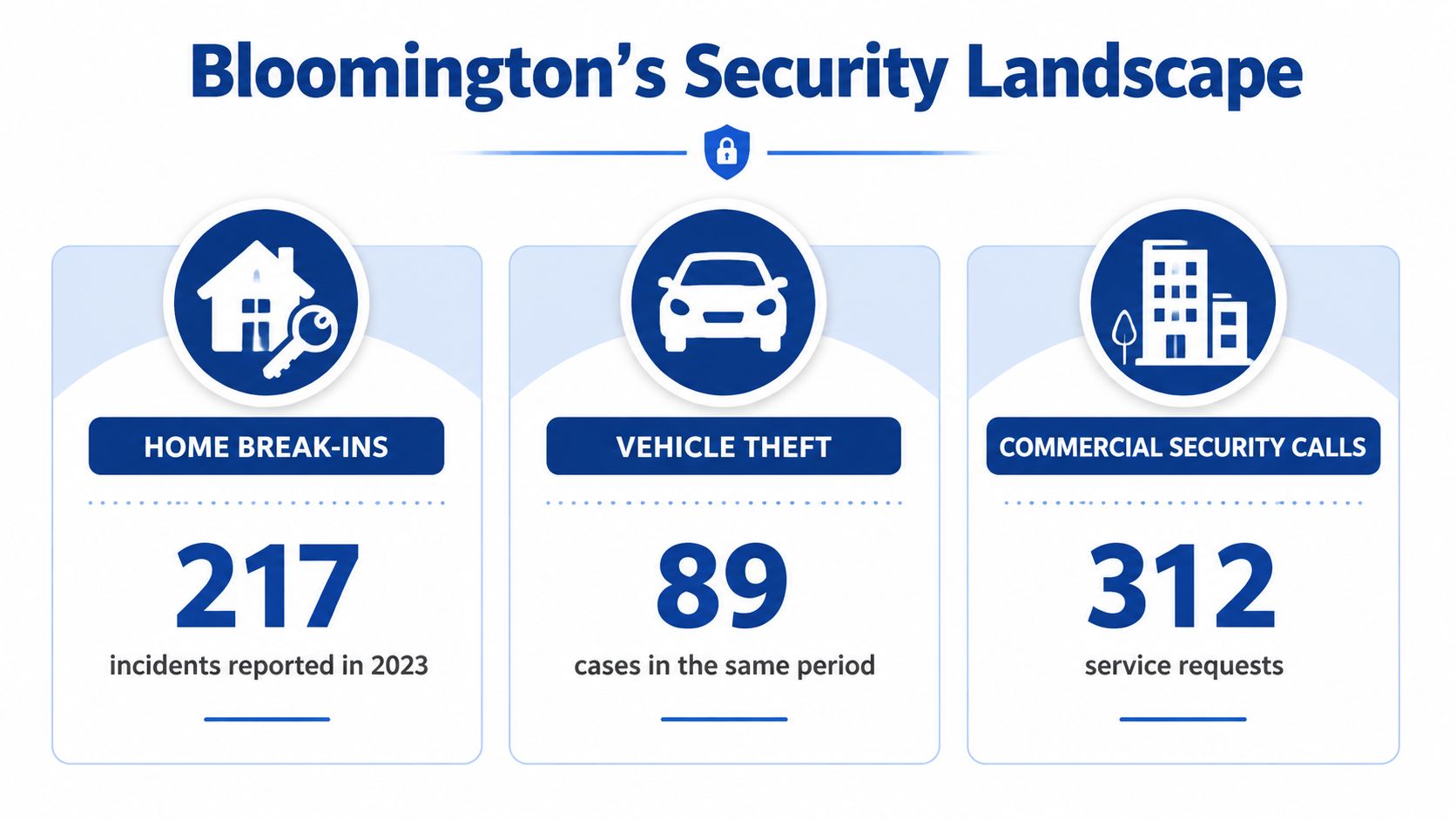
Bloomington is a substantial suburban market, not a small isolated community. The city is Minnesota's fourth-largest, with 91,330 residents and 39,279 households in 2023, along with 43,274 taxable housing units, according to Bloomington housing and crime information. That housing stock includes detached homes, apartments, condominiums, and rental properties, each with its own pattern of key turnover, lock wear, and emergency access needs.
More doors create more service situations. A tenant moves out and the owner needs a rekey. A homeowner inherits keys from a former occupant. A property manager finds that a common-area latch is failing. A business needs a storefront cylinder repaired before opening. Those aren't signs that every property is unsafe. They're ordinary access-control problems in a dense residential and commercial environment.
Bloomington's recent crime snapshot listed 3,045 property crimes and 292 violent crimes, with a total crime rate of 37.77 incidents per 1,000 residents. Property crime was listed at 34.47 per 1,000 residents, and the cited estimate put the chance of property-crime victimization at about 1 in 29, as reported in Bloomington crime statistics. These figures provide context, not a reason to panic.
Security decisions should follow the property
The same lock recommendation doesn't fit every Bloomington building. A seldom-used interior storage door has different demands from an apartment entrance, a busy office door, or a detached garage. Start with the doors that control exterior access, then review strike plates, hinges, door alignment, deadbolts, and who currently holds keys.
A separate city report cited in the same crime reference listed 2024 year-to-date burglary at 200 incidents, up from 171 the previous year, while all crime data fell 8% from 8,951 to 8,193. The practical lesson is straightforward. Overall crime can move in one direction while a specific entry-related concern moves another, so property owners should maintain basic access control instead of waiting for a single alarming event.
For homeowners and landlords, rekeying after a move or tenant change is often more appropriate than replacing every lock. For businesses, controlled key duplication, master key planning, and durable door hardware can reduce confusion. The best upgrade addresses the point of failure, whether that's lost key control, weak hardware, poor alignment, or an entry door that receives constant use.
Residential, Commercial, and Automotive Services Explained
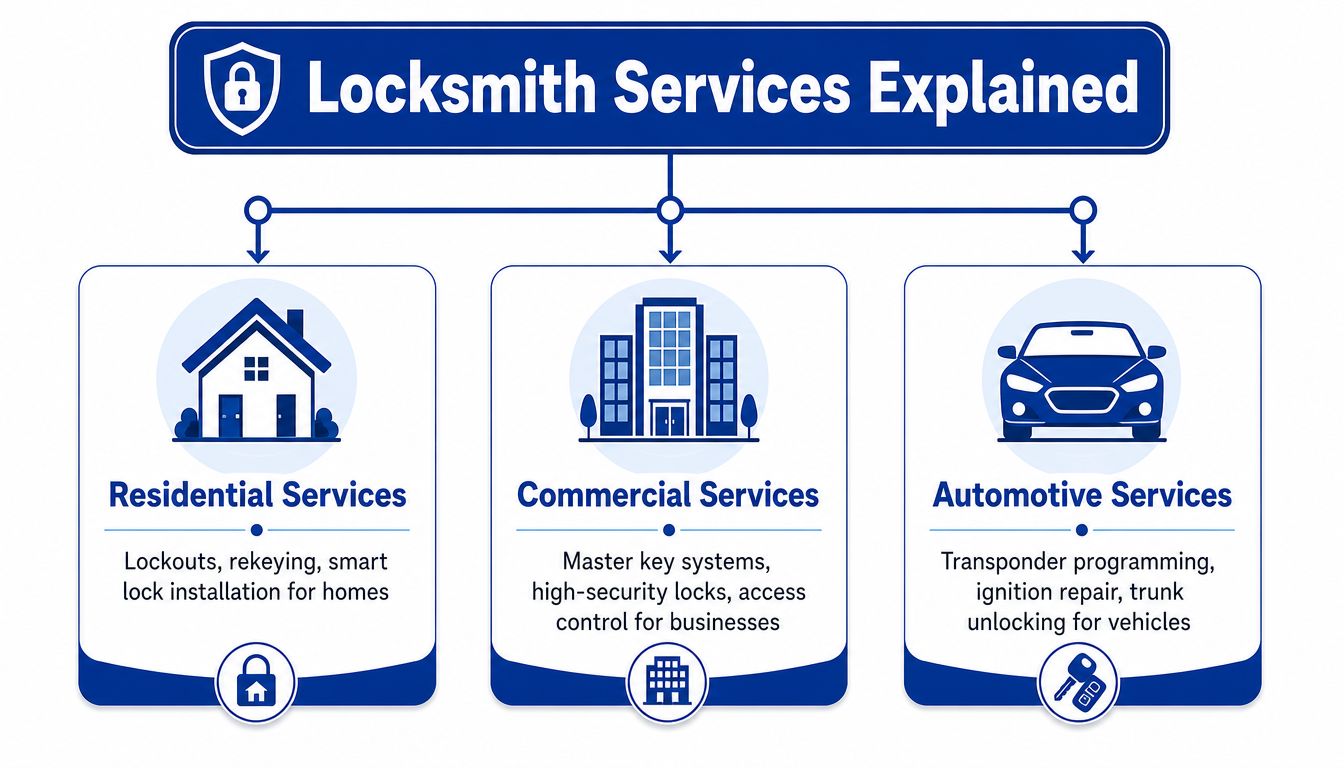
Locksmith work changes significantly depending on what's being secured. A house lockout, an office master-key issue, and a vehicle entry call may all involve keys, but the tools, authorization checks, and repair decisions aren't interchangeable.
Residential work
Residential service usually starts with access or key control. A locksmith can help with a home lockout, repair a sticking latch, install a deadbolt, rekey cylinders after a move, or fit a smart lock where the door and frame support it. Rekeying changes the internal combination of an existing lock so old keys no longer operate it. Replacing the lock changes the hardware itself, which may be necessary when the cylinder, case, trim, or latch is damaged.
A planned appointment makes sense when the lock works but the property's access history has changed. An emergency call is more appropriate when you're outside, a lock has failed, or a door can't secure the property. In every case, the technician should explain whether repair, rekeying, or replacement is the most sensible option.
Commercial service
Businesses need more than a functioning keyway. A locksmith may work on storefront cylinders, panic hardware, office lever sets, door closers, restricted key systems, master key arrangements, or access-control components. The right solution depends on employee turnover, tenant divisions, after-hours access, and the consequences of a locked door during operating hours.
A master key system can simplify authorized access, but poor planning can make a lost master key more disruptive. A commercial locksmith should map doors and permissions before cutting keys or changing cylinders. For a damaged entry, restoring safe operation can matter as much as restoring access. A door that opens but fails to latch securely still leaves a business exposed.
Automotive service
Vehicle lockouts and key problems require vehicle-specific knowledge. Modern vehicles may include transponder keys, electronic immobilizers, remote systems, sensitive airbags, and door electronics. A mobile automotive locksmith may handle non-destructive entry, key programming, ignition concerns, or trunk access, depending on the vehicle and available equipment.
Purpose-built tools are preferable to improvised methods because they're designed to reduce the risk of damage to weather stripping, linkages, airbags, and electronic components, as described by automotive access-tool information. Tell the dispatcher the vehicle make, model, year if known, and whether the key is locked inside, lost, broken, or turning without operating the lock.
How to Avoid Locksmith Scams and Verify Legitimacy
A phone number with a Bloomington reference doesn't prove that the company is local. The Minnesota Attorney General's locksmith guidance warns that deceptive advertisements may use local town names, local phone numbers, and false addresses while sending calls to out-of-state call centers.
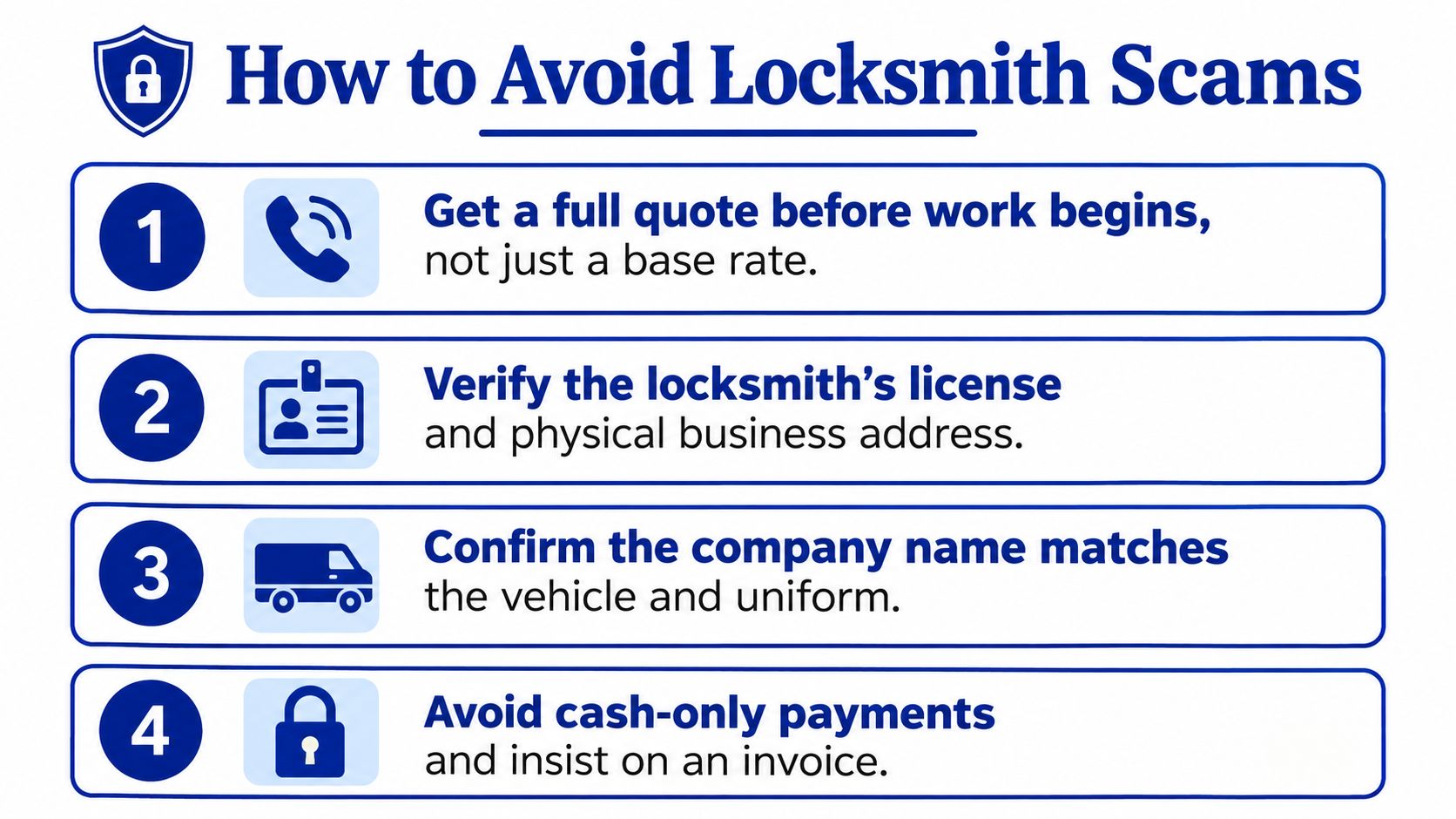
That matters most when you're stressed. A caller may quote an attractive base rate, dispatch someone in an unmarked vehicle, and present a much higher charge after arrival. You can reduce that risk by verifying the business before authorizing the work.
Ask direct questions before dispatch
Use plain questions and listen for specific answers:
- What is the legal business name and physical location? A real operator should be able to identify the business, not hide behind a generic dispatch label.
- What will the complete estimate include? Ask about the service call, labor, replacement parts, emergency timing, and any possible additional work.
- Can the technician verify insurance? Don't assume coverage. Ask before work starts, especially for commercial property or expensive doors.
- What identification will the technician show? Confirm the person who arrives matches the company you called.
- Will I receive an itemized receipt? Refuse a blank work order and don't accept unexplained charges.
Before the technician starts: Confirm the company name, total estimate, payment method, and scope of work in writing when possible.
The Attorney General also recommends checking identification on arrival, demanding a detailed estimate, confirming insurance, refusing blank work orders, and requesting an itemized receipt. Those steps aren't excessive. They establish accountability before someone works on your home, business, or vehicle.
A professional may recommend drilling when a lock is genuinely failed, inaccessible, or unsuitable for non-destructive entry. The important distinction is whether the technician explains why and obtains approval first. If someone refuses to identify the business, changes the price without explanation, or pressures you to authorize unnecessary replacement, stop the job and seek another provider if your safety allows.
Choosing the Right Lock Hardware for Your Needs
Lock grade is a useful way to compare durability and impact performance, but it isn't the entire security decision. Door construction, frame strength, strike installation, alignment, key control, and installation quality all affect how well an entry performs.
ANSI/BHMA testing distinguishes the grades by cycle endurance, impact testing, and weight testing. The cited trade explanation lists the following benchmarks for levers and knobs:
| Grade | Cycle Testing | Impact Resistance | Best For |
|---|---|---|---|
| Grade 1 | 800,000 cycles | 6 door-strike impacts and 360-pound weight test | High-use commercial entries and demanding exterior doors |
| Grade 2 | 400,000 cycles | 4 strikes and 250-pound weight test | Most residential exterior doors and rental properties |
| Grade 3 | 200,000 cycles | 2 strikes and 150-pound weight test | Lower-use interior or light-duty applications |
These figures come from ANSI/BHMA lock-grade guidance. Grade 1 is built for heavier use, while Grade 2 often balances durability and practicality for homes, apartments, and moderate-use entries. Grade 3 may suit a lower-demand application, but it's a poor choice when a door receives constant traffic or repeated tenant turnover.
Match hardware to use, not sales pressure
A rental entrance, office corridor, or common exterior door experiences more repeated operation than a private interior room. For those locations, cycle fatigue and impact resistance can become more important than adding another convenience feature. A locksmith should explain the application rather than recommend the most expensive product.
Smart locks add convenience through codes, apps, or temporary credentials, but they introduce batteries, connectivity, user-management, and compatibility questions. Before installing one, confirm that the door closes and latches correctly, that a mechanical backup exists where appropriate, and that you have a plan for access if batteries fail. If you're considering a connected system, review smart lock installation options and ask how the device fits your existing door.
Navigating Lock Changes for Renters and Landlords
A lock change can be a routine turnover task or part of a serious dispute. The legal authority to authorize the work matters as much as the hardware. Minnesota legal aid materials explain that a landlord can't lock out a tenant or change the locks to force someone out without a court eviction, while a tenant may be allowed to change locks when the rental agreement doesn't prohibit it, with the landlord retaining access rights in many situations. Review the Minnesota tenant-rights guidance on lock changes for the governing details.
Separate routine turnover from a lockout dispute
A landlord or property manager handling a lawful move-out should document the change in possession, confirm the lease status, and authorize rekeying or replacement in writing. Rekeying may preserve usable hardware while ending access for former keyholders. Replacing the lock makes more sense when the hardware is damaged, outdated, incompatible, or no longer suitable for the door.
A tenant should check the lease before changing a lock and should ask the landlord or manager how keys will be provided. Even when a tenant has a legal basis to change hardware, failing to coordinate access can create a practical and legal conflict. For a roommate disagreement, domestic safety concern, or disputed eviction, a locksmith can address the hardware only after confirming authorization. The locksmith can't decide who has the right to possession.
If the dispute concerns eviction or possession, pause the hardware decision and seek legal guidance. A locksmith visit won't replace a court process.
Property managers should keep a written turnover procedure, record which cylinders were changed, control duplicate keys, and give authorized occupants the correct copies. For a deeper explanation of the practical difference between changing hardware and changing the key combination, see rekeying locks versus replacing them.
What to Expect During Your Locksmith Service Visit
A professional visit should follow a clear sequence. The technician confirms authorization, inspects the door or vehicle, explains the entry or repair method, and provides an estimate before starting. For an automotive lockout, that usually means selecting specialized entry tools instead of forcing the frame or using improvised objects that can damage seals, linkages, airbags, or electronics.
The completed job should include a function test. A residential technician should check the key, latch, deadbolt, and door alignment. A vehicle technician should confirm the doors, trunk, ignition, or programmed key functions involved in the service. The work area should be left orderly, and you should receive an explanation of any new keys, codes, batteries, or maintenance needs.
Payment should match the agreed scope. Ask about warranty coverage, receipt details, and follow-up support before closing the transaction. For a clearer discussion of what affects a service estimate, review this locksmith pricing guide.
Mena's Key provides mobile residential, commercial, automotive, and emergency locksmith assistance across Bloomington and the Minneapolis–Saint Paul metro, with clear estimates and on-site service. When you need a locksmith who explains the work and verifies the details before starting, visit Mena's Key to request assistance or schedule service.