
Commercial Door Hardware: A Practical Guide for 2026
You're standing in a hallway with a maintenance list, a sticky note from the tenant, and a door that's been “acting up” for weeks. The lock still turns, but the closer slams, the lever feels loose, and somebody says the front door “probably needs a new part,” which doesn't help much when you're trying to keep a Minneapolis storefront or office compliant and open for business.
That's the core problem with commercial door hardware. It's not one product, and it's not a catalog decision. It's a set of parts on a specific opening, each one carrying a different risk, a different code requirement, and a different maintenance burden.
Table of Contents
- What Commercial Door Hardware Actually Includes
- Standards, Grades, and Code Numbers That Drive Every Spec
- Choosing the Right Hardware for Offices, Retail, and Multi-Tenant Buildings
- Keying, Rekeying, and Access Control Options
- Common Problems and How to Fix Them Before They Become Code Issues
- Cost Factors Most Buyers Overlook
- When to Call a Local Commercial Locksmith
- Your Commercial Door Hardware Checklist
What Commercial Door Hardware Actually Includes
A property manager usually sees the symptom first, not the system. A tenant says the door won't latch, the cleaner complains the closer is slamming, or the front entry is dragging on the threshold, and the parts list starts to blur together. The fix gets easier once you can name what's on the door.
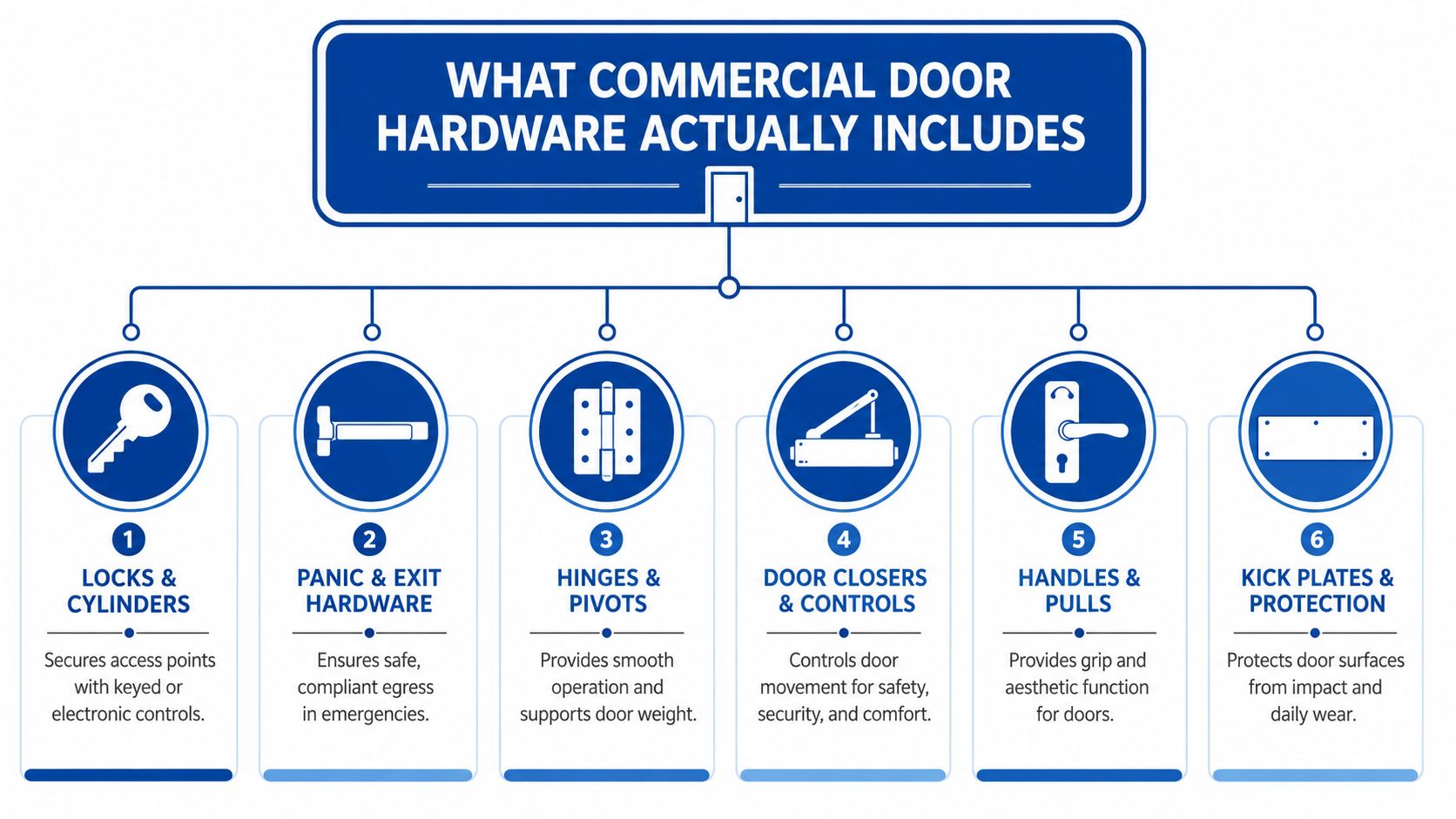
The six parts that make up a working opening
A typical commercial opening includes locks and cylinders, exit devices, door closers, hinges or pivots, strikes and latch guards, and electrified hardware. A storefront entrance is the easiest way to picture the whole system, because every piece has a job that affects the others.
The lockset or mortise lock is what secures the door in the closed position. On a retail front door, the cylinder, latch, and lever all have to work together or the door won't stay secure or easy to use.
The exit device, often called a panic bar, handles quick egress. The closer controls how the door returns, which matters for latch engagement and for keeping the door from slamming.
The hinges or pivots carry the weight and keep the door aligned. If they're worn or loose, even a good lock will start acting wrong because the latch and strike stop lining up.
Strikes and latch guards give the latch a place to land and protect the edge of the door frame from abuse. Electrified hardware adds readers, electrified trims, or strike releases when access control or alarm integration is part of the job.
Practical rule: if one opening is failing, don't shop for “a lock.” Identify the whole set of parts first, because a door is a system, not a single component.
If you can point at a door and name each of those pieces, you're already making better decisions than most buyers. You'll know whether the problem belongs to a latch, a closer, a hinge set, or the access system controlling the opening.
Standards, Grades, and Code Numbers That Drive Every Spec
A lot of hardware mistakes happen because people treat grade as a marketing tier. It isn't. ANSI/BHMA grades are really a duty-cycle and performance hierarchy, and that's why commercial doors in busy buildings need a different spec than a back room or a storage closet.
What the grade actually tells you
Grade 1 is the highest commercial performance tier, and it's the safe starting point for heavy-use openings like main entries and corridors. Practical specification guidance commonly uses roughly 1,000,000+ cycles for closers and 1,500,000 cycles for locksets as a benchmark for that tier, because repeated use is what kills lighter hardware first (commercial hardware specification guide).
Lower grades can still have a place, but only where traffic is lighter. The mistake isn't buying Grade 2. The mistake is putting it on a door that sees constant daily traffic and then acting surprised when it starts to loosen, bind, or mis-latch.
ADA and life-safety rules sit on top of the grade decision. For interior doors, commercial specs commonly use 5 lbf opening force, and many also reference 1.5 seconds minimum closing time from 70° to fully closed because controlled closing helps latch engagement without slamming (CSUSM door hardware summary). That force and timing balance matters in occupied buildings where accessibility and wear both matter.
Why inspectors care which version is installed
The code logic is simple. ADA cares about operability and accessibility. NFPA 101 cares about egress. ANSI/BHMA tells you whether the hardware can stand up to the use pattern you're asking of it.
If a door is hard to open, hard to close, or slow to latch, someone will eventually treat it as a maintenance nuisance. An inspector may treat it as a compliance issue.
That's why the grade question should always start with the opening, not the brand. A door near a lobby entrance is a different risk than a low-use interior office, and the spec should follow that reality.
Choosing the Right Hardware for Offices, Retail, and Multi-Tenant Buildings
The same building can need three different answers. A Twin Cities office suite, a retail storefront, and a multi-tenant corridor all put different stress on the door, so copying the same hardware everywhere usually wastes money in one spot and creates failures in another.
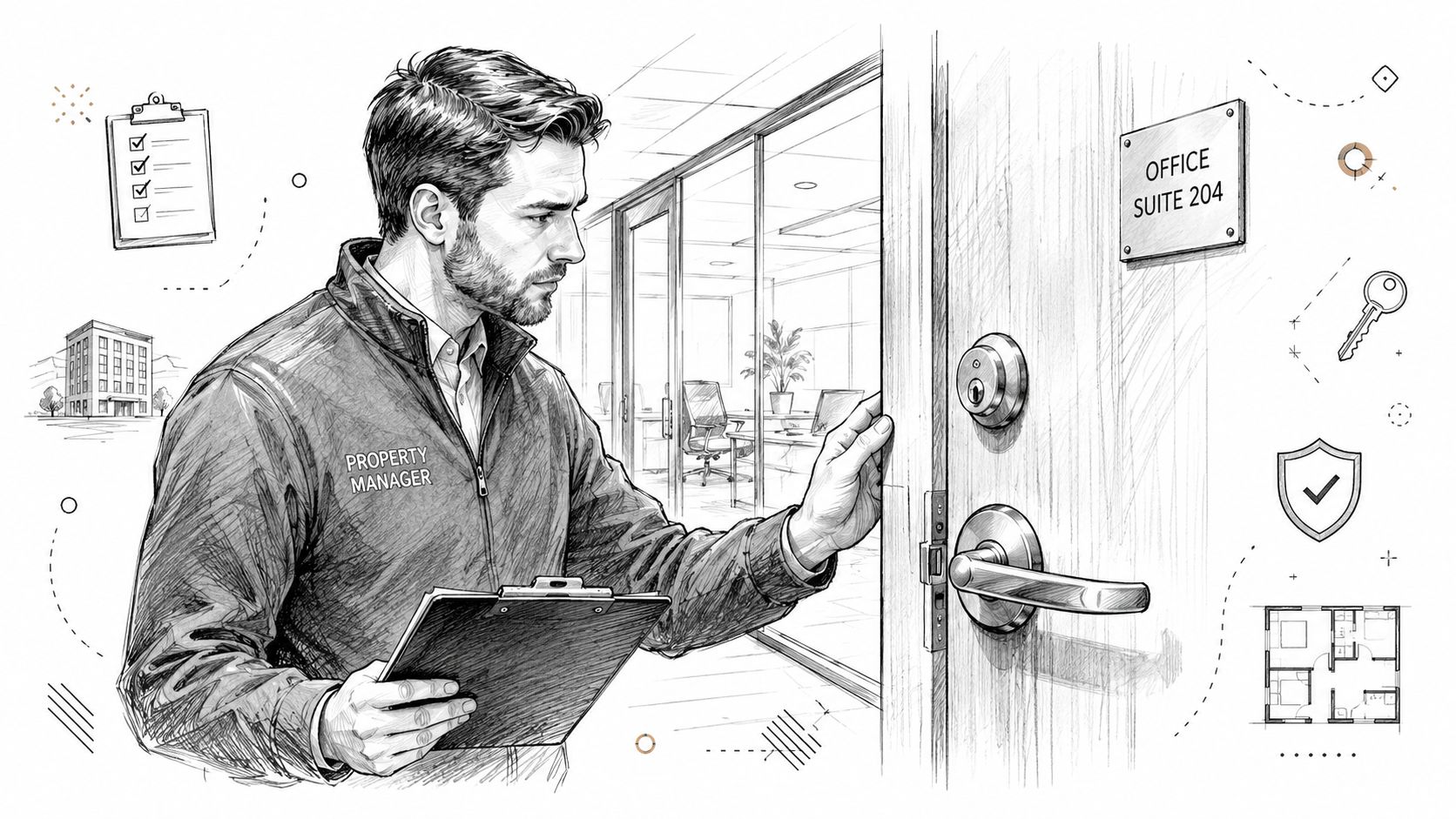
Office suites need steadiness, not overkill
Office doors usually see predictable traffic. People enter in the morning, move through during the day, and leave without the abuse a storefront gets from constant public use. That makes the opening a good candidate for commercial-grade hardware that fits the duty cycle without overspending on features the door never needs.
A suite entry still needs the basic disciplines from the standards section. If it's the primary entry to the tenant space, the lever needs to be easy to operate, the closer needs to return the door cleanly, and the strike needs to line up reliably. A fancy lock won't save a door that's sagging off its hinges.
Retail storefronts need the toughest spec at the front
Retail is where cheap hardware fails fastest. The front door gets used hard, customers push it, staff prop it, and closers get adjusted too loosely so the door “feels nicer” until it starts slamming or not latching. That's where Grade 1 hardware belongs most often, especially at the main entry.
Back-of-house doors are a different story. A stockroom or employee-only door may not need the same duty level, but it still has to satisfy accessibility and egress rules if it serves as an occupied opening. The least expensive part is often not the cheapest choice once you count callbacks.
Multi-tenant buildings need opening-by-opening judgment
Corridor doors, suite entries, and shared common doors all live different lives. One opening may need frequent access control changes after tenant turnover, while another only needs reliable passage and controlled closing. That's where a doorway-by-doorway survey matters more than a wholesale hardware swap.
For a broader planning approach, a local team can tie the spec to the opening and the code path, including access control options like commercial door hardware integration and access control.
Keying, Rekeying, and Access Control Options
Once the hardware itself is right, the next question is who gets in. That decision changes more often than people expect, especially in leased spaces, medical offices, and mixed-use buildings where keys move around with staff changes and tenant turnover.
Three ways properties usually control access
A master key system still makes sense in a lot of buildings. It lets ownership or management carry a higher-level key while tenants or staff use sub-masters and individual keys below that. The upside is simplicity and familiar service procedures. The downside is that every lost key can become a bigger administrative problem than the person holding it realizes.
Standalone electronic locks trade keys for PINs, cards, or proximity credentials. They're useful where access changes often and you want to avoid a full rekey every time a tenant leaves or a staff member changes roles. They also keep the door simpler than a fully networked system.
Integrated access control ties the opening into a larger software platform. That makes sense when door schedules, audit trails, or remote permission changes matter more than a purely mechanical setup. It also brings more system dependency, which means battery, wiring, software, and service planning all matter.
| Approach | Best Fit | Main Trade-Off |
|---|---|---|
| Master key system | Buildings that need simple, familiar control | Rekeying and key tracking become recurring tasks |
| Standalone electronic lock | Doors with changing access needs and moderate scale | Batteries, credential management, and device upkeep |
| Integrated access control | Sites that need centralized control and reporting | Higher complexity and more points of failure |
A good rule is to match the control method to the turnover rate and the sensitivity of the space. If the building changes hands often, mechanical-only keying can become a hidden labor expense. If the door is critical to operations, the control system needs to be maintained like any other part of the opening, not treated as a set-it-and-forget-it feature.
Common Problems and How to Fix Them Before They Become Code Issues
A lot of hardware trouble starts small. The door still works, just not well. That's when a non-specialist usually thinks “minor adjustment,” while the hardware is already warning you that a bigger repair is close.
The failures a route tech sees most often
Door sag usually shows up as scraping, latch drag, or a lever that suddenly feels wrong. The common cause is worn hinges, loose fasteners, or an opening that's drifted out of alignment over time. If a quick adjustment doesn't restore clean latch line-up, the hinge set or related components may need replacement.
Hydraulic closer leaks or slamming are easy to spot. If oil is visible or the door no longer closes at a controlled speed, the closer is likely at the end of its service life or improperly adjusted. A closer that slams doesn't just annoy people, it also beats up the latch and frame.
Exit devices that won't latch are usually a strike, alignment, or dogging issue, not just a “bad bar.” If the push bar still releases but the door won't secure, the latching path needs to be checked before the opening becomes a safety problem.
A good maintenance log helps here, and a service visit should focus on the full opening, not a single symptom. For routine upkeep and service planning, a local provider's commercial door hardware maintenance support can keep a door from drifting into a code complaint.
A door that needs force, a second push, or a hard slam is already telling you the geometry is wrong.
What gets fixed quickly and what doesn't
Minor strike adjustments and closer tuning are fast when the door and frame are still sound. Bent parts, damaged latch hardware, and repeated misalignment usually point to component replacement. Electrified hardware that drops power intermittently can be wiring, battery, or device failure, and it needs a technician who can test the whole path instead of guessing.
The key is to treat these symptoms early. Once a door stops latching reliably, you're no longer dealing with a convenience issue. You're dealing with a security and life-safety issue.
Cost Factors Most Buyers Overlook
The sticker price on a lock or closer is usually the smallest part of the bill. The cost shows up in the grade, the control method, the code requirements, and the labor needed to keep the opening working after installation.
What actually moves the price
Higher grade hardware costs more up front because it's built for heavier duty cycles and better endurance. That extra spend often pays back in fewer repairs and fewer emergency calls, especially on doors that see all-day use.
Electrified components raise the total because you're not just buying a lock, you're buying parts that interact with readers, controllers, or strike releases. Those systems also need proper service planning when batteries, wiring, or access permissions change.
Code-driven upgrades can force a decision you didn't budget for. If the opening must meet accessibility or egress requirements, the “cheap” option may not be acceptable once the hardware is matched to the door's actual use.
Labor is where many owners get surprised. After-hours service, emergency entry, or repeated return trips can make a low-cost part the expensive choice in practice.
A useful market context helps explain why these decisions matter. One independent analysis says the U.S. commercial door hardware market exceeds $7 billion annually, while another report estimates the commercial door hardware market at $10.5 billion in 2024 and projects $15.2 billion by 2033 at 5.2% CAGR (market overview). That's not a niche purchase category. It's a major building spend tied to construction, renovation, and maintenance.
If you want a separate pricing reference before you approve a job, use a commercial locksmith pricing guide to sanity-check the estimate against the scope.
When to Call a Local Commercial Locksmith
A handyman can tighten a hinge screw. That's not the same thing as specifying a code-compliant opening, servicing an exit device, or reworking access control after a tenant move-out. Those jobs need someone who works on commercial openings every day.
The jobs that justify a locksmith
Call a commercial locksmith when the work touches code compliance, master key changes, exit devices, electrified hardware, or emergency access. Those are the jobs where the door's function, the building's liability, and the final inspection outcome are all connected.
A local mobile locksmith is useful because the work happens on site, at the opening, with the actual frame, door, strike, and operator in front of them. That's especially valuable across Minneapolis, Saint Paul, and the surrounding suburbs, where a single property can have storefront glass, office suites, and back-of-house doors with very different needs.
Mena's Key handles commercial door hardware service, rekeying, and access-related work as a Minnesota mobile locksmith, so it fits naturally as one option when a building needs on-site service, not a parts run.
A proper estimate should tell you what will be adjusted, what will be replaced, and what part of the opening still has to be checked after the repair.
The right locksmith also helps you avoid overbuying. If one opening needs Grade 1 hardware and another doesn't, you want a tech who can separate those calls instead of quoting the most expensive solution for every door in the building.
Your Commercial Door Hardware Checklist
Before you approve the next repair, walk each opening and write down the basics. Note the door type, the traffic level, the hardware on the opening, and whether it's a mechanical or electrified setup. Then check for sag, slam, latch failure, and any sign that the door takes too much force to open or close.
If the opening serves the public, think about ADA and egress first, then match the grade to the duty cycle. If the door changes users often, flag whether rekeying, key control, or electronic access would reduce future work. If you can't tell what's installed, that's already a reason to get a site assessment.
For Twin Cities properties, a local mobile locksmith can usually inspect, spec, repair, and rekey on site. If you want a no-obligation quote, schedule a walk-through with a Minnesota commercial locksmith who can look at the door as a whole system, not just a broken part.
If you need help sorting out a storefront, office suite, or multi-tenant opening, Mena's Key can assess the hardware on site, explain the trade-offs, and handle the repair or upgrade without sending you through a general contractor. Visit Mena's Key to request a free, no-obligation quote and get a clear next step for your commercial door hardware.


