Car Key Replacement: Minneapolis Drivers Guide 2026
You're standing in a parking lot, bag in one hand, phone in the other, and the key you know you had ten minutes ago is nowhere to be found. Maybe it vanished at the grocery store, maybe it's locked in the truck, maybe it's on the kitchen counter back home in St. Paul. Either way, car key replacement stops feeling like a routine errand and starts feeling like a problem that can ruin the rest of your day.
The first thing to sort out is not who to call. It's what kind of key you lost, because that single detail shapes the cost, the timeline, and whether help can come to you or your car has to go somewhere else. In modern vehicles, the key is often part of the security system, not just a piece of cut metal.
Table of Contents
- What Happens When You Lose Your Car Keys
- How Car Key Replacement Actually Works
- Understanding Car Key Replacement Costs
- Dealer vs Locksmith vs DIY Which Option Fits Your Situation
- What to Have Ready Before You Call for Help
- Emergency Steps and Local Help in MinneapolisSaint Paul
What Happens When You Lose Your Car Keys
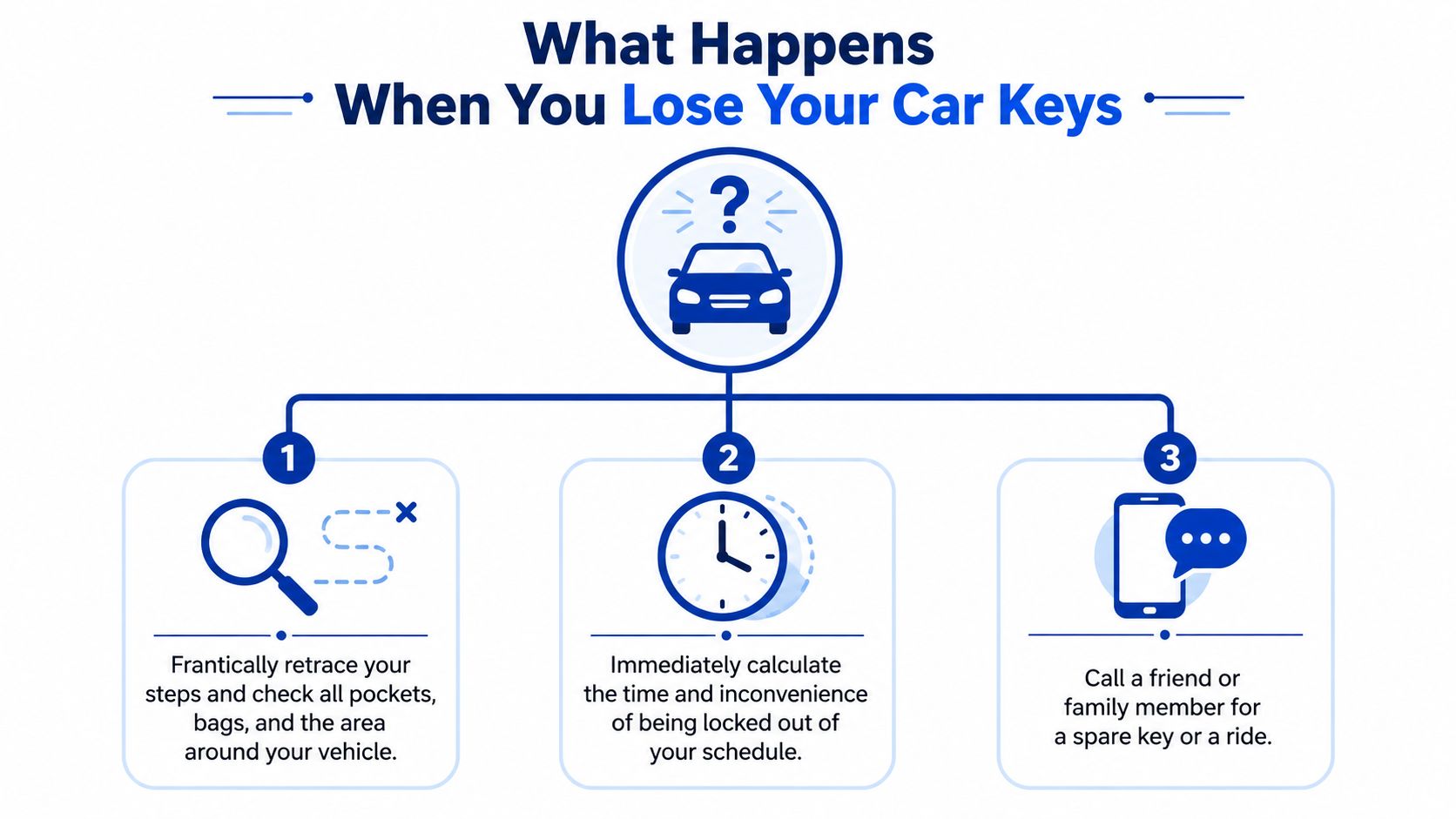
You finish shopping at Target in Fridley, reach into your pocket, and nothing's there. Or you walk out of a lecture building near the U of M campus and realize your keys are missing, along with the only fob that starts your car. That moment is usually where people jump straight to the dealership, but the better move is to figure out what kind of key you lost before you make the call.
The key type matters more than most drivers expect
A mechanical key is the simplest version. It's just cut metal, so replacing it is usually straightforward if the lock code or an existing key is available. A transponder key looks similar, but it contains a chip that has to be recognized by the car.
A key fob adds remote buttons for locking and unlocking, and a smart key or proximity fob goes further, because it lets the car recognize the key nearby for push-button start. That means the replacement isn't just about cutting a blade. It's about pairing the new key with the vehicle's security system.
Practical rule: If the vehicle has push-to-start, assume the replacement is more than a simple duplicate until proven otherwise.
That distinction keeps drivers from getting bad advice. It also keeps them from overpaying for a job that a mobile locksmith can often handle without towing, or from expecting a quick hardware-store copy to solve an immobilizer problem it can't touch.
How Car Key Replacement Actually Works
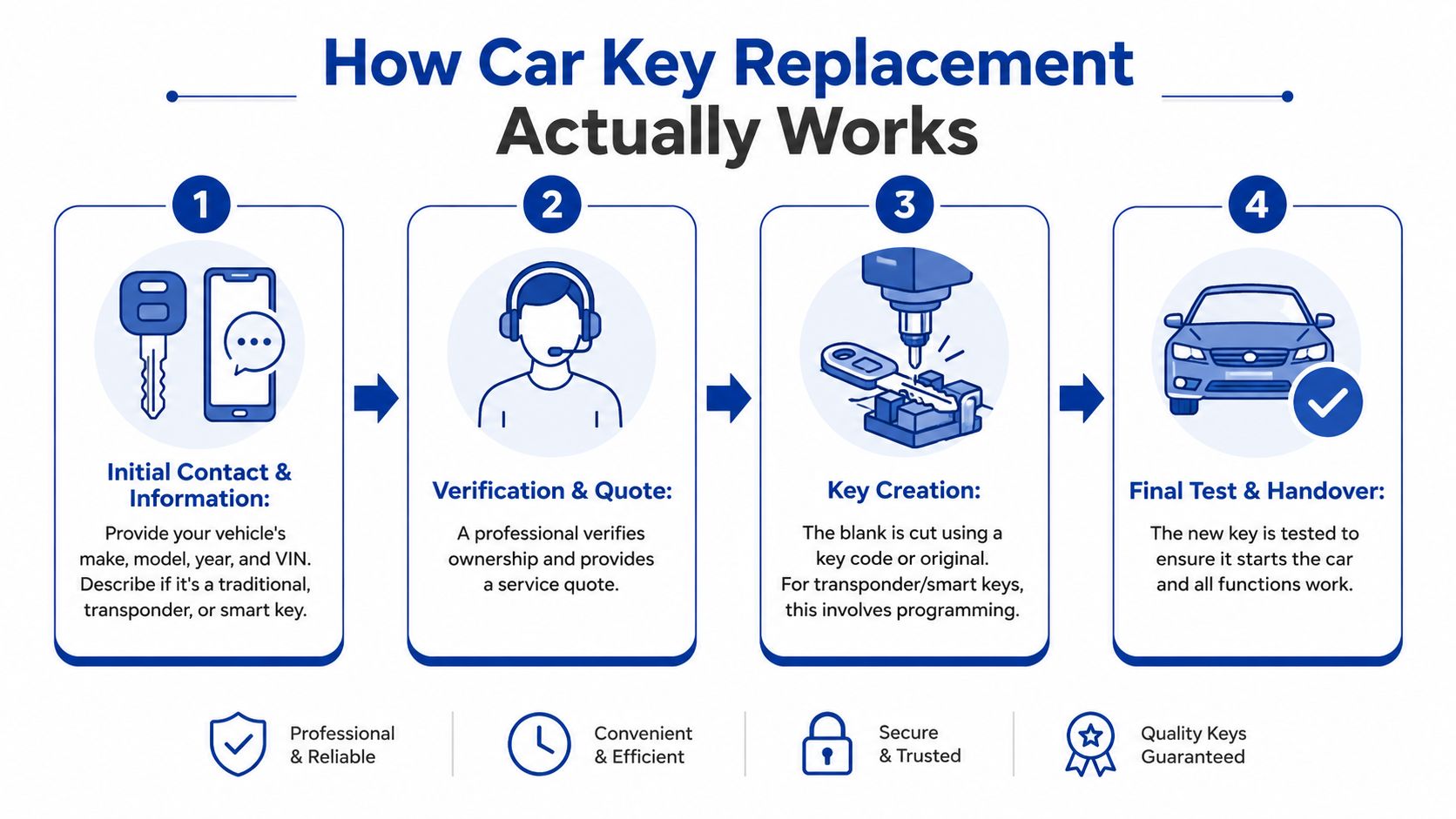
The process starts with a phone call, not a key machine. A locksmith or dealer needs the vehicle's make, model, year, and VIN, plus proof that you're allowed to get a replacement. Once ownership is confirmed, the next step is identifying the key type and deciding whether the work can happen on-site.
Cutting the key is the easy part
On many jobs, the metal blade is the least complicated piece. A blank gets cut to match the lock code or an existing key pattern, then the vehicle still has to accept it electronically. For a transponder key, that usually means OBD-II synchronization, where diagnostic equipment talks to the car's immobilizer system.
For a smart key or proximity fob, the pairing process is more involved. The replacement has to communicate with the vehicle's anti-theft electronics, and some jobs call for manufacturer-level tools or more advanced procedures. In higher-complexity cases, technicians may need EEPROM-level work, which can involve micro-soldering and binary data handling on immobilizer components.
Why the same job isn't the same on every car
That's why some mobile services can finish a key replacement at the curb while others can't. A locksmith needs the right blank, the right programming gear, and the right access method for the vehicle in front of them. If any one of those pieces is missing, the job slows down fast.
If you're comparing service pages while stranded, the details on car fob replacement near me help make the difference between a simple cut-and-program visit and a situation that needs more specialized support. The important takeaway is simple. Replacement is usually a programming job first, a cutting job second.
Understanding Car Key Replacement Costs
Cost surprises usually come from comparing a modern key replacement with the old habit of copying a plain metal spare at a hardware store. That comparison no longer fits how most vehicles are built. Basic mechanical keys are still the least expensive option, roughly $5 to $15 for the blank alone, while transponder keys typically land around $125 to $250 once programming is included. Smart keys and keyless fobs often run $200 to $500 or more because of chip encryption, diagnostic access, and the need to pair the new key to the vehicle's anti-theft system. KBB's key fob replacement guide lays out those common price bands clearly.
Why the price climbs so fast
The more electronics in the key, the more work the technician has to complete. A mechanical key needs cutting. A transponder key needs cutting and programming. A smart key needs pairing, testing, and sometimes more specialized access to the vehicle's security system.
That pattern shows up in real-world consumer costs. RAC-backed research found that in the UK, 54% of drivers who permanently lost their keys bought a replacement rather than relying on a spare, at an average cost of £176.20 per replacement, creating a UK-wide bill of more than £181 million. The same research found that 43% of drivers regularly misplace their keys and spend about 2 minutes 10 seconds searching for them each day, which adds up to nearly 14 hours a year per driver. The RAC research summary shows how quickly key issues become a real household expense.
What usually changes the quote: chip type, programming access, and whether the technician can do the work on-site.
Replacement costs have risen significantly as vehicles have moved toward more advanced locking and keyless systems. Older cars are usually cheaper to handle. Newer ones bring more electronic complexity, more time at the vehicle, and sometimes more equipment on the locksmith side. For a local estimate breakdown, the locksmith pricing guide helps show what tends to be labor, what tends to be programming, and what tends to be equipment.
Dealer vs Locksmith vs DIY Which Option Fits Your Situation
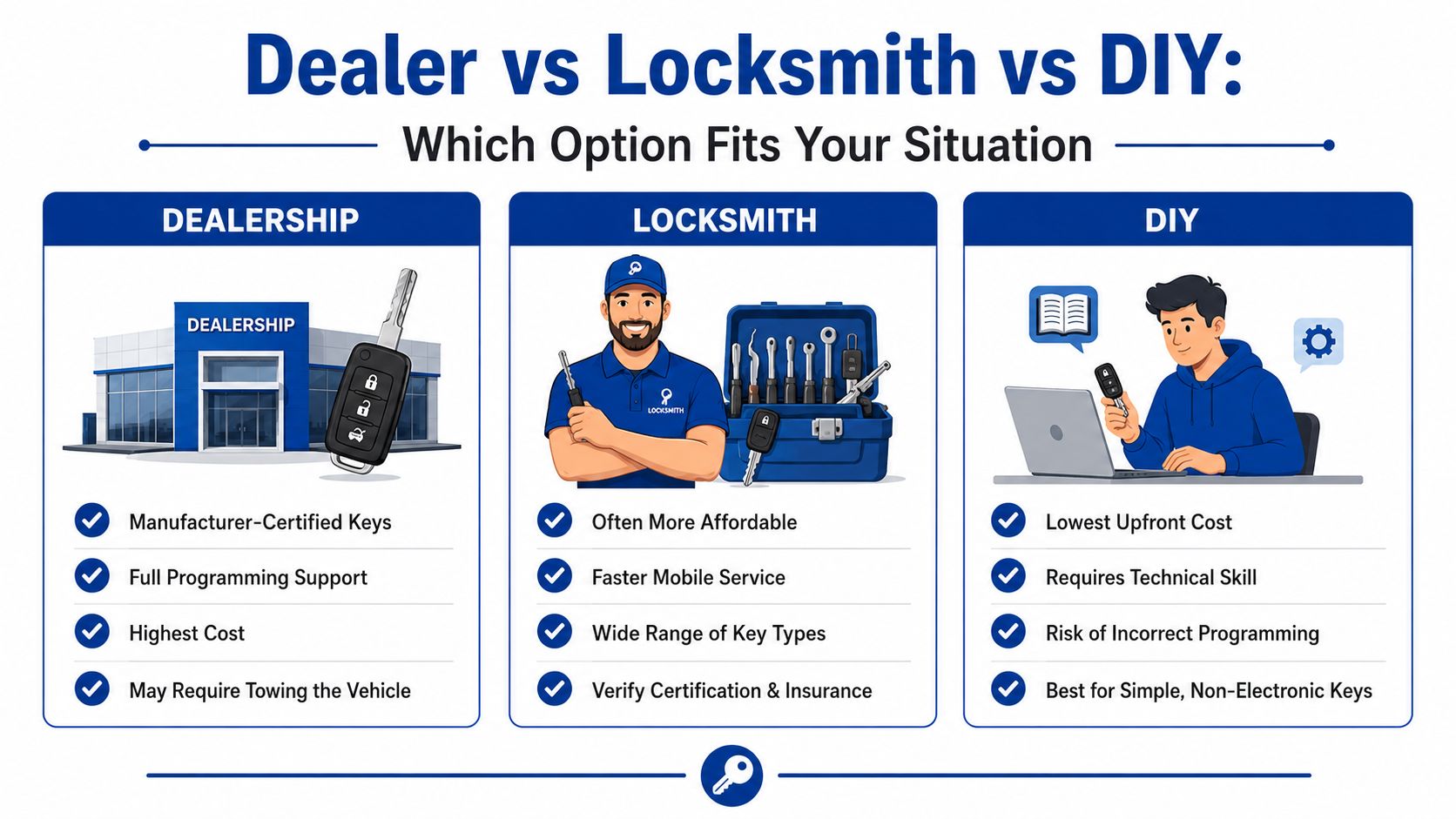
The right choice depends on where the vehicle is, how advanced the key is, and how quickly you need to move. A dealer is often the cleanest path for manufacturer-specific work, but it can also mean towing, waiting for an appointment, and paying more than you expected. A mobile locksmith can often come to the vehicle, cut and program on-site, and finish the job without turning the day into a logistics project.
When the dealer makes sense
A dealership is the safer bet when the vehicle uses proprietary programming that outside tools can't access, or when the model is unusual enough that a locksmith may not stock the right blank. Dealers also handle manufacturer-certified keys and full programming support. The trade-off is time and transport, since many drivers end up needing a tow.
When a locksmith is the smarter call
A mobile locksmith is usually the better fit when the car is stuck in a driveway, parking lot, or job site and you need a working key now. Many common vehicles can be handled on-site, including replacement, programming, and testing. A reputable service should also verify ownership, carry insurance, and explain what's possible before rolling a truck.
When DIY is worth considering
DIY only makes sense for simple mechanical keys or a narrow slice of older systems with straightforward programming. Even then, it's a poor fit if you're already stressed, because one wrong step can create a second problem around the ignition or immobilizer. If the vehicle uses a transponder chip or smart fob, the risk jumps quickly.
If the car has a push-button start and you're stranded, DIY is usually a false economy.
For drivers in the Twin Cities who need automotive help right now, Mena's Key's automotive locksmith page is one place to review mobile options that include vehicle lockout help, lost key replacement, and transponder key programming. The right provider won't just tell you “dealer or locksmith.” They'll tell you which one fits your vehicle and why.
What to Have Ready Before You Call for Help
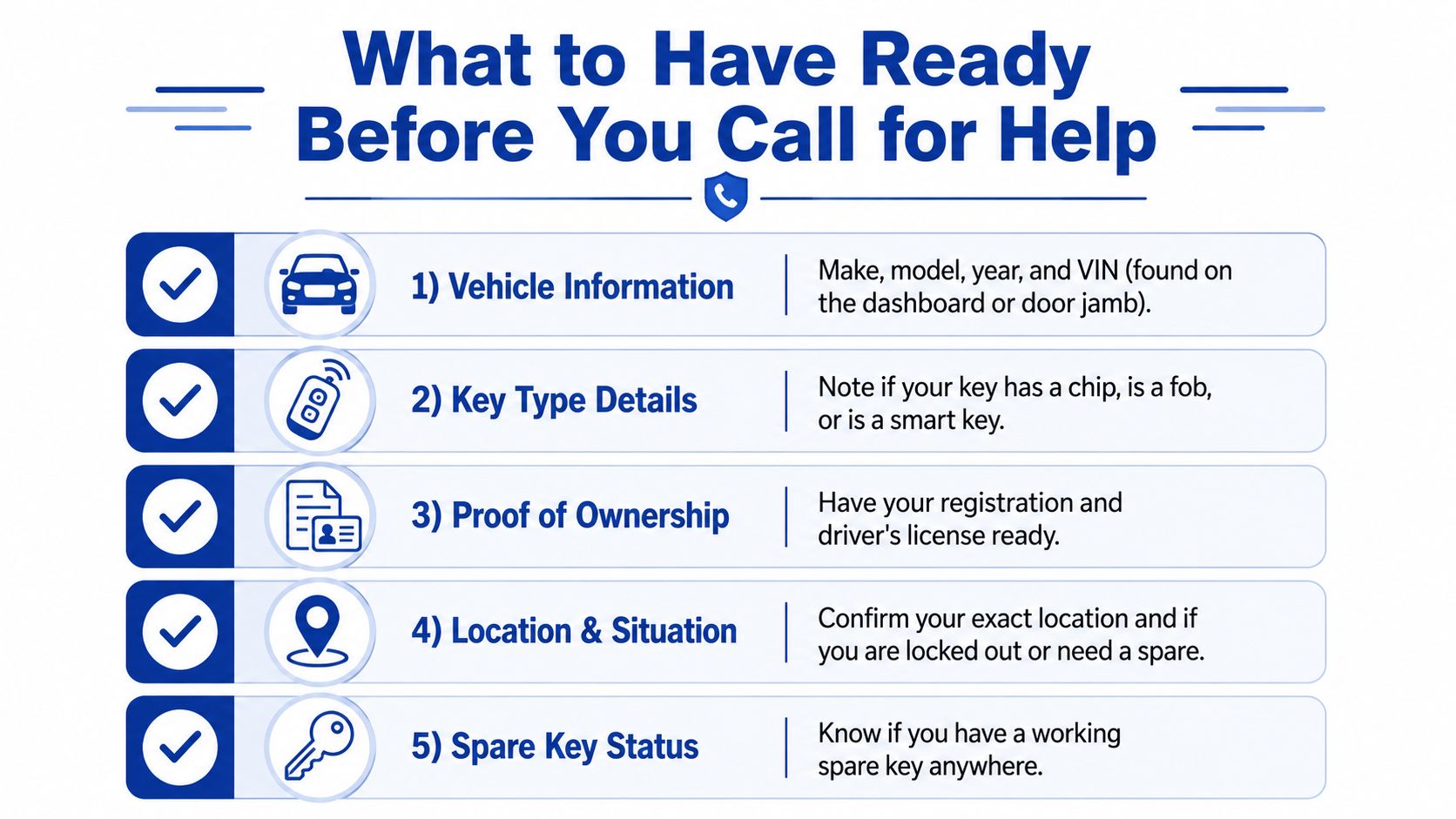
A good call shortens the whole job. A messy one turns into back-and-forth, extra waiting, and sometimes a second trip. Before you call, gather the details that prove the vehicle is yours and tell the technician what they're walking into.
The documents and details that matter
- Vehicle information: Have the make, model, year, and VIN ready. The VIN is usually on the dashboard or the driver-side door jamb, and it helps the technician identify the right key code and programming path.
- Proof of ownership: Bring your registration and a government-issued photo ID that matches the name on the paperwork. Locksmiths and dealers ask for this to prevent unauthorized duplication.
- Key type clues: Tell them whether the key has a chip, a fob, or a smart key. That one detail changes the equipment they bring.
- Location and situation: Say exactly where the car is parked and whether the doors are secured, open, or partially secured.
- Spare key status: If you still have a working spare anywhere, mention it. That affects how the programming process may be handled.
Why prep helps so much
The most annoying delays usually come from missing information, not from the actual cutting. If the technician shows up without enough detail, they may need to make a second trip with a different blank or a different programmer. If you already have the paperwork and vehicle details ready, the call moves faster and the quote is usually more accurate.
Straight answer: proof of ownership isn't paperwork theater, it's what keeps someone else from getting a key to your car.
That matters even more if the vehicle is shared by a spouse, roommate, fleet driver, tenant, or employee. The cleaner the handoff, the faster the replacement gets done.
Emergency Steps and Local Help in MinneapolisSaint Paul
Start with the obvious safety checks. If the vehicle is accessible, secure it first. If you've got roadside assistance or insurance coverage that includes lost key support, check that next so you don't pay twice for the same problem. After that, be careful about the first search result you see, because urgent key problems attract unverified operators who count on panic.
A solid local provider should explain what they can do on-site, what documents they need, and whether towing is necessary. That's the practical divide between a real locksmith and a call center that just forwards your number. If the key is gone in a parking ramp, on a job site, or outside your apartment, mobile service is often the only option that doesn't waste half the day.
For drivers in Minneapolis, Saint Paul, and nearby suburbs, Mena's Key is a locally owned Minnesota locksmith that handles automotive, residential, commercial, and emergency work. Their service area includes mobile coverage across the metro, and their site states they offer 24/7 emergency response, free no-obligation quotes, on-site workmanship, and a satisfaction guarantee. They also list lost car key replacement and transponder key programming as part of their automotive services, which matters when the issue is more than a simple cut key.
The best local choice is the one that can verify ownership, arrive with the right tools, and tell you clearly whether the job can be finished where the car sits. That's the standard I'd want if it were my truck sitting in a Minnesota lot in January.
If you're dealing with a lost key right now, don't guess at the next move. Visit Mena's Key to check automotive locksmith help, ask for a clear quote, and get the right replacement path for your vehicle before the day gets any longer.