Automotive Locksmith Near Me: Local Guide to Fast Help
You're standing in a cold parking lot, the car's locked, the groceries are sitting in the cart corral, and your keys are still on the driver's seat. If you're in Brooklyn Park, Bloomington, Blaine, or anywhere across the Twin Cities, that search for an automotive locksmith near me is usually not research, it's a time-sensitive problem that needs a real person who can get to the curb, work on the vehicle, and keep the day moving.
Table of Contents
- Why Local Automotive Locksmith Help Matters
- What Modern Automotive Locksmiths Do
- Immediate Steps During a Car Lockout
- Automotive Locksmith Services Available
- Typical Pricing and Cost Variables
- How to Verify a Trustworthy Locksmith
- FAQs and Booking Mena's Key Today
Why Local Automotive Locksmith Help Matters
A car lockout feels small until you're the one standing outside the vehicle after dark. In a grocery lot, on a side street, or in a driveway in the Twin Cities, the problem is immediate, local, and usually tied to the exact place you're parked. That's why a search for an automotive locksmith near me is different from looking up a general service, because the buyer usually needs someone who can come out now, not later.
The local market behind that search is bigger than many expect. In the United States, the locksmiths industry is projected to reach $3.0 billion in 2026, with 29,620 businesses operating in the sector and a 3.4% CAGR from 2021 to 2026, according to IBISWorld's industry profile. That scale matters for drivers, because automotive help sits inside a mature local-services market, not a niche hobby trade.
Search behavior says the same thing in plain language. The term “locksmith near me” exceeds 1 million monthly U.S. searches, while “car locksmith near me” is about 75,000 monthly searches and “auto locksmith” about 27,100, according to WebTonic's locksmith SEO statistics. Those are urgent, location-based queries, which tells you the caller is usually trying to solve a problem at the curb.
Practical rule: if the car is disabled, the key is missing, or the doors won't open, a mobile locksmith is the right category to call first.
That's where a locally owned mobile service fits naturally. Mena's Key operates in Minnesota with 24/7 standby and on-site support across the Minneapolis–Saint Paul area, so the service model matches the situation: travel to the car, handle the access issue there, and avoid turning a lockout into a tow problem.
What Modern Automotive Locksmiths Do
A modern automotive locksmith does more than pop a door open. Think of the job like restoring access to a phone account. The old metal key is the basic password, but the chip or fob is the second layer that tells the vehicle the user is authorized.
Three steps, one outcome
The technical workflow usually follows three stages. First, the locksmith identifies the vehicle by VIN, year, make, model, and trim, because the right key path depends on the exact car. Next comes code-cutting or laser-cutting equipment to create the mechanical key profile. Then comes transponder or smart-key programming, which lets the immobilizer recognize the key and allow the engine to start, as described in this automotive locksmithing guide.
That last step is where many drivers get confused. A key can look correct, slide into the lock, and still fail at the ignition if the chip isn't programmed. On many late-model vehicles, the mechanical cut and the electronic authorization are separate jobs, and both have to be right.
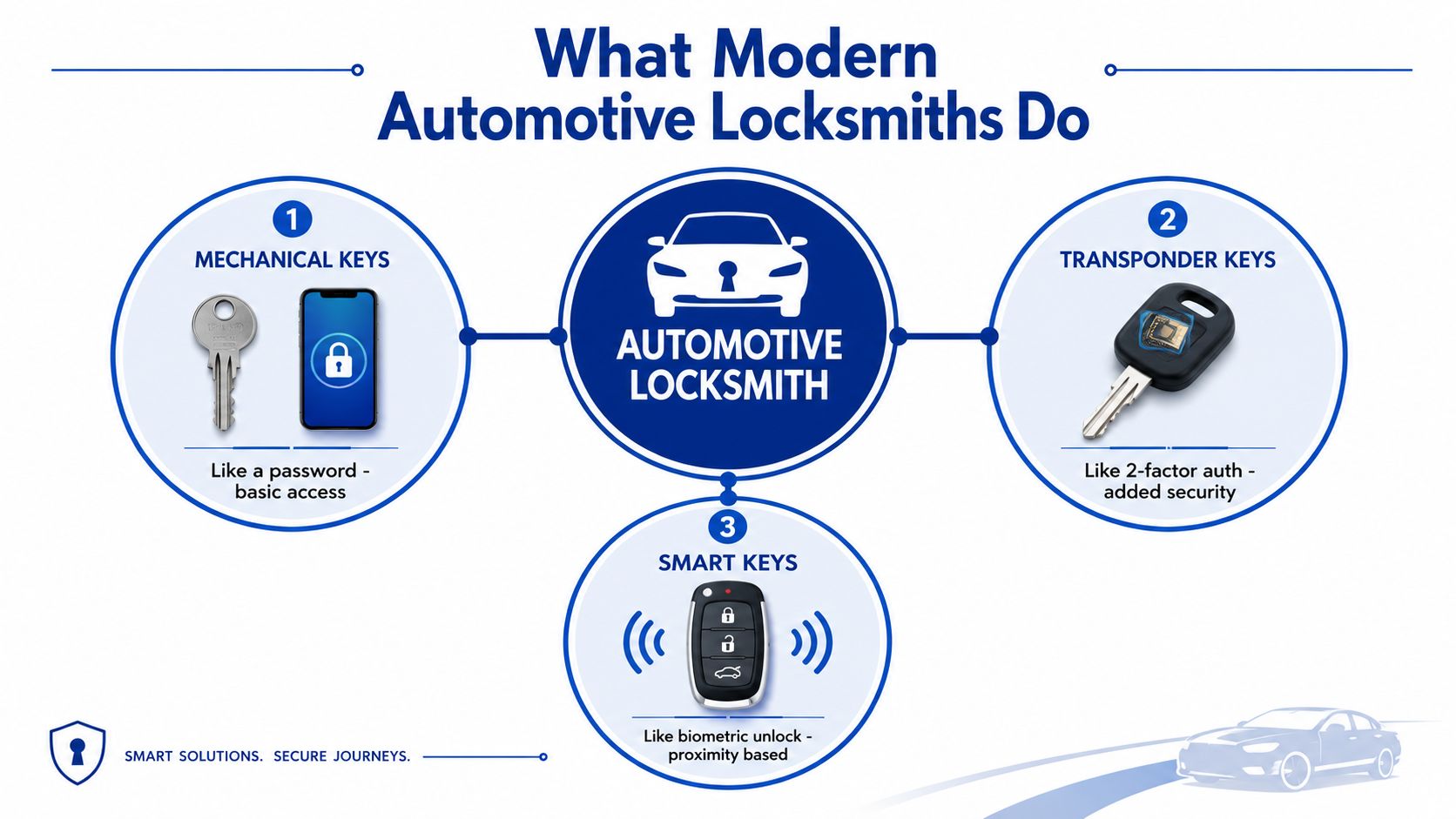
Mechanical, transponder, and smart keys
A mechanical key is the simplest version. It's a physical cut that works the lock, much like a password that opens a basic account.
A transponder key adds a chip. That chip communicates with the vehicle, so the car knows the key isn't just shaped correctly, it's also authorized.
A smart key changes the experience again. The system can recognize proximity and enable push-button access, which makes the service feel more like a biometric entry than a traditional key turn.
A mechanically perfect key still won't start many newer cars unless the chip or fob data is matched correctly.
That's why automotive locksmithing has become part metalwork, part mobile electronics service. The technician isn't just cutting hardware. They're also working with the vehicle's security logic so the driver can leave with a working start solution, not just a door that opens.
Later-model vehicles make that distinction especially important, because the access system can be tied to immobilizer data, remote entry, and fob programming. Once you understand that split, it becomes much easier to judge whether a provider handles your car or only handles the oldest type of lockout.
Immediate Steps During a Car Lockout
The first few minutes matter because panic creates bad decisions. If you're locked out, move to a safe place near the car, stay visible if it's dark, and keep your phone charged enough to make the call. If you're in a busy lot, don't wander far from the vehicle, because the technician will need to find you quickly when they arrive.
What to check before calling
Start with the obvious doors, then the trunk. Sometimes a rear door or hatch is not secured even when the driver's door isn't, and that saves everyone time.
Then gather what the technician will likely need to see. Have your ID and proof of ownership ready, because the locksmith needs to confirm the vehicle belongs to you before opening it or cutting a replacement key.
Avoid DIY attempts that bend weather stripping or scratch paint. Coat hangers, screwdrivers, and improvised wedges often create a second repair bill, and they don't solve transponder or smart-key issues anyway.
For many drivers, the lockout happens after business hours, which matches the industry pattern that 39% of inbound locksmith calls arrive between 6 PM and midnight, with the busiest single hour at 8 PM, according to The Keybot's 2026 industry dataset. That timing is why mobile dispatch and clear expectations matter so much, especially when the problem hits after dinner, during a late shift, or on the way home.
A simple order of operations
- Stay safe first. If the area feels uncomfortable, move closer to lights or people.
- Confirm the exact vehicle. Make, model, year, and whether it's a push-to-start car all help the technician prepare.
- Check for spare access points. Trunk, hatch, or passenger side may be the easiest route.
- Prepare ownership documents. This speeds verification when help arrives.
- Describe the problem clearly. Locked keys inside is different from lost keys or a broken fob.
You don't need to diagnose the car. You just need to avoid making the situation worse and give the locksmith clean information. That keeps the response focused on access, not on fixing damage caused by rushed guesses.
Automotive Locksmith Services Available
On-site automotive service covers more than one kind of failure. Some calls are simple lockouts, while others involve key cutting, broken-key extraction, or programming a replacement fob so the car will start. In a mobile setup, the value is that the technician comes to the vehicle instead of sending the car to a shop first.
The most common curbside jobs
A straightforward door opening is the fastest job category. The technician uses non-destructive entry methods, then verifies that the car opens and closes normally.
A broken-key extraction is different. Here, the problem is a snapped blade in the lock or ignition, so the locksmith removes the fragment before dealing with replacement access.
A code-cut replacement applies when the original key is gone or unusable. The key is cut to the vehicle's code so the profile matches the lock, which is useful when there's no working spare.
Then there's transponder and smart-fob programming, which matters for newer cars. This is the part many drivers overlook until the key turns or the fob lights up but the engine still refuses to start.
Why mobile service changes the experience
Mobile work saves the hassle of arranging a tow just to reach a dealer counter. In many cases, that matters as much as the key itself, because the vehicle is stranded where it sits.
On-site response also fits local service areas better. Mena's Key handles mobile automotive requests across Minneapolis–Saint Paul suburbs such as Brooklyn Center, Bloomington, and Blaine, with 24/7 emergency availability and up-to-date tools for curbside work. For a driver, that means the solution can happen where the problem happened.
The practical split is simple. If the issue is only access, the technician opens the door. If the issue is access plus authorization, the technician also has to deal with the key system. That's why asking whether a provider can handle your exact car matters more than asking whether they “do car locks” in general.
Typical Pricing and Cost Variables
Price is where many car lockout pages get vague, and that's a problem. A stranded driver needs enough detail to decide whether a quote is fair before the truck rolls out. The clearest comparison is between mobile locksmith service and dealer replacement, especially when towing is part of the dealer route.
| Service | Locksmith | Dealer |
|---|---|---|
| Standard transponder key + programming | about $150 to $250 | about $250 to $500 plus towing |
| Smart or proximity fob | about $225 to $350 | about $300 to $700 plus towing |
Those ranges come from an industry cost comparison, and the difference is easy to understand. The locksmith usually comes to the car, while the dealer route can add towing and more overhead. That's why mobile service often becomes the practical choice for lockouts and all-keys-lost situations.
The broader market also gives a sense of the ticket size. One industry review places automobile-related locksmith services at 35–40% of U.S. locksmith industry revenues, and notes a typical professional vehicle lockout at about $75 to $150, with emergency and after-hours calls often higher, according to River City Lock and Key's locksmith stats roundup. A 2026 dataset from The Keybot lists the average automotive lockout ticket at $215, which shows how strongly urgency and after-hours timing can move the final bill.
What changes the final price
- Lockout complexity. A simple service is faster than a broken-key or lost-all-keys call.
- Key type. A plain cut key costs less work than a programmed transponder or smart fob.
- After-hours timing. Late-night, weekend, and holiday service can add surcharges.
- Vehicle system. Push-to-start and immobilizer-equipped cars often require more technical steps.
- Quoted scope. A phone estimate that excludes service fees can look cheap until the technician arrives.
That's why pricing transparency matters more than a generic “free quote” promise. If the provider can explain the variables in plain English before dispatch, you're less likely to get surprised when the work is done.
How to Verify a Trustworthy Locksmith
A stranded driver doesn't need a sales pitch. You need a straight answer, an exact price range, and proof that the technician can work on your vehicle. The fastest way to filter out trouble is to ask the right questions before anyone is on the road.
Practical rule: ask for the full price before service, including the call-out fee and any night or weekend surcharge.
That advice lines up with consumer warnings about locksmith scams, which often start with vague phone estimates that jump after arrival. The FTC advises consumers to ask for an exact price before service, including service-call fees and extra charges tied to time of day or vehicle type. A strong locksmith should be able to answer without dodging.
A quick checklist before you book
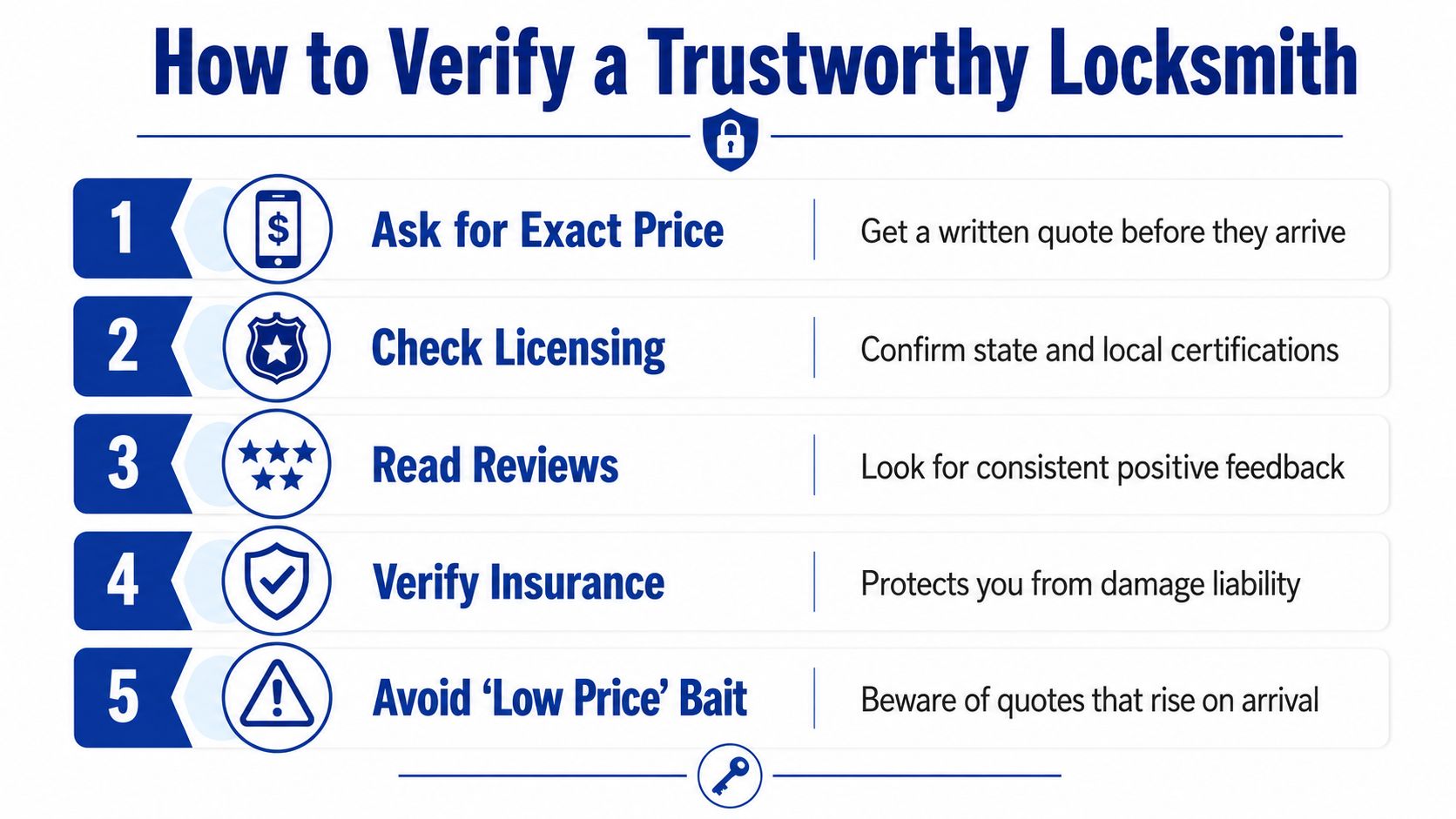
- Ask for Exact Price: Get the quote before dispatch, not after the truck is already outside.
- Check Licensing: Confirm any state or local certification the company references.
- Read Reviews: Look for repeated comments about punctuality, clean work, and fair billing.
- Verify Insurance: Damage coverage matters when the job involves doors, trim, or ignition parts.
- Avoid Low-Price Bait: If the estimate sounds too good to be true, ask what it excludes.
The other test is vehicle knowledge. If the dispatcher can't tell you whether they handle transponder programming, smart fobs, or push-to-start systems, you may be dealing with a generalist rather than a true automotive specialist. The difference matters because a car that opens isn't always a car that starts.
Mena's Key fits the mobile side of this category with phone and online estimates, local Minnesota ownership, and on-site automotive service. If you're comparing options, the key question is simple, can they quote the work clearly and handle your exact car at the roadside.
FAQs and Booking Mena's Key Today
A lot of drivers ask the same questions once the panic drops a little. The first is whether a mobile locksmith can handle push-to-start vehicles on-site. In many cases, yes, as long as the technician has the right tools and the car's key system is supported. The second is whether you need to tow the car first. Usually, no, if the issue is lockout, key cutting, or programming that can be done at the curb.
Another common question is what to have ready before calling. Keep your location, vehicle details, ID, and proof of ownership handy, and describe whether the problem is a lockout, broken key, lost key, or dead fob. That simple detail helps the dispatcher send the right kind of help instead of guessing.
If you want to move from uncertainty to a real quote, use the booking path on menaskey.com for a no-obligation estimate. Mena's Key handles automotive, residential, commercial, and emergency locksmith work in Minnesota, with mobile response across the Minneapolis–Saint Paul area and 24/7 standby for urgent calls.
The simplest next step is to call or book online, share the car's year, make, model, and the symptoms you're seeing, then ask for the full price before dispatch. That gives you a clear answer, a realistic arrival plan, and a service path that fits the actual problem.
If you're locked out or dealing with a key that won't start your car, Mena's Key provides mobile automotive locksmith help across the Minneapolis–Saint Paul area. Visit Mena's Key to request a quote, confirm service for your vehicle, and get help where the car is parked.