Cost to Rekey Locks on House: 2026 Pricing Guide
A typical house rekey costs $75–$300 total, with most homes containing 4–6 locks landing around $110–$220 when the quote combines a $35–$100 service call with $15–$40 per lock. That pricing applies to ordinary residential work, while emergency timing, difficult hardware, and mobile service details can push the final bill higher.
You may be dealing with this right after closing on a Minneapolis home, losing a key, or realizing that a former tenant, contractor, or neighbor might still have access. The locks may work perfectly, but you can't know how many copies of the old key exist. Rekeying solves that access problem without automatically forcing you to buy new locksets.
The important question isn't just the advertised price per lock. The cost to rekey locks on a house depends on the service-call structure, the number and type of cylinders, your scheduling window, and whether the locksmith has to travel across the Twin Cities. Here's how to judge a quote before work starts.
Table of Contents
- Understanding Rekey Pricing Structure
- Rekeying Versus Full Lock Replacement
- What Happens During a Professional Rekey Service
- Factors That Drive Rekey Costs Up or Down
- DIY Rekeying Kits Versus Professional Service
- Minneapolis–Saint Paul Market Considerations
- Making Your Rekey Decision and Next Steps
Understanding Rekey Pricing Structure
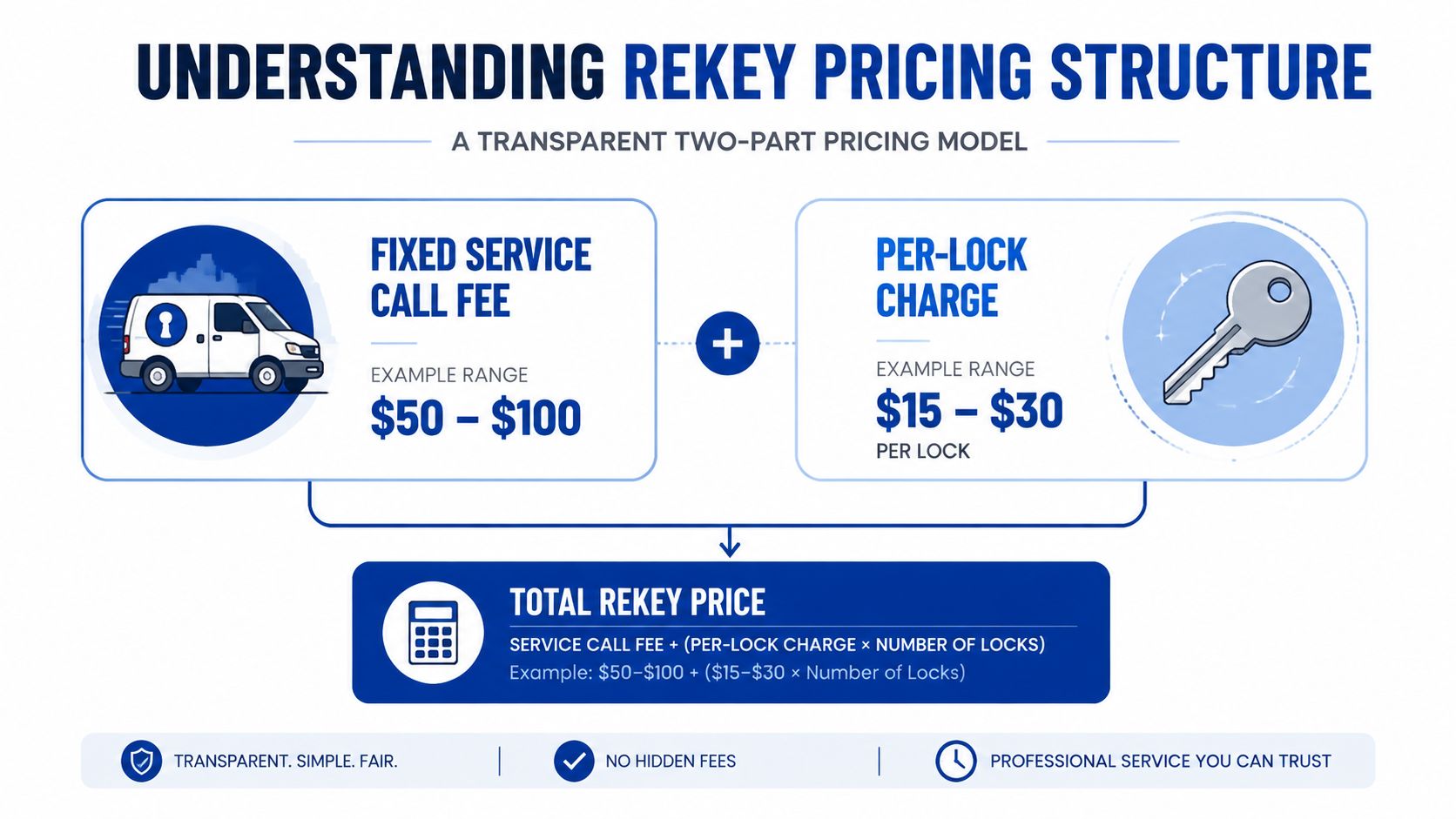
Most locksmith quotes use two charges. The first is a fixed service-call fee, which covers dispatch, travel, arrival, and the technician's initial assessment. The second is a per-lock or per-cylinder charge for opening the lock, changing its internal pin arrangement, cutting or supplying new keys, and testing the finished work.
Independent 2026 pricing guides commonly place the service call around $35–$100, with an additional $15–$40 per lock or cylinder. For a full home with 4–6 locks, that creates a broad total of roughly $75–$300, depending on the hardware and the number of cylinders serviced. See the 2026 locksmith pricing guide for another explanation of how residential service estimates are commonly structured.
Why lock count changes the math
Suppose a locksmith charges one trip fee and then adds a charge for each cylinder. On a single-lock visit, the travel cost is attached to one piece of hardware. On a five-lock visit, that same fixed cost is spread across five pieces of hardware, so the effective per-lock price falls even though the overall invoice rises.
That explains why one lock can commonly total $50–$130, while a complete home with 3–5 or 4–6 locks may land around $100–$300. A guide specifically places a 5–6-lock home around $110–$220, while another lists about $130–$270 for five locks. These ranges aren't contradictory. They reflect differences in lock type, labor, travel, and how each provider packages the visit. The underlying figures come from consumer rekey pricing data.
| Job size | Typical pricing logic |
|---|---|
| One lock | The service fee is concentrated on one cylinder, so the total per lock is high |
| Several locks | The fixed travel cost is distributed across the job |
| Whole-house visit | Several cylinders can be handled in one appointment, lowering the effective unit cost |
What to ask before accepting the quote
Ask whether the estimate includes the service call, every cylinder, new keys, and testing. Also confirm whether a double-cylinder deadbolt counts as one lock or two cylinders, because locksmiths may price hardware by the work performed rather than by the number of doors.
My recommendation is straightforward: if you need more than one exterior lock changed, bundle the work into one scheduled visit. Calling separately for the front door, back door, garage entry, and side door usually wastes the fixed dispatch charge. Gather every lock you want keyed alike before requesting the estimate.
Rekeying Versus Full Lock Replacement
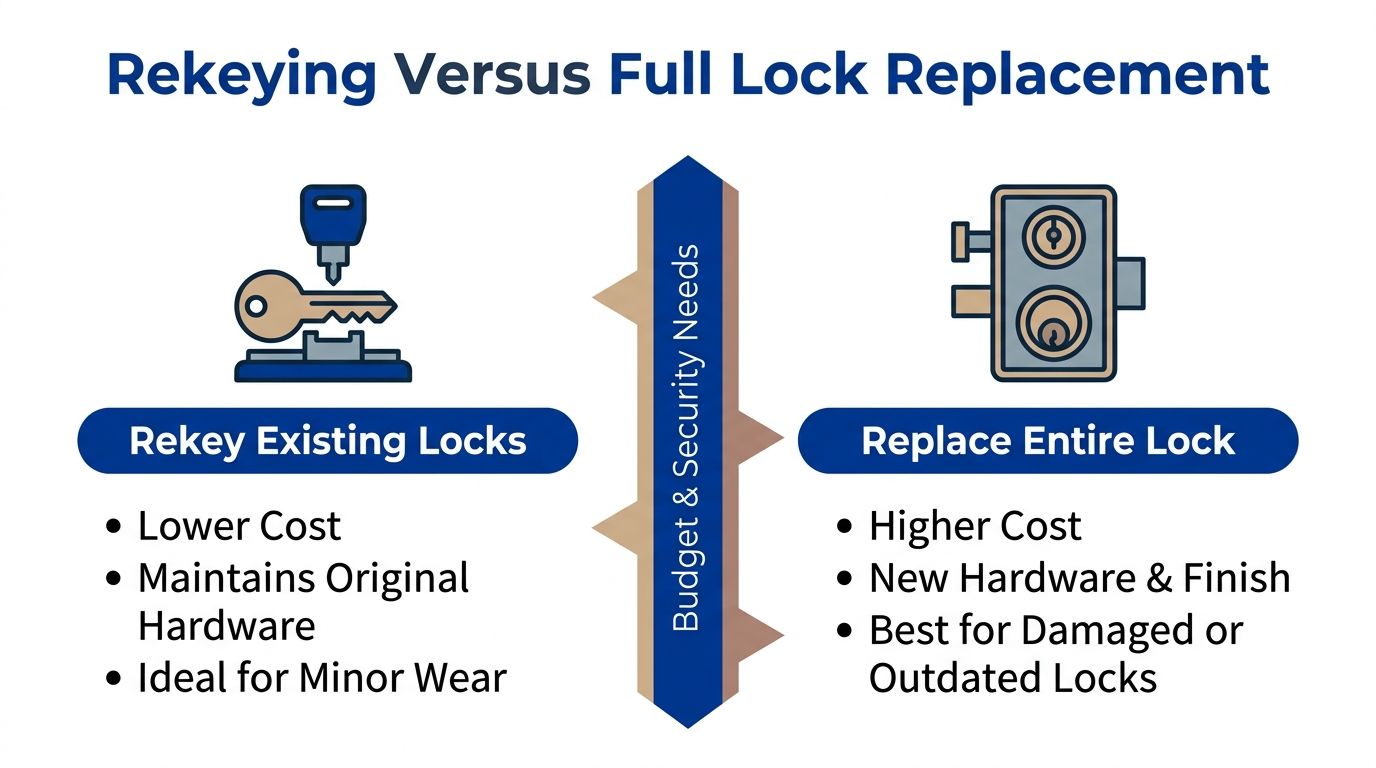
Rekeying changes the internal pin configuration inside an existing lock cylinder. The lock body, exterior trim, finish, and door preparation remain in place, but the old key stops operating the cylinder and a new key works instead.
Replacement removes the existing lockset and installs new hardware. That gives you a new cylinder, new keys, and potentially a different security grade, finish, or function. It also creates more hardware and installation cost, which makes replacement unnecessary when the current lock is sound.
Choose rekeying when the hardware is healthy
Rekeying is the sensible choice after buying a previously occupied home, losing control of a key, changing roommates, finishing work with contractors, or taking over a rental property. In each case, your main problem is who can operate the existing lock, not whether the lockset belongs on the door.
It also makes sense when several compatible locks need to operate from one key. A locksmith can often rekey the cylinders during one visit, provided the hardware can accept the same key system and remains in serviceable condition.
Choose replacement when the lock itself is the problem
Replacement earns its cost when the deadbolt sticks, the cylinder is loose, the key repeatedly binds, the housing is damaged, or the hardware is outdated for your security goals. It also makes sense when you want a smart lock, a different lever or knob style, a new finish, or a hardware platform that supports features the existing lock can't provide.
Use this decision test:
- Access control problem: Rekey the existing lock.
- Mechanical failure: Repair or replace the hardware.
- Security upgrade: Replace with suitable new hardware.
- Appearance or function change: Replace.
- Several usable locks after a move: Rekey first.
A professional should explain why replacement is necessary instead of treating every rekey request as a sales opportunity. The lock replacement service option is appropriate when the hardware is damaged, worn, or no longer matches the home's security requirements.
What Happens During a Professional Rekey Service
A proper rekey isn't just cutting a different key. The locksmith first checks the doors, identifies the lock brands and cylinder types, and confirms which locks should work from the new key. This inspection catches problems such as a misaligned strike, a damaged cylinder, or a lock that shouldn't be rekeyed without repair.
The technician then removes the cylinder or lock hardware as needed. For a common pin-tumbler cylinder, the locksmith takes out the old pins and installs a new pin combination that matches the replacement key. The original lock remains on the door, but the old key no longer matches the new pin arrangement.
The service sequence
- Inventory the hardware. The technician identifies each exterior lock and determines whether the cylinders can be keyed alike.
- Disassemble carefully. The cylinder is removed or opened with the correct tools, while springs, pins, retainers, and small components are kept in order.
- Set the new combination. Pins are selected and installed to match the new key's cuts.
- Cut or verify keys. The new key must operate smoothly without excessive force or binding.
- Reinstall the cylinder. The locksmith returns the hardware to the door and checks the latch and deadbolt alignment.
- Test both key sets. The new key should work consistently, and the old key should fail to operate the rekeyed cylinder.
Quality check: The locksmith should test the lock with the door open and closed. A cylinder can turn freely while the door is open yet bind when the bolt enters a misaligned strike plate.
The disruption is usually limited to the technician working at each door. You should expect brief periods when a lock is disassembled and unavailable, but the job shouldn't require tearing into walls or replacing functioning door frames. The work becomes more involved when the home has high-security cylinders, restricted key systems, smart hardware, or locks from incompatible manufacturers.
Before the locksmith leaves, test every rekeyed door yourself. Confirm that the new key works from both sides where applicable, the deadbolt throws fully, and the old keys no longer provide access.
Factors That Drive Rekey Costs Up or Down
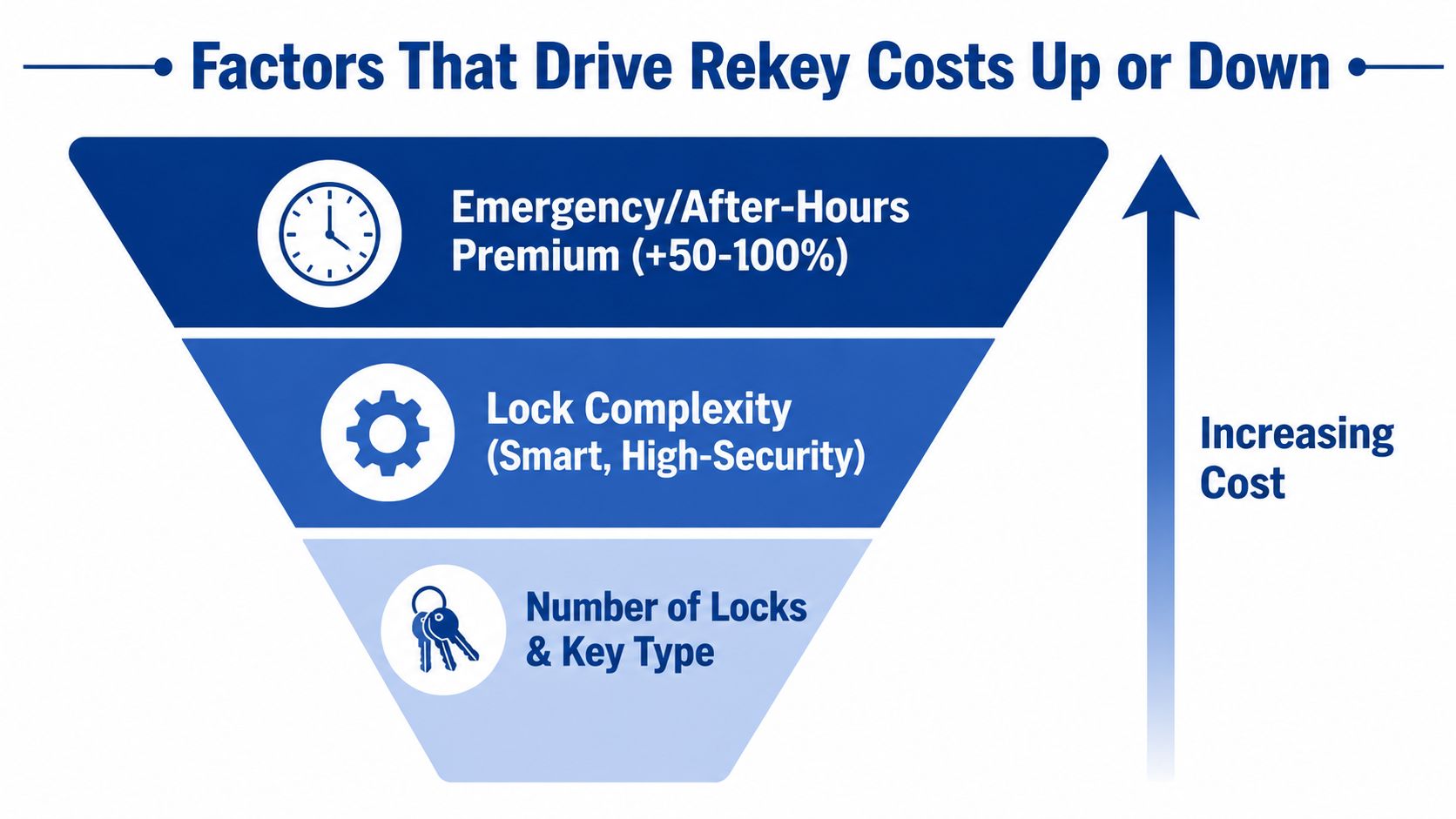
The number of locks matters, but it isn't the only variable. Two homes with the same number of doors can receive very different quotes if one needs a daytime appointment with standard deadbolts and the other needs urgent service on specialty hardware.
Timing can change the invoice
Emergency and after-hours calls generally cost more because the locksmith must rearrange dispatch, travel outside normal scheduling patterns, and respond when routine appointments aren't available. If a lost key presents an immediate access or security risk, paying for urgent service may be justified. If the locks work and you want to secure a recent purchase, book a regular appointment instead.
The best cost-control move is simple: don't turn a routine rekey into an emergency call. Ask for the regular service window and whether nights, weekends, holidays, or same-day dispatch use a separate rate.
Mobile service carries a travel component
A shop visit can be efficient when you can safely remove and transport compatible cylinders. Most homeowners, however, need the locksmith to inspect door alignment, service the locks in place, and make sure every finished cylinder operates correctly on the actual door.
In Minneapolis and Saint Paul, travel across suburbs can affect scheduling and the service fee. Tell the dispatcher the property's city, the number of doors, and whether the home is in a dense neighborhood, a distant suburb, or a difficult-to-access location. A clear location helps prevent a vague phone estimate from becoming a surprise onsite charge.
Hardware complexity affects labor
Standard residential pin-tumbler locks are usually more straightforward than high-security cylinders, restricted key systems, mortise locks, interconnected locksets, or smart locks. Smart hardware may involve electronic configuration in addition to mechanical work, while specialty cylinders may require brand-specific tools or parts.
You control some cost drivers:
- Schedule: Choose normal hours when the situation isn't urgent.
- Bundle: List every cylinder before the technician arrives.
- Describe hardware: Send photos or provide the brand and lock type.
- Request scope: Ask what the service call includes.
- Avoid assumptions: Confirm whether garage, patio, mailbox, and interior locks are part of the quote.
DIY Rekeying Kits Versus Professional Service
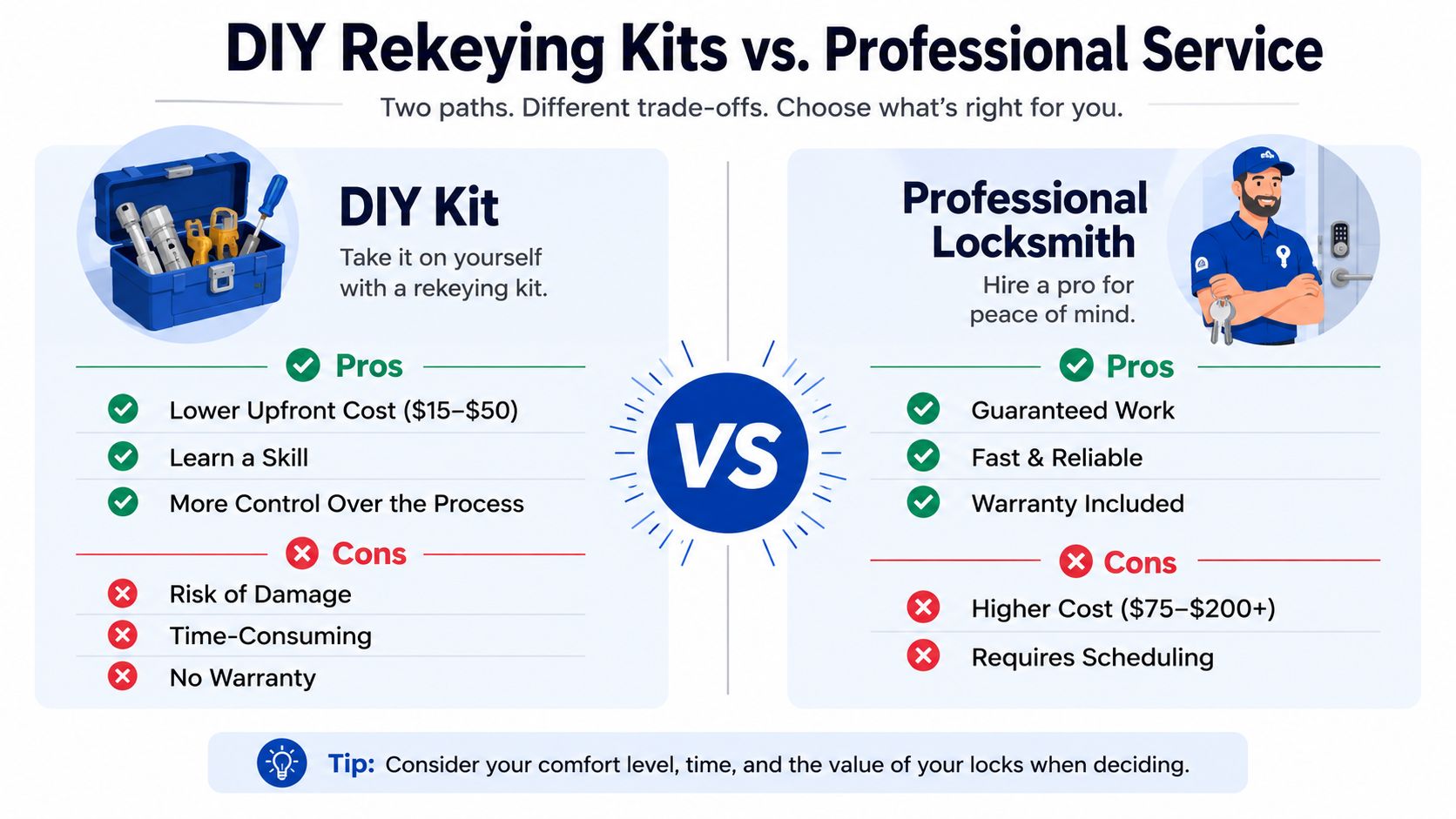
DIY kits appeal to homeowners because the upfront purchase is low. Hardware-store kits commonly sell for $15–$50, but that price buys a kit, not guaranteed results. You still need compatible locks, a clean work area, patience, and the ability to keep tiny springs and pins organized.
A standard rekey kit may include a plug follower, pin tweezers, a key gauge, replacement pins, and a collection of tools for a particular lock family. Compatibility matters. A kit designed for one brand may not contain the right pins or tools for another cylinder, and a smart lock or high-security system may not be a realistic DIY candidate.
When a kit makes sense
DIY rekeying can be reasonable if you're comfortable with small mechanical parts, own standard compatible cylinders, and can work on a spare lock before touching the only entry door. Remove the cylinder, follow the kit's pinning chart, and keep the plug follower engaged so the springs and top pins don't spill into the housing.
The risk isn't limited to inconvenience. A misplaced pin, damaged retaining clip, incorrect key combination, or scratched cylinder can leave the lock unreliable. If the lock must then be repaired or replaced, the original savings can disappear.
When the professional premium is justified
Hire a locksmith when you need several doors keyed alike, the locks are unfamiliar, the home has high-security or electronic hardware, you need the work completed quickly, or you can't tolerate a lockout caused by a failed repair. A professional also tests the finished work in the door, not just on a workbench.
| DIY kit | Professional service |
|---|---|
| Lower upfront purchase price | Includes labor, diagnosis, and onsite testing |
| Requires compatible hardware and careful handling | Handles mixed lock conditions and complex cylinders |
| You carry the risk of damage or rework | A qualified technician assumes responsibility for the service |
| Works best for a controlled, nonurgent project | Better for multiple doors or time-sensitive security needs |
Watch the process before attempting your first job:
My view is practical: DIY is fine as a learning project on a replaceable standard cylinder. It isn't the right place to save money when the lock protects your primary entrance or when several doors must work reliably from one key.
Minneapolis–Saint Paul Market Considerations
Twin Cities homeowners should treat a rekey quote as a mobile service estimate, not just a price multiplied by the number of doors. Minneapolis, Saint Paul, and surrounding suburbs have different travel patterns, parking conditions, housing stock, and appointment demand. A technician may also encounter older mortise locks, narrow door clearances, storm-door interference, or hardware installed through multiple remodels.
Start the conversation with a complete inventory. Tell the locksmith how many exterior doors have keyed cylinders, whether the garage entry has a separate lock, and whether you want one key for everything. Send photos of the face of each lock and the edge of the door if the provider accepts images. This gives the dispatcher more information than saying, “I need my house rekeyed.”
Questions that protect your budget
Ask for the service-call fee, the charge for each cylinder, the treatment of double-cylinder hardware, and any separate emergency or after-hours pricing. Confirm whether new keys, cylinder testing, and minor adjustment are included. A legitimate provider should explain the scope before starting work and should tell you if replacement is necessary because of damage or incompatibility.
Local response can vary with the time of day and the provider's current route. Moving season, severe weather, and periods when homeowners are addressing security concerns can make appointments less flexible, so a nonurgent rekey deserves advance scheduling rather than a last-minute call.
Verify the person at your door
Look for a real business identity, a marked service vehicle, technician identification, clear contact information, and an estimate that matches the phone conversation. Be cautious if a provider advertises an unusually low entry price but refuses to explain the service-call structure, immediately insists on drilling, or pushes replacement without inspecting the lock.
Mena's Key operates as a locally owned Minnesota locksmith with mobile residential service across the Minneapolis–Saint Paul area. Its stated services include rekeying, lock installation, repair, lockout assistance, emergency response, and phone or online estimates. Treat that information as a starting point for a quote, then compare the written scope with other local providers.
Making Your Rekey Decision and Next Steps
Rekeying is usually the right first move when the locks work, the concern is unknown key access, and you want several doors controlled by a new key. Replacement is the better answer when the hardware sticks, shows damage, lacks the features you need, or can't support the key system you want.
Use this checklist before booking:
- Count cylinders: Include every exterior lock and note any double-cylinder hardware.
- Collect details: Photograph the lock faces and record visible brands.
- Choose timing: Schedule routine work during normal hours when possible.
- Request scope: Get the service fee, per-lock charge, key costs, and replacement conditions in writing.
- Prepare keys: Gather old keys, but don't assume every old copy is accounted for.
- Test completion: Verify every new key and confirm the old keys no longer work.
If you want electronic access later, review smart lock installation options separately from a basic rekey. Smart hardware can add convenience, but it should match the door, frame, household habits, and backup-entry plan.
After the service, keep the new keys organized, lubricate only with a product suitable for the lock manufacturer, and address door alignment if the deadbolt drags. Recheck the hardware after repairs, tenant changes, or any event that puts a key outside your control.
Mena's Key provides mobile residential rekeying, lock repair, replacement, and emergency locksmith service across the Minneapolis–Saint Paul metro area, with estimates available by phone or online. For a clear quote based on your actual lock count and hardware, visit Mena's Key and request service before a routine rekey becomes an emergency.