Emergency Replacement Car Keys: Your Guide to Fast Service
If you need emergency replacement car keys, a mobile locksmith can handle 90% of lost key situations on-site and often costs 40 to 70% less than a dealership for equivalent replacement and programming. The first thing to do is confirm you really don't have a spare, then gather your ID, registration, and VIN so whoever helps you can verify ownership without delay.
Losing your keys has a way of stopping the whole day at once. You check the cup holder, the floor mat, yesterday's jacket, the shopping bag, then check all of them again because your brain still thinks the keys must be nearby.
Most of the time, this is fixable faster than people expect. The actual problem isn't just getting a new key cut. It's figuring out who can solve your specific key problem today, without wasting hours on the wrong call. If your key was lost, one path usually makes sense. If it was stolen, the security steps change. And if you drive a newer push-button-start vehicle, the answer depends on whether your locksmith has the right programming capability or whether the dealer is the only practical route.
Table of Contents
- That Sinking Feeling When Your Car Keys Are Gone
- Your First 15 Minutes What to Do Right Now
- Comparing Your Replacement Options Locksmith vs Dealer vs DIY
- What to Expect During the On-Site Service Call
- Important Security Steps and Future Prevention
- Your Go-To Emergency Locksmith in Minneapolis-St. Paul
That Sinking Feeling When Your Car Keys Are Gone
It usually starts in a parking lot. You've finished work, loaded groceries, or buckled a tired kid into the back seat. Your hand goes to the pocket where the keys should be, and there's nothing there. That's when people start making rushed decisions. They pry at the door, call the first number they find, or assume the dealership is the only answer.
That panic is understandable, but it's also where expensive mistakes happen.
A missing car key problem usually falls into one of two buckets. You're either locked out with the key inside, or the key is gone completely. Those aren't the same job. One may only require safe entry. The other may require entry, decoding, cutting, and programming before the car will start again.
Practical rule: Don't decide based on stress. Decide based on your key type, your vehicle age, and whether the key is lost or stolen.
There are also two different service routes people confuse all the time. A mobile locksmith comes to the vehicle and may be able to cut and program the replacement on-site. A dealership can be necessary for some newer encrypted smart keys, but it often means more waiting, more logistics, and sometimes towing.
The goal right now is simple. Stabilize the situation, avoid damaging the car, and choose the service path that matches the key system your vehicle uses. That's what gets you back on the road without turning one bad moment into a bigger bill.
Your First 15 Minutes What to Do Right Now
Before you call anyone, slow the situation down. The next few minutes matter because they determine whether this becomes a simple service call or a messy one.
Search once, thoroughly
Do one serious search, not six panicked half-searches.
Check the obvious spots first, then the places people miss: between the seat and center console, inside bags, under the car, the trunk lip, jacket linings, and the last place you paid for something. If you were at home, check yesterday's clothes and the door you used last.
If you have another driver in the household, call and ask about the spare before you do anything else. A lot of emergency calls happen because the spare exists, but nobody checked.
Gather ownership documents before the call
If the key is gone, get your paperwork in hand. The fastest calls are the ones where the driver is ready to prove the vehicle is theirs.
Have these ready:
- Driver's license: The name should match the vehicle records or make sense for the driver's use of the vehicle.
- Registration: This is commonly used to verify ownership on-site.
- VIN: You'll usually find it at the base of the windshield on the driver side or on your registration and insurance paperwork.
Mobile locksmiths are often the right first call because they can verify ownership on-site using a driver's license and registration, then cut and program a new key without towing in 90% of lost key scenarios, according to this overview of emergency car key service. If you're trying to understand what help looks like in practice, this guide on how a locksmith for cars helps in emergency situations gives a useful local example.
Check your safety before your schedule
If you're in a dark lot, stranded on a shoulder, or parked somewhere that doesn't feel safe, deal with that first. Move to a lit area if you can do it without leaving the vehicle unsecured. If you're with children, older family members, or in bad weather, that changes the urgency.
If the location is unsafe, say that clearly when you call. The service provider needs to know whether this is just inconvenient or a genuine safety issue.
A calm, complete first call saves time. Tell them the year, make, model, whether you have push-button start or a metal key blade, whether all keys are gone, and whether you believe the key was lost or stolen. Those details matter more than is often realized.
Comparing Your Replacement Options Locksmith vs Dealer vs DIY
The right option depends on the key technology, how fast you need the car back, and whether someone can program your vehicle on-site.
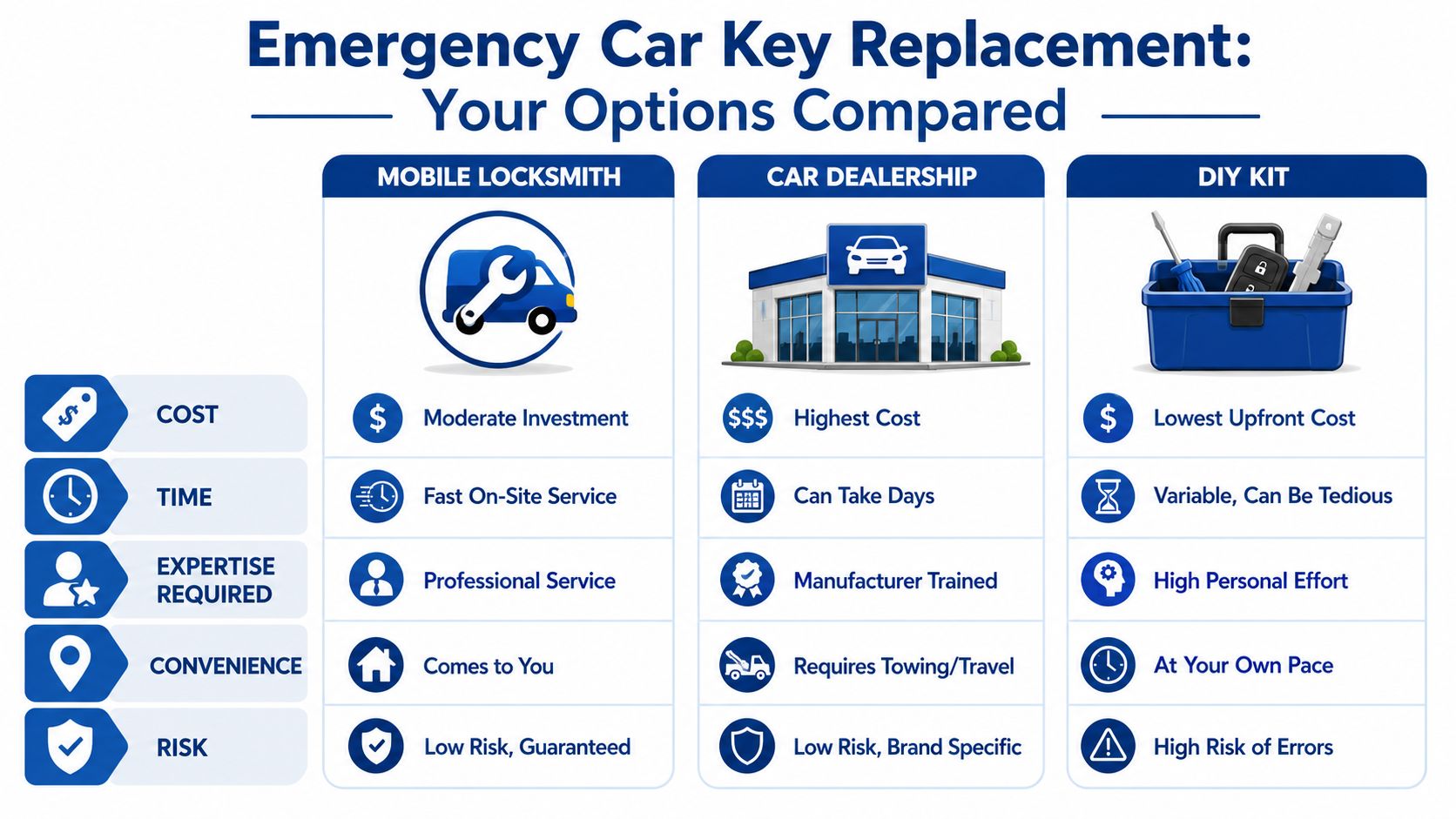
Here's the cost picture based on the verified ranges available.
| Key Type | Mobile Locksmith Cost | Dealership Cost | Typical Time (On-Site/At Dealer) |
|---|---|---|---|
| Basic Metal Key | $50 to $150 | Qualitatively higher in many cases | Often same visit on-site |
| Transponder Key | $150 to $250 | Qualitatively higher in many cases | Often same visit on-site if supported |
| Fob/Remote Key | $200 to $450 | Qualitatively higher in many cases | Varies by vehicle and programming support |
| Smart/Proximity Key | $250 to $600 | Often the highest cost, and luxury keys frequently exceed $600 | Varies widely. Some can be done on-site, some require dealer tools |
The mobile-versus-dealer cost gap is real. This breakdown of emergency car key replacement work states that mobile locksmith services cost 40 to 70% less than dealerships for equivalent replacement and programming, and that vehicles over five years old can often avoid enough towing and parts cost to save $100 to $300 in total emergency expense.
Mobile locksmith
This is usually the most efficient option when the provider has the right tools for your vehicle.
A capable automotive locksmith can verify ownership, gain entry if needed, decode the lock, cut the blade, and program the chip or remote at the car. That avoids the dead time of arranging transport and waiting in a dealer queue. For Twin Cities drivers dealing with newer systems, this page on smart key solutions and modern automotive locksmith services shows the kind of vehicle key work a mobile provider may offer.
Where drivers get tripped up is assuming every locksmith can do every smart key. That's not true. Some advanced transponder keys, switchblades, and smart keys need equipment many local shops don't carry.
Car dealership
The dealership is the safer bet when your vehicle uses a newer encrypted smart key system that independent programming tools can't handle.
That doesn't mean the dealer is always the best first call. It means the dealer is sometimes the necessary second step. If the vehicle requires proprietary programming access, that's where you end up. This issue is why many drivers waste time calling around after being told a tow is unavoidable.
The same source above notes that success for on-site full replacement drops on newer models with encrypted smart keys, and 30% of modern smart key emergencies still require towing to a dealer for dealership-level diagnostics and programming.
DIY options
DIY sounds cheap until it goes wrong.
If you're talking about a plain old metal key for an older vehicle, a basic duplication route may be possible if you already have a working key. That is not the same as an all-keys-lost emergency. Once immobilizers, transponder chips, rolling codes, remote boards, or proximity systems enter the picture, do-it-yourself replacement becomes a gamble.
The fastest way to make this worse is to buy a random key online and hope it programs itself.
DIY lockout attempts are even riskier. Coat hangers, wedges from the garage, and improvised tools often damage seals and trim. If your vehicle is modern enough to need programming, the lowest-cost route upfront can still leave you paying a professional afterward.
What to Expect During the On-Site Service Call
When the van pulls up, the process should feel methodical, not mysterious.
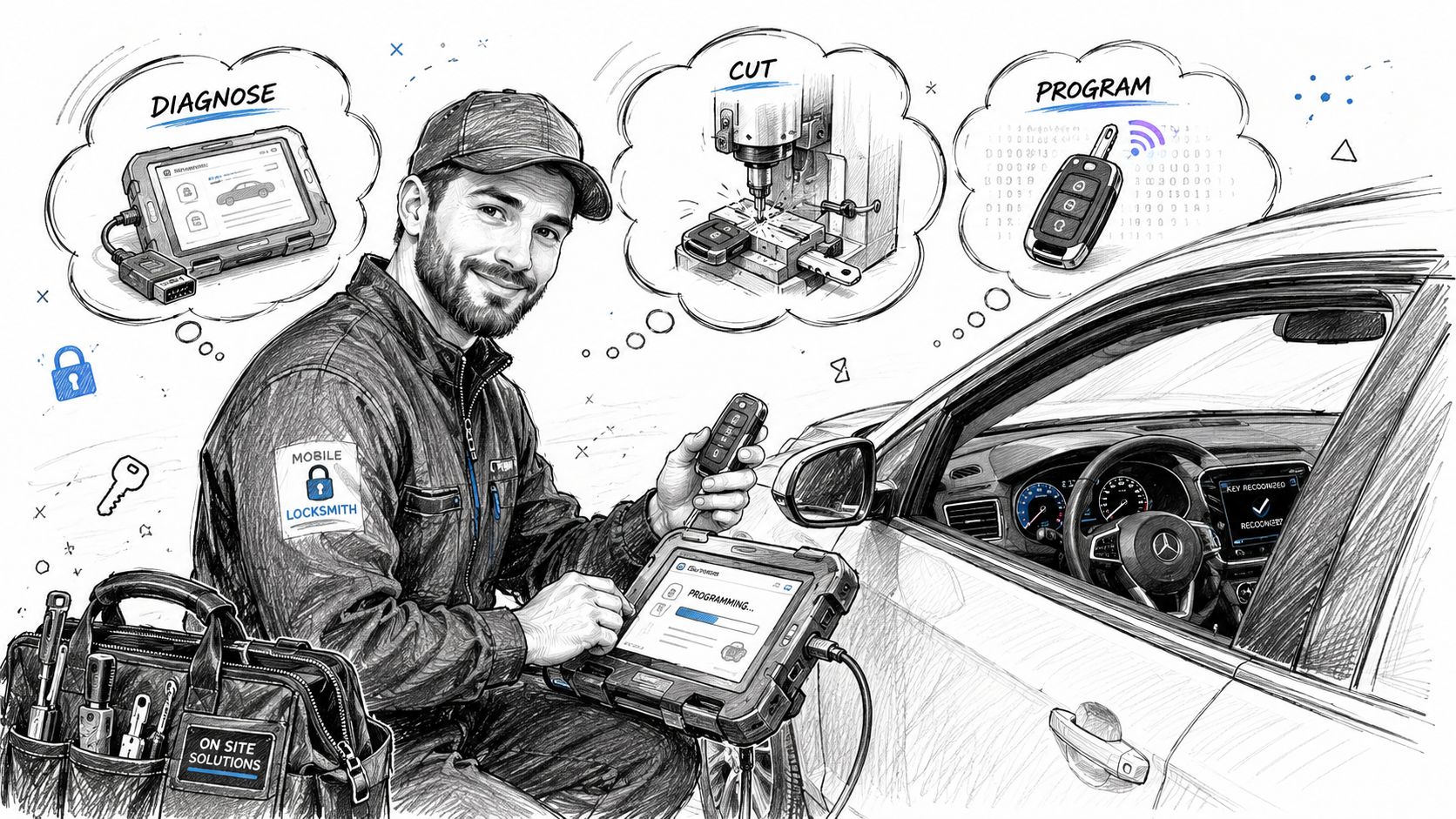
A professional starts with the paperwork. Before any lock is touched, you'll usually be asked for your ID, registration, and vehicle details. That protects you, protects the technician, and avoids programming the wrong vehicle with the wrong data.
After that, the locksmith confirms what job this is. Locked keys in car. All keys lost. Broken key. Dead fob with mechanical access still available. Those are different workflows.
How entry usually happens
For lockouts, professional entry is built around avoiding damage. This 24-hour auto locksmith explanation reports a 96% non-destructive entry success rate, with typical arrival in 20 minutes and opening the vehicle in about 8 minutes using tools such as air wedges, long-reach tools, and Lishi lock picks.
That's why a trained locksmith doesn't reach for a coat hanger.
The air wedge creates controlled space without forcing the door frame. A long-reach tool can manipulate the interior lock or handle. On vehicles where decoding and precision picking make more sense, a Lishi tool may be used to read and work the lock directly.
A good lockout should end with the door open and the weatherstripping, frame, and glass seals still intact.
If you want to see the kind of work involved, this clip shows the hands-on side of vehicle key and lock service:
How the new key gets made
If all keys are gone, the job moves beyond entry. The locksmith may decode the lock to determine the proper cut, then use a key machine to cut the blade. If the vehicle uses a transponder or remote system, the next step is programming so the immobilizer recognizes the new key.
This is the point where the difference between “has key blanks” and “can finish the job” becomes obvious. Proper programming has to match the vehicle's system. A sloppy generic approach can leave you with a key that turns but won't start the car.
In a well-run service call, the technician tests every function before leaving. That includes door operation, ignition or push-start recognition, and remote buttons if the replacement includes them.
Important Security Steps and Future Prevention
A lot of drivers say they lost the key when what they really mean is they don't know where it went. That distinction matters.
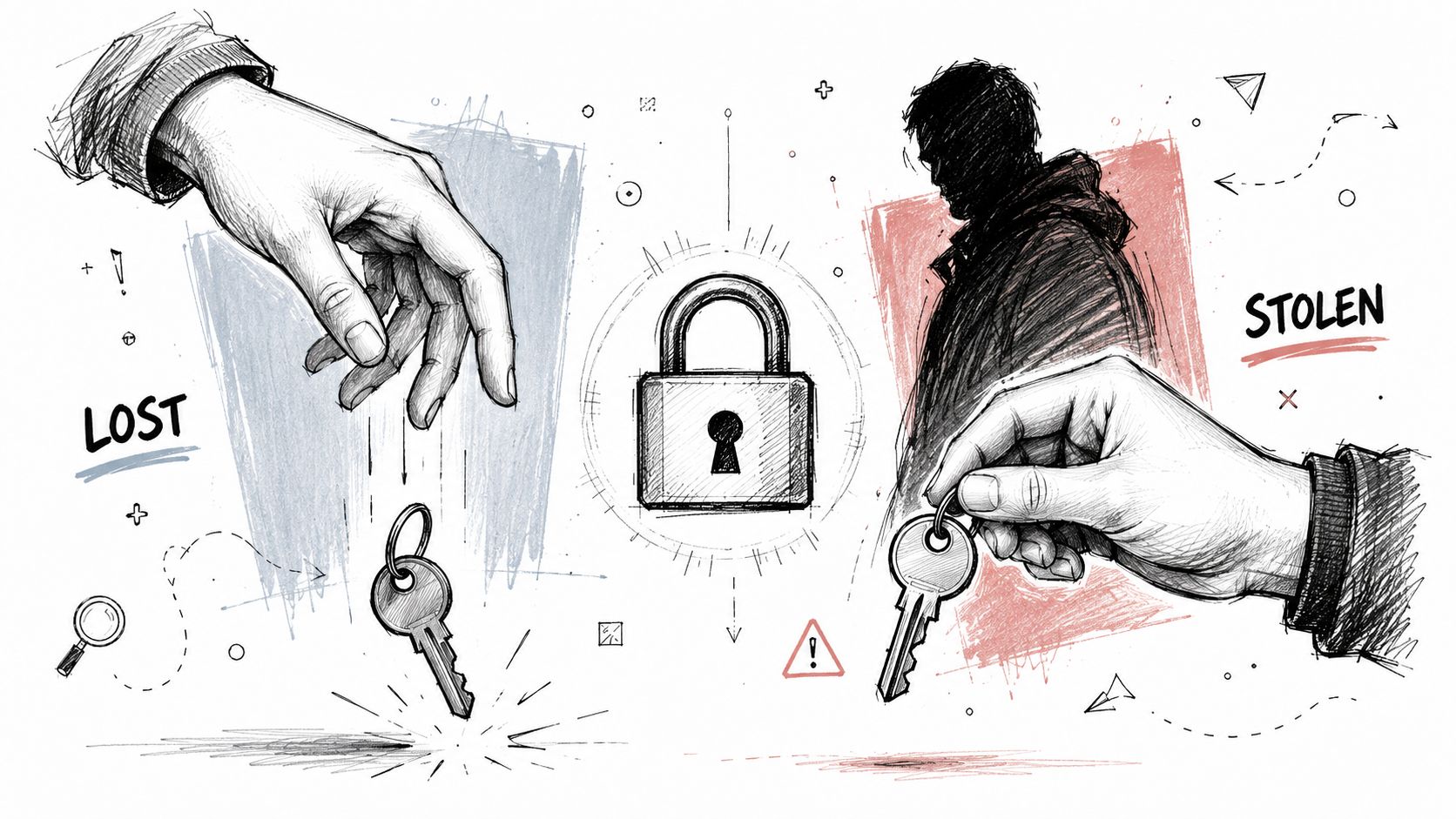
If the key slipped out of your pocket somewhere random, replacement is mainly a convenience and access problem. If you suspect it was stolen, dropped with identifying information, or taken along with something that shows where you live or what you drive, it becomes a security problem.
Lost key versus stolen key
This is the part most generic advice skips.
If a key was stolen, replacing it isn't enough. This security guidance on what to do if you lose your keys says owners should ask the locksmith or dealership to re-key or reprogram the vehicle's immobilizer system to invalidate the stolen key's code. That step cuts off the stolen key's ability to start the car.
If theft is possible, also:
- File a police report: Especially if the key was taken from a bag, jacket, workplace, or shared space.
- Notify insurance if appropriate: Some situations are worth documenting right away.
- Remove assumptions: Don't tell yourself “it's probably just misplaced” if the circumstances don't add up.
If the wrong person has your key, speed matters less than disabling that key.
A new key gets you moving. Reprogramming protects the vehicle.
How to avoid doing this again
Once the immediate problem is solved, do one thing that lowers the odds of repeating it.
A few practical habits work well:
- Make a spare before the next emergency: It's cheaper and less stressful when you're not stranded.
- Keep keys separate from identifying paperwork: Don't make it easy for a thief to match car, address, and access.
- Use one home location: Bowl, hook, tray, drawer. One place, every day.
- Add a tracker if that fits your routine: It won't prevent every loss, but it does cut down on blind searching.
- Replace weak fob batteries early: Some “lost key” calls begin with a dead remote and a locked car.
Good prevention isn't complicated. It's boring, repeatable habits that keep a small problem from becoming a roadside one.
Your Go-To Emergency Locksmith in Minneapolis-St. Paul
If you're in the Twin Cities, what matters most is finding a mobile service that can come to you, verify ownership, and tell you whether your vehicle can be handled on-site or needs dealer-level programming.
Mena's Key is one local Minnesota option for that kind of work. The company provides mobile locksmith service across the Minneapolis-Saint Paul area, including automotive lockout help and emergency response, with scheduling and estimates handled by phone or online. If you're in Saint Paul and need a local starting point, their page on emergency locksmith services in Saint Paul outlines the type of mobile support available.
When you make the call, give the technician useful information right away:
- Vehicle details: Year, make, model.
- Key type: Metal key, transponder, remote fob, or push-button smart key.
- Situation: Locked out, all keys lost, broken key, or possible theft.
- Your documents: ID, registration, and VIN ready to go.
That last point saves more time than people think. A locksmith can only move as fast as the verification and programming process allows. If you're organized, the job moves faster. If the vehicle has an advanced smart key system, an honest provider should tell you quickly whether they can finish it on-site or whether the dealer is the right move.
If you're stuck right now and need help with emergency replacement car keys in Minneapolis or Saint Paul, contact Mena's Key for mobile locksmith service, clear estimates, and on-site assistance. Have your ID, registration, VIN, and vehicle details ready so the call can move as quickly and safely as possible.
Crafted with Outrank