Emergency Locksmith Near Me: What to Do First
You're standing outside a door that won't open, or sitting in a car that's locked itself with the keys inside, or staring at a storefront with business inside and no way to get in. The clock says late, the phone battery says low, and the first instinct is usually bad: call the first result, accept the first price, hope the problem solves itself. Don't do that. Use a simple triage sequence, stabilize the situation, verify the company, then dispatch, and you'll avoid most of the mess people run into when they search Emergency Locksmith Near Me in a panic.
Table of Contents
- It Is 11 PM and You Are Locked Out
- How to Verify an Emergency Locksmith Before You Let Them Dispatch
- What to Actually Say When You Call
- What Happens When the Technician Arrives
- Pricing Questions That Protect You From Surprise Bills
- Why a Local Mobile Locksmith Beats a Call Center in an Emergency
- Quick Reference You Can Pull Up on Your Phone
It Is 11 PM and You Are Locked Out
A parent is standing outside a house with a sleeping child on the other side of the door. A driver is staring through a car window at keys sitting on the seat. A shop owner is looking at a deadbolt on an office door after closing time. Different scenes, same problem, you need access now, and you need to stop making it worse.
First, slow the panic down
Check whether anyone is in danger on the other side of the door. If a child, older adult, tenant, or employee is inside and cannot safely wait, treat that as urgent and call immediately. If nobody is at risk, look for a secondary entry, a spare with a trusted neighbor, or a simple mistake like a back door you forgot.
Practical rule: if you can solve it without force in the next few minutes, do that first. Forced entry turns a lockout into a repair job.
Keep your ID, proof of residence, or business information close by. A technician may ask for it before opening anything, especially in an apartment, office, or rental unit. That is normal, and it protects you as much as it protects the property.
Don't turn a lockout into damage
Do not climb through a window unless there is a genuine safety issue. Do not pry the door with a screwdriver, credit card, or kitchen tool. Those shortcuts crack frames, bend latches, and can leave you paying for more than a simple entry job.
If the situation can wait until morning, say so and save the after-hours call. If it can't wait, write the problem down in three lines before you dial: what happened, where you are, and what kind of lock or vehicle you're dealing with. That keeps the call clear and cuts the rambling that slows dispatch.
For home entry help, the service request at Mena's Key lock out service is the kind of page people should look for only after they've already decided they need help, not before they've checked the basics.
How to Verify an Emergency Locksmith Before You Let Them Dispatch
The first Emergency Locksmith Near Me result is not the one you should trust by default. Lockouts make people rush, and that is exactly when bad operators get through the door. Verify the shop first, then let them dispatch.
Use a two-minute screening script
Ask these questions in order. Do it plainly.
- Company name and local address. You want a real business footprint, not just a name and a phone line.
- Recent reviews on more than one platform. A single polished profile is easy to fake. A pattern across platforms is harder to fake.
- State-required licensing and active insurance. If they cannot confirm both, move on.
- Written estimate before arrival. Ask for the price structure in writing, not a vague promise.
- Technician name and vehicle description. If the person on the phone cannot tell you who is coming, that is a problem.
A generic 800 number that sends you into a call center is a warning sign, especially if the person on the phone will not name the technician or local coverage area. An unmarked vehicle is another warning sign. So is a quote that changes the second the door opens.
Know what a real emergency provider can answer
A legitimate shop should tell you whether it handles residential, automotive, commercial, or office access without hesitation. If you are dealing with a midnight apartment lockout, a storefront problem, or a car lockout, you want a provider that says exactly what it can do on-site.
You also want confirmation that the shop is open when you need it. If the issue happens after hours, check a clear guide to whether locksmiths are 24/7 and make the dispatcher say that the company can handle your call right now. A real emergency provider should not stumble over basic availability.
The safest path is to ask for documentation before you commit. The consumer guidance at HomeAdvisor's emergency locksmith guide points readers toward trusted directories, review checks, active insurance, and written estimates for a reason. In an emergency, those basics matter more than slick ads.
What to Actually Say When You Call
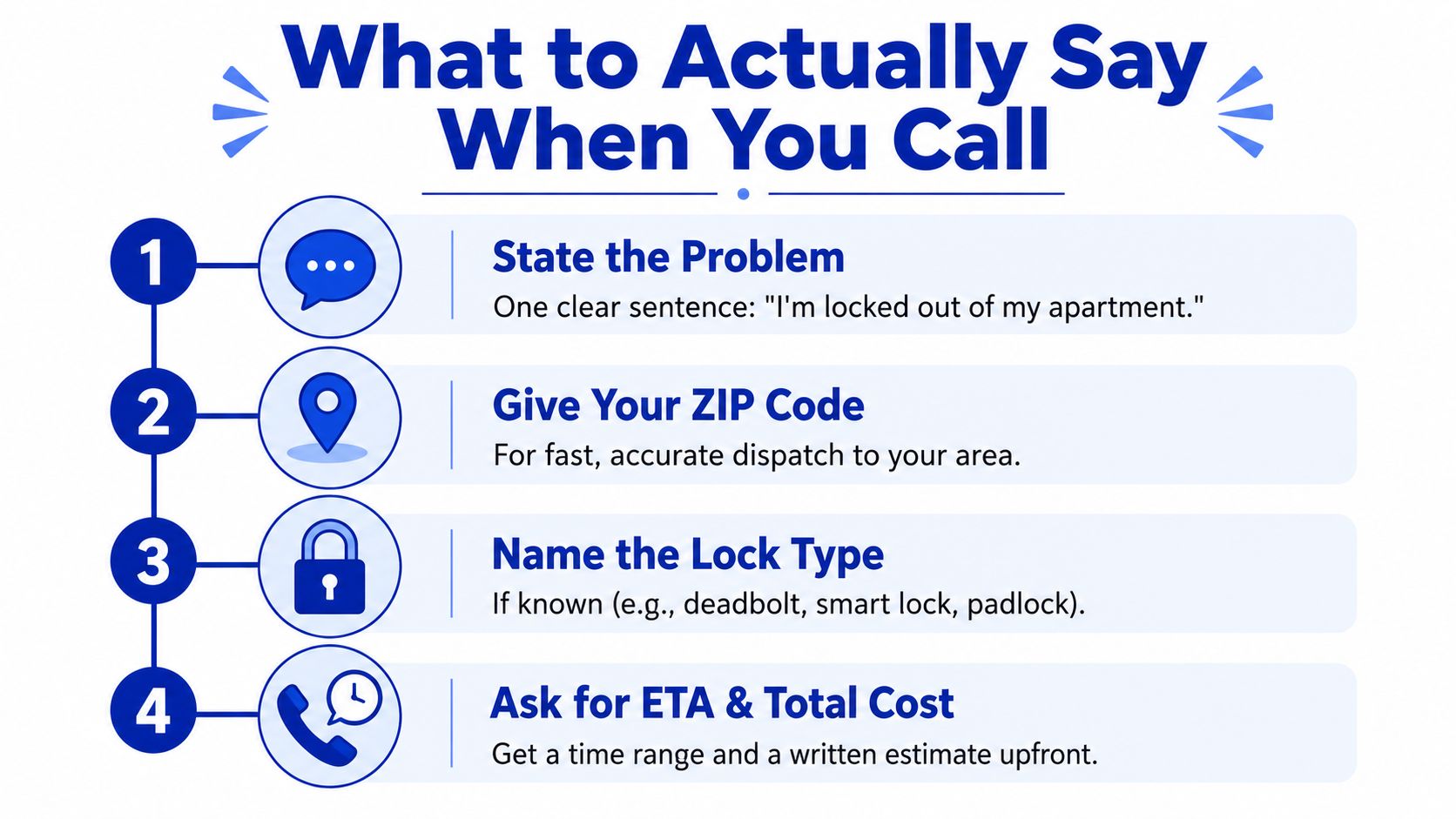
Do not start with, “How much?” Start with the facts the dispatcher needs to place the job correctly. One clean sentence is enough: “I'm locked out of my apartment in this ZIP code, it's a deadbolt, and I need entry tonight.”
Give the dispatcher the details that change the ETA
ZIP code first. Lock type second, if you know it. Then say whether it's a house, apartment, business, or vehicle. That tells the shop what equipment to send and whether the job is likely to be a simple entry or something more involved.
Live calls beat texting in this category, because direct conversation can shorten dispatch by 5–15 minutes according to the service guidance in the brief. If the situation is urgent, call. A text thread feels convenient, but it usually slows the first response.
Ask for the ETA in minutes, not “soon.”
For timing, the benchmark is straightforward. Urban response windows are often 15–30 minutes, suburban windows 25–50 minutes, and rural windows 45–90 minutes, with 10–20 extra minutes after business hours. If someone promises under 10 minutes in a suburban area, that's usually not a serious estimate. The best move is to ask for a realistic range, then compare it to where you are.
Don't accept a call-center script
The first “near me” result may have a polished page and still not be the right choice. If the person can't confirm the company name, a local address, the technician's name, and a written estimate, keep the conversation short and move on.
Be blunt about the situation. If it's a vehicle, say that. If it's a business door with staff waiting, say that too. Dispatch gets faster when the company knows what kind of truck, tools, and access problem it's walking into.
What Happens When the Technician Arrives
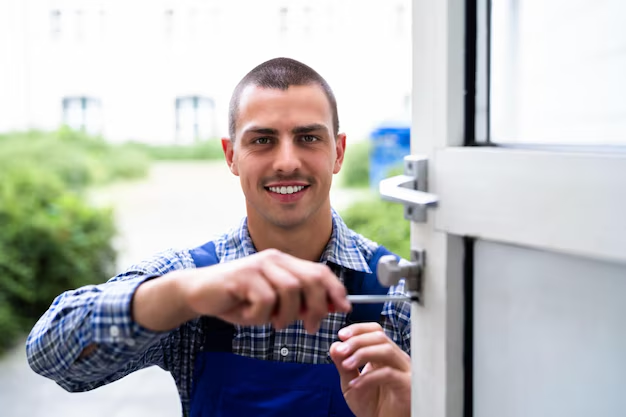
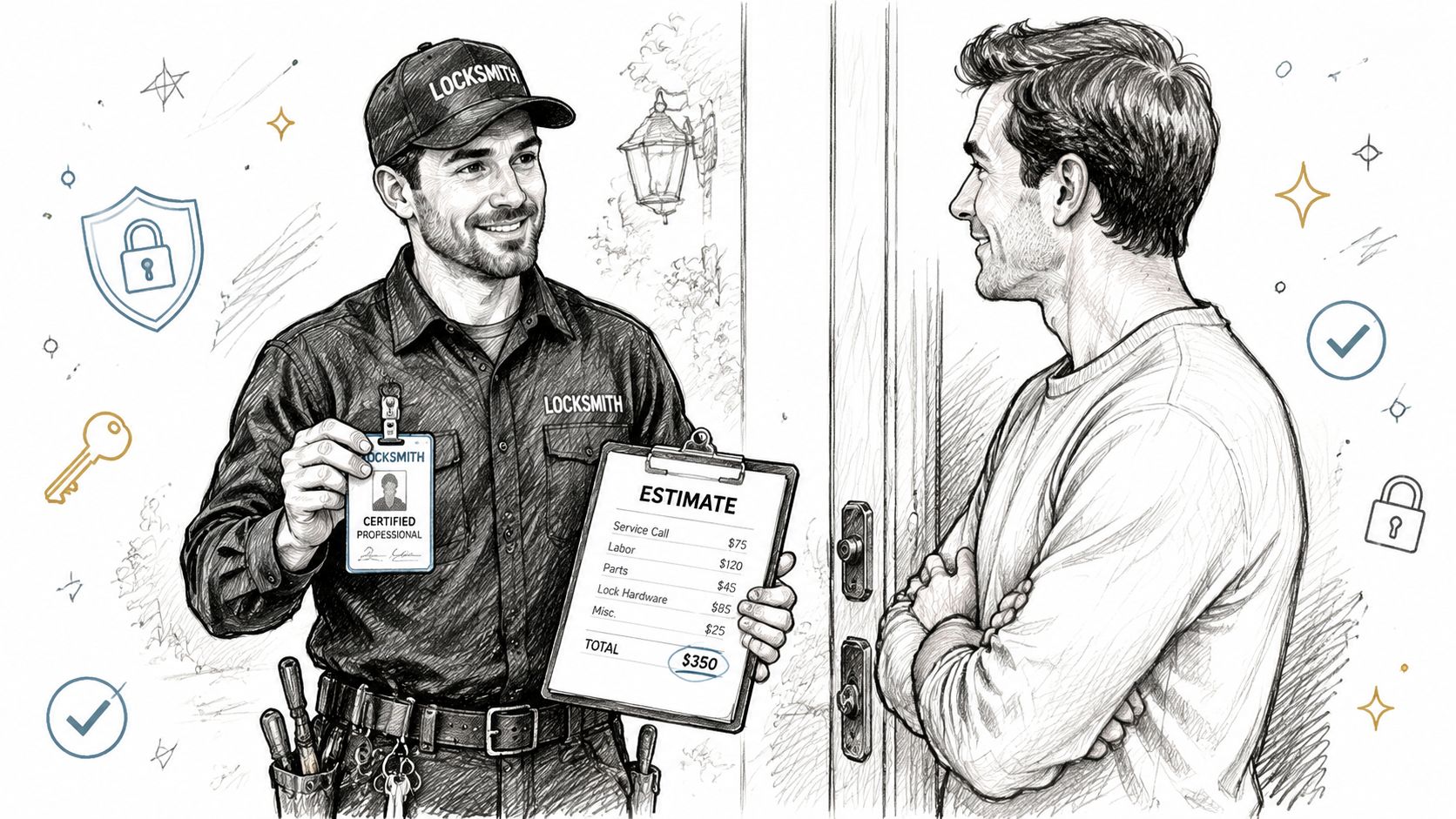
A professional arrival should feel boring in the best way. The technician identifies themself, shows credentials, and reviews the estimate before touching the door, lock, or ignition. If that sequence gets skipped, the visit is already off track.
The clean workflow is non-destructive first
The right order is pick first, then impression or bypass, then cylinder removal or replacement if the lock will not yield. That matters because most residential lockouts can be resolved without damage when the technician starts with non-destructive methods.
Simple openings can take 30 seconds to 5 minutes. More complex or high-security locks can take 10–20 minutes. If a key snapped off inside the cylinder, add another 10–15 minutes for extraction. That is the actual pace of the job, not the fake “instant” promise some ads use.
Watch for unnecessary upsells
A technician should not drill a working lock without a good reason and your permission. They also should not push a full rekey on the spot unless the actual problem requires it. If the fix is a standard entry, keep it a standard entry.
If the hardware is damaged and the plan has to change, the technician should explain that before moving ahead. That is the difference between service and improvisation. The goal is to get you back inside with the least hardware damage possible, not to turn a lockout into a bigger invoice.
For a local example of how a mobile locksmith service presents emergency, residential, commercial, and automotive help, Mena's Key is structured around on-site response across the Minneapolis-Saint Paul metro. For a closer look at how pricing is usually organized, see Mena's Key pricing guide. The value there is direct. A mobile locksmith brings the tools to finish the job where you are, instead of sending you into a second appointment.
Pricing Questions That Protect You From Surprise Bills
Lockout pricing gets ugly when the quote is vague. A fair estimate should tell you what's being charged, what might change, and what's included before any tool comes out. If the person on the phone won't spell that out, hang up.
Compare the quote structures, not just the number
A flat trip fee plus a lockout tier is common because it separates travel from labor. An hourly minimum with parts can work, but it can also hide how long the clock runs. An all-in advertised price sounds simple, yet it often leaves room for add-ons after arrival.
| Line Item | What It Covers | Why It Appears |
|---|---|---|
| Trip fee | Travel to your location | Covers dispatch and mileage |
| Labor minimum | First block of time on site | Sets the base cost of the visit |
| Lockout tier | Standard entry work | Prices the most common emergency |
| Parts | Replacement hardware if needed | Only applies if the lock can't be opened cleanly |
| After-hours surcharge | Nights, weekends, holidays | Reflects off-hours response |
| Written ceiling | Maximum agreed price | Protects you from surprise billing |
A written estimate should include the trip fee, labor minimum, lockout tier, parts if needed, and any after-hours surcharge. If a technician says, “We'll figure it out when we get there,” that's not a quote, it's a risk.
Ask the money question that stops the upsell
Use one direct line: “If this turns into a rekey, replacement, or car key issue, what does that cost, and is it required?” That shuts down pressure tactics before they start. You're not refusing service, you're refusing ambiguity.
For a deeper look at how pricing gets built, the Mena's Key locksmith pricing guide is the sort of reference a caller should check before agreeing to dispatch. You don't need a lecture. You need a number that makes sense.
Why a Local Mobile Locksmith Beats a Call Center in an Emergency
A local mobile locksmith gives you a cleaner handoff. The person answering, the person dispatching, and the person arriving usually sit inside the same operation. That matters when the call is urgent and there is no room for confusion. It also matters when the work has to get done on-site instead of bouncing between different vendors.
The difference shows up at the door
Call centers sell speed first and accountability second. Local mobile shops usually know the neighborhoods, the roads, and the difference between a fast residential entry and a more complicated automotive or commercial call. That usually means better routing and fewer surprises when the technician shows up.
The advantage is control over the whole job. A home lockout, car lockout, or office access issue should be handled by the technician who arrives, not passed off after a long back-and-forth. Mobile service earns its keep by finishing the work where you are.
Use the local option that matches the problem
Mena's Key is a Minnesota-owned mobile locksmith service that covers residential, commercial, automotive, and emergency work across the Minneapolis-Saint Paul metro. That setup fits the situations people run into at night, whether the issue is a house lockout, a vehicle lockout, or office access after hours. The site materials also present 24/7 emergency availability, which fits late-night calls.
The order still stays the same. ID first, written estimate second, non-destructive entry attempt third. If the technician starts pushing damage before trying the clean method, that points to a rushed approach, not a better local service.
Quick Reference You Can Pull Up on Your Phone
Keep this simple. If you're still on the curb, in the driveway, or outside the storefront, use this as your script and your filter.
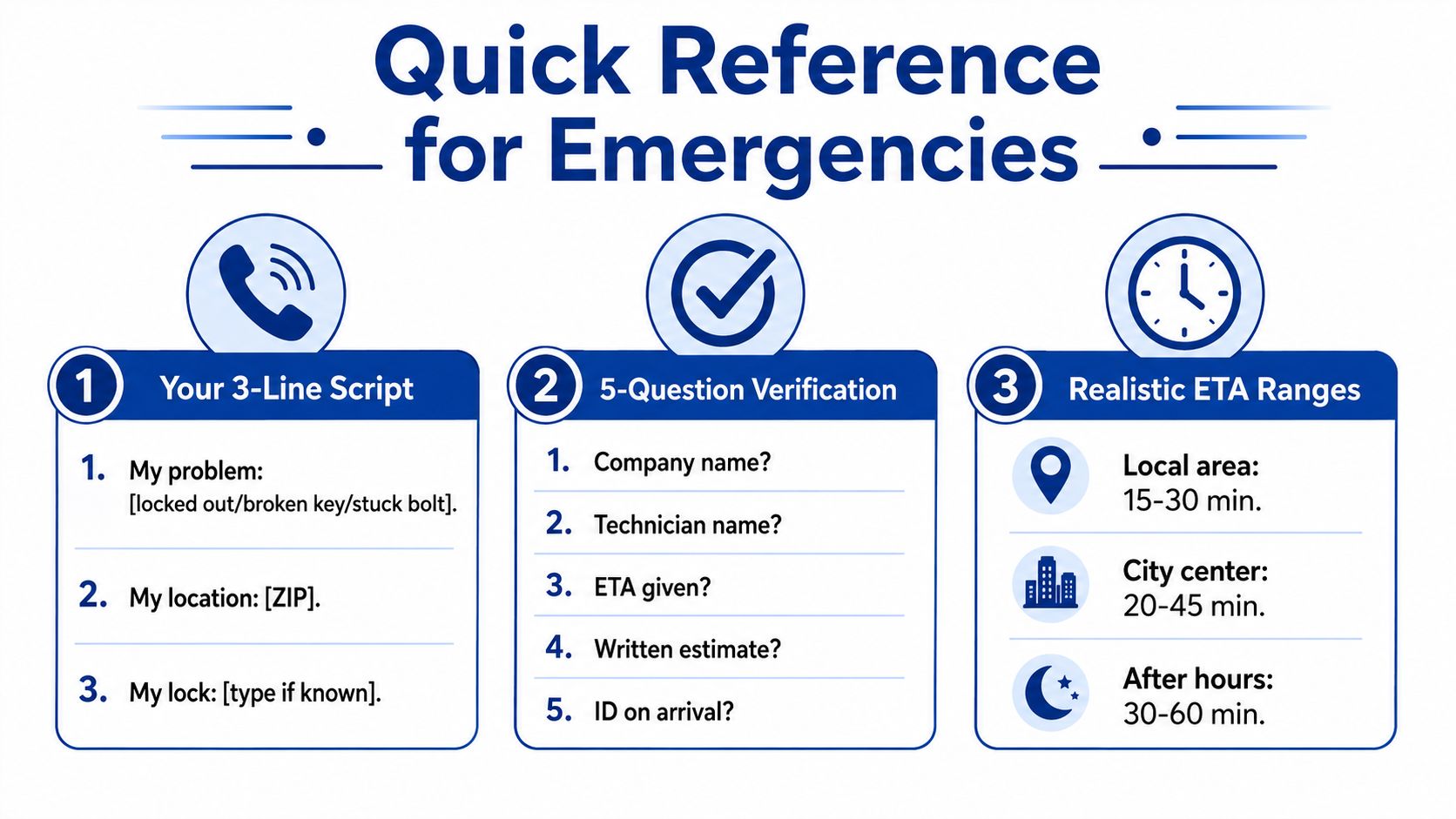
Your 3-line script
- My problem: locked out, broken key, or stuck bolt.
- My location: ZIP code and city.
- My lock: deadbolt, smart lock, padlock, car door, or office hardware if you know it.
The five questions to ask before dispatch
- Company name?
- Technician name?
- ETA given in minutes?
- Written estimate before arrival?
- ID shown on arrival?
The ETA range you should expect
- Local area: 15 to 30 minutes
- City center: 20 to 45 minutes
- After hours: 30 to 60 minutes
Before you hang up
Ask for the trip fee, the labor minimum, the lockout tier, and any after-hours charge. If the answer stays vague, keep calling. A fair estimate should read like a plan, not a surprise.
For next time, keep one real spare key in a lockbox, not a fake rock, and track who has the other copy. That small habit saves you from a lot of late-night phone calls.
If you need a calm, local response instead of a call-center script, visit Mena's Key and ask for emergency locksmith help across the Minneapolis-Saint Paul area. You'll get a mobile team that can handle home, car, or office lockouts with upfront coordination and on-site work.