Are Locksmiths 24/7? Emergency Service Guide
Yes, most emergency locksmiths are 24/7 in the sense that calls are answered and technicians can be dispatched at any hour, but actual on-site arrival depends on staffing and distance. If you're standing outside a locked door at midnight, the question isn't the slogan, it's whether someone can answer, send a van, and get to you fast.
That's why the label causes so much confusion. A company can say 24/7 and still leave you waiting until morning if nobody's on call, so you need to know what kind of coverage you're buying before you trust the sign on the truck.
Table of Contents
- Why Most Locksmiths Advertise 24/7 Service
- What 24/7 Really Means for a Locksmith
- How an Emergency Locksmith Call Works Step by Step
- Typical Response Times for Emergency Lockouts
- After-Hours Pricing and What Drives the Cost
- How to Tell If 24/7 Is Real or Just Marketing
- Safety and Verification Tips Before You Let a Locksmith In
- Getting Fast Help Across the Twin Cities
Why Most Locksmiths Advertise 24/7 Service
You don't think about locksmiths until you're locked out at the worst possible time. That usually means late evening, after dinner, on a weekend, or after a long shift when every minute feels longer than it should.
The industry built its service model around that reality. One locksmith-industry analysis says about 67% of locksmith calls occur after traditional 9-to-5 hours, and another found 39% of inbound calls land between 6 PM and midnight. That same study identified 8 PM as the single-busiest hour, which is exactly why emergency providers advertise around-the-clock coverage instead of storefront-only hours, because after-hours demand is the market.
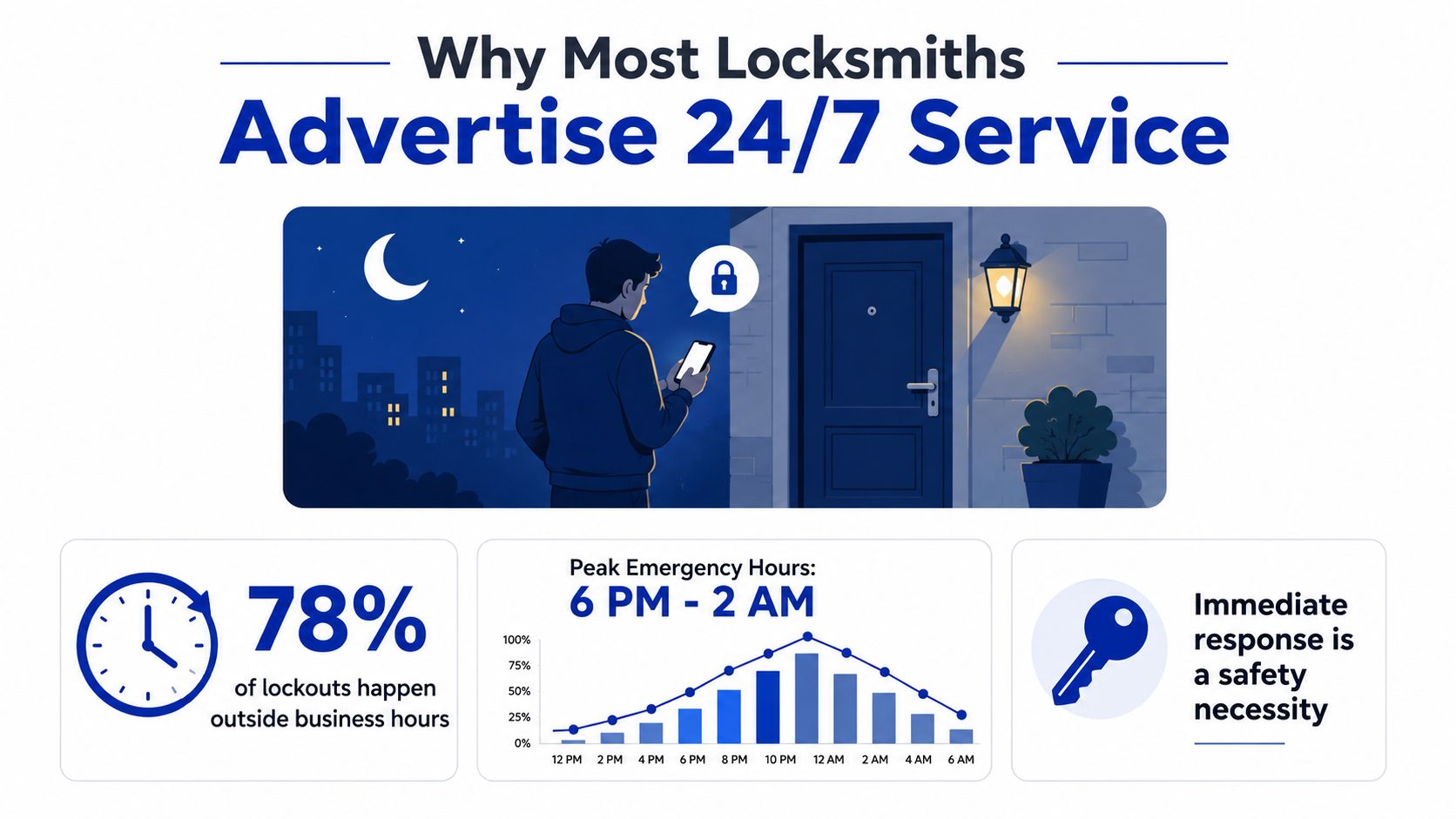
Why the demand pattern matters
A home lockout often happens when someone gets back from work and realizes the key is missing. An auto lockout usually happens after a restaurant stop, a gas station run, or a late-night errand. Commercial lockouts often show up during closing shifts, early openings, or when a building manager is already off-site.
That's why 24/7 isn't a gimmick in this trade. It's a response to when lockouts happen, not when a storefront is easiest to keep open.
Practical rule: if the problem can strand you outside your own property, the service needs to exist when the problem happens, not when the office reopens.
The operational takeaway is simple. A locksmith that closes in the evening risks missing a huge share of urgent demand, especially for home, auto, and business access problems that come up after people are already at their destination. Round-the-clock coverage is the default because the calls are round-the-clock.
What 24/7 Really Means for a Locksmith
The phrase 24/7 gets thrown around too loosely. In real life, it can mean three different things, and only one of them actually solves your problem at 1 AM.
The three tiers of real availability
First is live answering, which means someone picks up the phone or chat line at any hour. That's useful, but it's not enough by itself. If the person on the line only takes a message, you're still waiting.
Second is dispatch, which means the company can route a technician after hours instead of promising a callback in the morning. That's the point where the service becomes real. You're not just heard, you're put into motion.
Third is on-site arrival and resolution, which is the only tier that matters when you're standing outside with no key. Industry descriptions of emergency locksmith coverage define true 24/7 as daily availability, including weekends and holidays, with mobile technicians dispatched at any hour rather than a fixed storefront schedule, which is the difference between a slogan and actual access.
A business can be open to calls all night and still not be open to action all night.
Here's the practical test. Call two companies at 1 AM. One answers, takes your name, and says someone will call back in the morning. The other answers, gives you a dispatcher, confirms your location, and sends a technician. Only the second company is operating at the level people expect from 24/7 service.
Meeting all three tiers takes more than advertising. It takes staffed on-call locksmiths, rotating shifts, and mobile vans already positioned to cover a service area. That's why some businesses say they're 24/7 but function like daytime shops with a late voicemail message.
How an Emergency Locksmith Call Works Step by Step
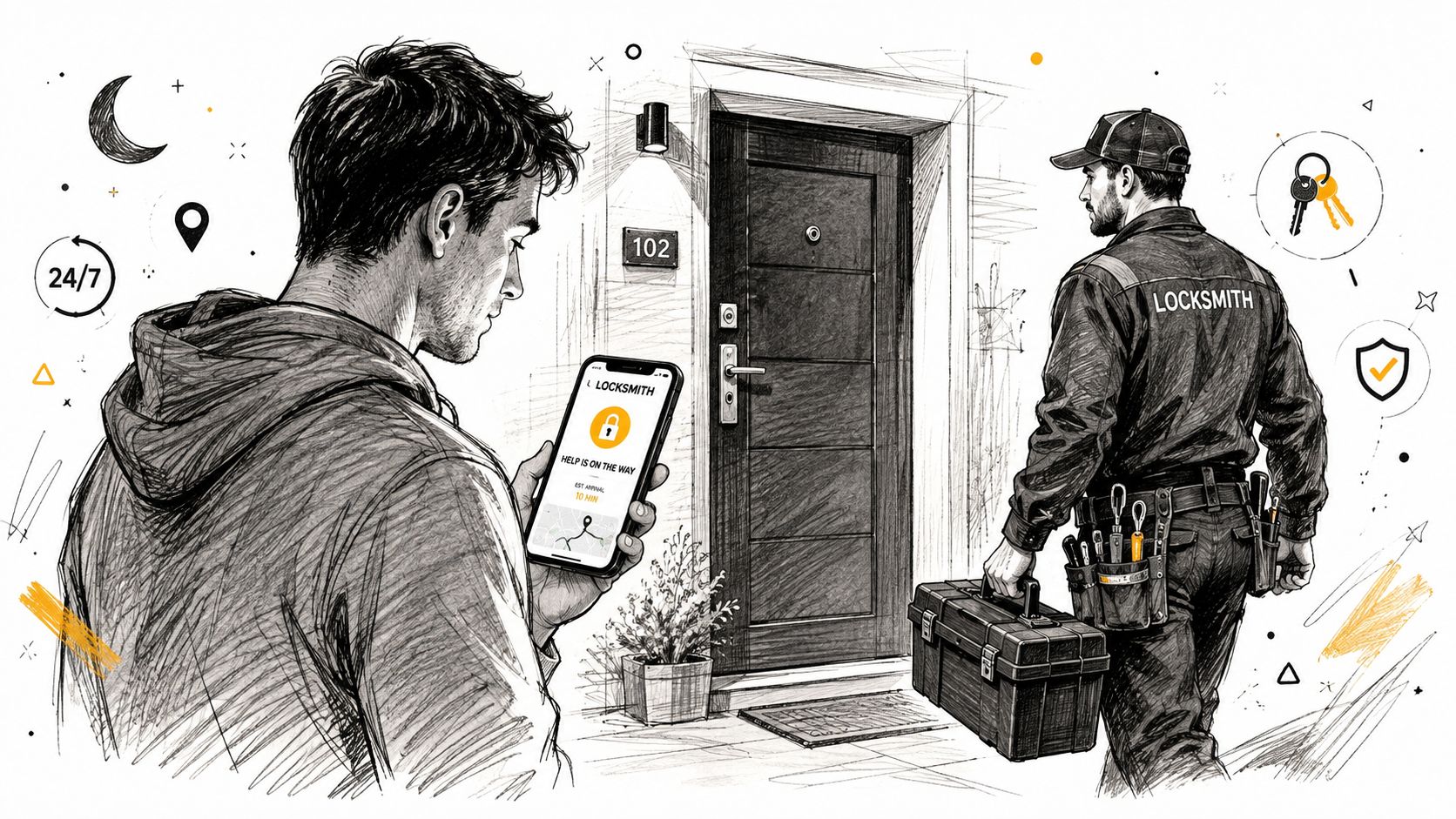
The process should be boring, clear, and fast. If it feels chaotic before the technician even arrives, that's a sign the company isn't organized for emergencies.
You start by calling or submitting a request online, then you describe the lockout, your exact location, and the type of property. A competent dispatcher gives you a preliminary estimate, confirms that a technician is coming, and tells you what to expect on arrival.
What happens once the truck is on the way
When the technician shows up, you should verify identity and company markings before you hand over the door, the car, or the lock. Ask what the plan is, and make sure the work order matches the quote you were given. If the situation has changed, the price should be explained before anyone starts work.
The customer still has control at a few key points:
- Before dispatch, you can ask for a written or text estimate.
- At arrival, you can check the technician's ID and vehicle.
- Before work starts, you can confirm the final price and the method they plan to use.
- Before payment, you can inspect the result and make sure the problem is solved.
The fastest calls are the ones where the customer has the basics ready. Give the dispatcher your full address, mention whether you're locked out of a house, apartment, office, or vehicle, and tell them if a child, pet, or security issue changes the urgency. That information helps the technician arrive prepared instead of guessing.
If a company gets vague at this stage, treat that as useful information. Clear dispatch on the phone usually means clear work on site.
Video guidance can help you understand the field process more visually, especially if you've never hired a locksmith before.
Typical Response Times for Emergency Lockouts
Don't expect every emergency locksmith to arrive in the same window. The honest answer is that timing depends on how the company staffs overnight, how far the technician is, and what else is already on the board.
Published emergency locksmith sources cite arrival targets ranging from about 19 minutes in one London operation to 20-30 minutes in general professional guidance, and 30-60 minutes for emergency dispatch in another national service. Those ranges show the practical link between staffing design and response performance, because rotating shifts and local mobile technicians keep overnight service moving.
What actually changes the ETA
Traffic matters, especially late at night when a long drive can still get slowed by weather or road work. Distance matters too, because a nearby van beats a technician coming from the edge of the coverage area. The dispatcher's location also matters, since a local team usually estimates more accurately than a remote call center.
Residential, automotive, and commercial lockouts don't always move through the queue the same way. A home lockout may be treated as an immediate safety issue, while an office lockout might involve building access details or a contact list before the technician rolls. Car lockouts often move fast if the vehicle is easy to reach, but the technician still needs the right tools and the right confirmation.
| Service Model | Typical Arrival Window | Staffing Approach |
|---|---|---|
| Local mobile emergency locksmith | About 19 to 30 minutes in cited guidance | Rotating on-call technicians and nearby vans |
| Broad emergency dispatch service | About 30 to 60 minutes in cited guidance | Central dispatch with field coverage |
| Single-site or daytime-only shop | Longer and less predictable after hours | Limited evening coverage or voicemail intake |
The cleanest rule is this. If a company won't quote a real ETA when you call, it probably doesn't have a strong overnight structure. A straight answer is more useful than a polished slogan.
After-Hours Pricing and What Drives the Cost
A lockout at 2 AM costs more than one at 2 PM because the locksmith is paying real operating costs to be available when everyone else is asleep. That includes on-call labor, vehicle readiness, overnight dispatch, and the overhead of keeping a phone line live when the office is closed.
The labor market gives that reality some context. The U.S. Bureau of Labor Statistics reported 14,790 locksmiths and safe repairers employed in May 2023, with a mean hourly wage of $25.06 and a mean annual wage of $52,130. The occupation's wage range ran from $31,620 to $76,460, which shows how much pay can vary by market and experience, and why round-the-clock staffing has to be funded.
What you should ask before you agree to anything
Ask for a written or text estimate before the technician starts. Ask whether the trip fee is separate from labor. Ask whether the quote changes if the lock is more complex than described on the phone.
Those questions matter because emergency service pricing is often built from the time of day, the type of job, distance traveled, complexity, and parts. In plain terms, the midnight call costs more because somebody is giving up sleep, driving a truck, and carrying the tools to fix the problem on the spot.
Mena's Key handles pricing the right way for this situation, with free, no-obligation quotes by phone and online so you know the estimate before you commit. That's the standard you should want from any emergency provider, whether you use them or keep calling around.
Good emergency pricing is not the cheapest number. It's the number you were told before the work started.
If the quote sounds vague, push for specifics. A real locksmith can explain what's included without making you fight for every detail.
How to Tell If 24/7 Is Real or Just Marketing
The easiest way to get burned is to trust the words 24/7 without checking the operation behind them. Plenty of companies can advertise after-hours service. Far fewer can prove they'll answer, dispatch, and arrive when the clock is ugly.
Start with the phone test. Call on a Sunday night, late enough that a weak operation will already be thinly staffed. If you hit voicemail, a generic answering service, or a promise to call back “in the morning,” you're not looking at true emergency coverage.
Fast checks that separate real coverage from fluff
- Ask for an exact ETA. If the answer stays fuzzy, the business may not have local dispatch control.
- Look for a local footprint. A verifiable service area and a real address usually tell you more than a flashy banner.
- Check the reviews for after-hours mentions. Daytime praise doesn't tell you much about midnight performance.
- Ask how the call is handled. Live answer, dispatcher, and technician arrival are three different things.
- Confirm what happens on weekends and holidays. That's where weak claims usually fall apart.
One locksmith training video explicitly tells businesses to advertise 24-hour service, while online discussion keeps circling the same question, whether a locksmith can really keep nonstandard hours. The answer is yes, but not every company can sustain it, and not every “24 Hour Locksmith” sign reflects live overnight coverage, which is why you have to verify the structure, not the slogan.
The fastest decision rule
If the company answers clearly, gives a real ETA, and can explain who is coming, you're probably dealing with an actual emergency operation. If the response sounds scripted, delayed, or vague, keep calling.
That's the whole filter. You don't need a long research project when you're locked out. You need a dispatcher who can tell you, in plain language, what happens next.
Safety and Verification Tips Before You Let a Locksmith In
When the technician arrives, slow down for thirty seconds and check the basics. A legitimate locksmith won't mind. In fact, the right company expects it.
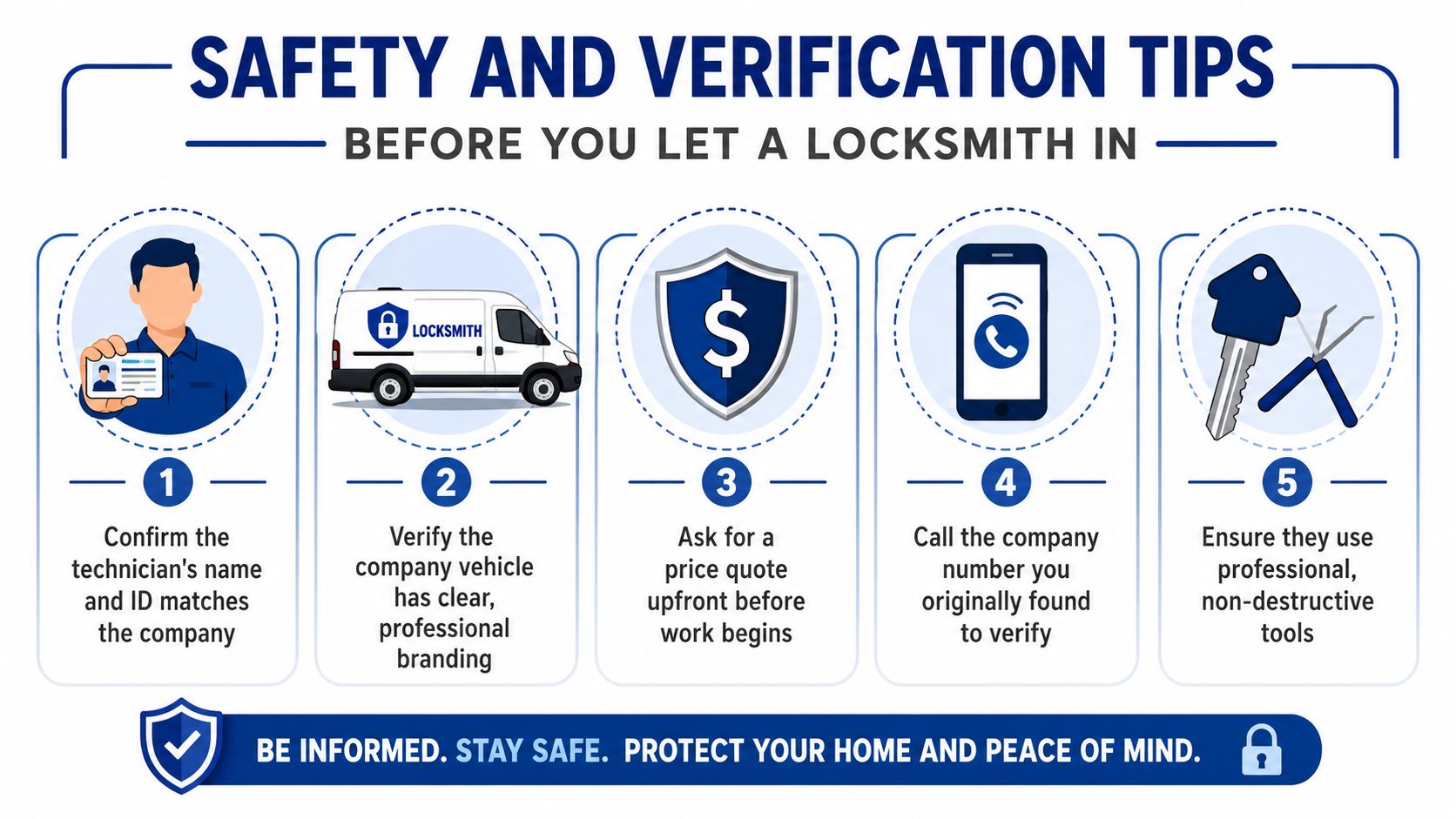
Start with the person, not the tool bag. Confirm the technician's name, look at the company vehicle, and make sure the branding matches what you were told on the phone. Then ask to see any state or local identification that applies in your area before you open the door or hand over keys.
The checks that protect you
Ask for a written estimate before work begins, not after the door is open. Never sign a blank authorization form. Pay by traceable method when possible so there's a record of what was agreed to and what was completed.
Watch for red flags. A quote that suddenly balloons after the work starts is a problem. A technician who wants to drill first instead of trying a non-destructive method is another problem. Cash pressure at midnight is also a bad sign.
A real emergency locksmith understands that a locked-out customer is cautious. That caution is normal, not rude.
The best operators make the process calm, not defensive. They answer identification questions, explain the method they plan to use, and give you room to confirm the work before you pay. That's the standard you should expect at any hour.
Getting Fast Help Across the Twin Cities
If you're in the Minneapolis-Saint Paul area, local coverage matters because the difference between a nearby mobile tech and a far-off dispatcher shows up in your wait time. Mena's Key is Minnesota-owned, mobile, and set up for emergency response across the metro, including home, apartment, condo, office, storefront, and automotive lockouts. It also serves nearby communities like Brooklyn Center, Brooklyn Park, Blaine, and Bloomington, with more service areas listed at Mena's Key.
That matters when you're trying to decide whether help can reach you. A company can't be useful at midnight if it can't get a technician moving across the suburbs quickly and keep you updated with a real ETA.
If you're locked out right now, call or submit an online request and ask for a free estimate before you commit. If you're planning ahead, save a provider that can answer the phone, dispatch, and show up when the situation is urgent.
If you need a locksmith who can handle lockouts, rekeying, and emergency access problems across the Twin Cities, Mena's Key offers mobile service with 24/7 availability and clear quotes before work begins. When you're ready, visit Mena's Key to request help and confirm a real ETA before you agree to anything.