Cheapest Car Keys for Minnesota Drivers
The cheapest usable car key for most drivers is a cut-only mechanical blade on an older vehicle, about $12–$28 in the U.S. Newer vehicles usually need a transponder key at roughly $85–$250 or a smart key around $200–$520, so the cheapest path depends on verifying the exact key type before you price anything.
A lot of Minnesota drivers find that out the hard way in a parking lot, usually when the car won't open, the spare is missing, and the dealer quote makes no sense. I've cut thousands of keys in this state, and the same mistake comes up over and over, people shop the sticker price instead of the usable price.
Table of Contents
- Why the Cheapest Car Key Depends on What You Drive
- Three Key Types That Drive Every Price You See
- How to Verify Exactly Which Key You Need
- Dealership vs Locksmith vs DIY in Minnesota
- Getting Accurate Quotes Without Getting Upsold
- Risks of Ultra-Cheap Online Keys
- Save Money and Get Back on the Road Today
Why the Cheapest Car Key Depends on What You Drive
The driver standing outside a Target in Blaine at 9 p.m. doesn't need a theory lesson. They need the cheapest working key that starts the car, opens the doors, and doesn't force a second trip. That's why the right question isn't “What's the cheapest car key?” It's “What kind of key does this vehicle accept?”
Old metal keys are still the low end
The lowest-cost path usually belongs to older, pre-1995 metal keys, because they're simple cut keys with no electronics. Modern price breakdowns put those keys at about $12–$28 in the U.S., while transponder chip keys are much higher and smart keys are higher still, because the price now includes electronics and programming, not just the metal cut itself (AAA history of car keys, 2024 car key price breakdown).
That basic split has a long history. Chrysler's 1949 ignition-key milestone, Ford's double-sided key design in 1965, and the mid-1990s shift to encrypted transponders all pushed the market away from cheap duplication and toward programmed replacements (AAA history of car keys).
Practical rule: if the key has no chip and the car has no immobilizer requirement, it's usually the cheapest replacement path. If the car expects electronics, the price jumps fast.
The cheapest advertised price can be the wrong price
A cut-only blade might be the lowest sticker, but it won't help if your vehicle needs an encrypted key to start. That's the part many drivers miss, especially when they compare a blank online with a fully programmed quote from a locksmith or dealer.
For Minnesota drivers, the decision path is simple. Verify the key architecture first, then compare prices. Skip that step, and the “cheap” option often turns into towing, reprogramming, or another trip across town.
Three Key Types That Drive Every Price You See
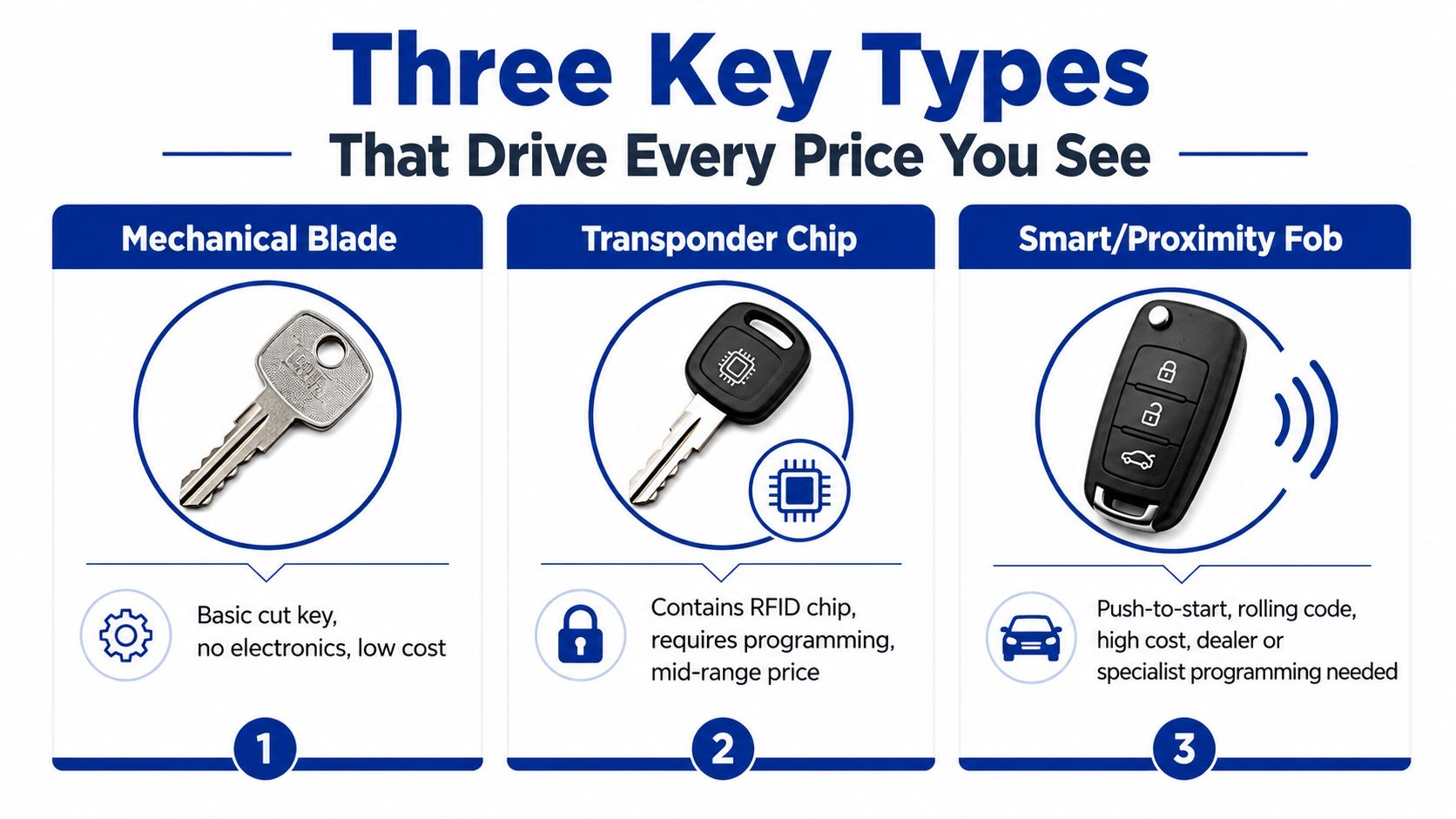
The easiest way to spot the price difference is to look at the key itself. A plain metal blade, a blade with a chip, and a proximity fob all behave differently, and that difference shows up on the invoice.
Mechanical blade
A mechanical blade key is the simplest design. It's just a steel blade with no battery, and the least expensive replacement path in major markets is usually the cut-only version, about $45–$85 for the cut itself (Bottega del Sarto price guide, Alibaba sourcing data).
That said, the term “cheap” still needs checking against the vehicle. Some older vehicles use a plain cut key and nothing else. Others use a similar-looking blade but still require security verification before the car will start.
Transponder chip
A transponder key looks close to a regular blade, but it contains an RFID microchip. That chip communicates with the vehicle, which is why the price is much higher than a simple cut. In modern replacement markets, transponder keys typically cost $85–$175, and Kelley Blue Book reports typical totals of $125–$250 (2024 car key price breakdown).
The important part is not the metal cut, it's the pairing. If the chip isn't recognized, the key may turn but still won't let the vehicle run.
Smart or proximity fob
A smart key or proximity fob is the most expensive common setup. These systems use rolling-code proximity authentication, and the fob may also contain a battery that commonly lasts 1–2 years (Alibaba factory car keys data).
Price runs higher because you're buying hardware plus programming. In 2024 market data, smart keys commonly land around $220–$410 or more, while Kelley Blue Book reports typical totals of $200–$400 (2024 car key price breakdown).
Price bands at a glance
| Key type | What you're buying | Typical cost signal |
|---|---|---|
| Mechanical blade | Cut metal only | Lowest-cost option |
| Transponder chip | Blade plus encrypted chip | Mid-range, programmed |
| Smart/proximity fob | Fob, battery, proximity electronics | Highest-cost option |
The cheapest quote only makes sense after you know which column you're in. A driver who buys the wrong blank ends up paying twice, once for the part and again to fix the mismatch.
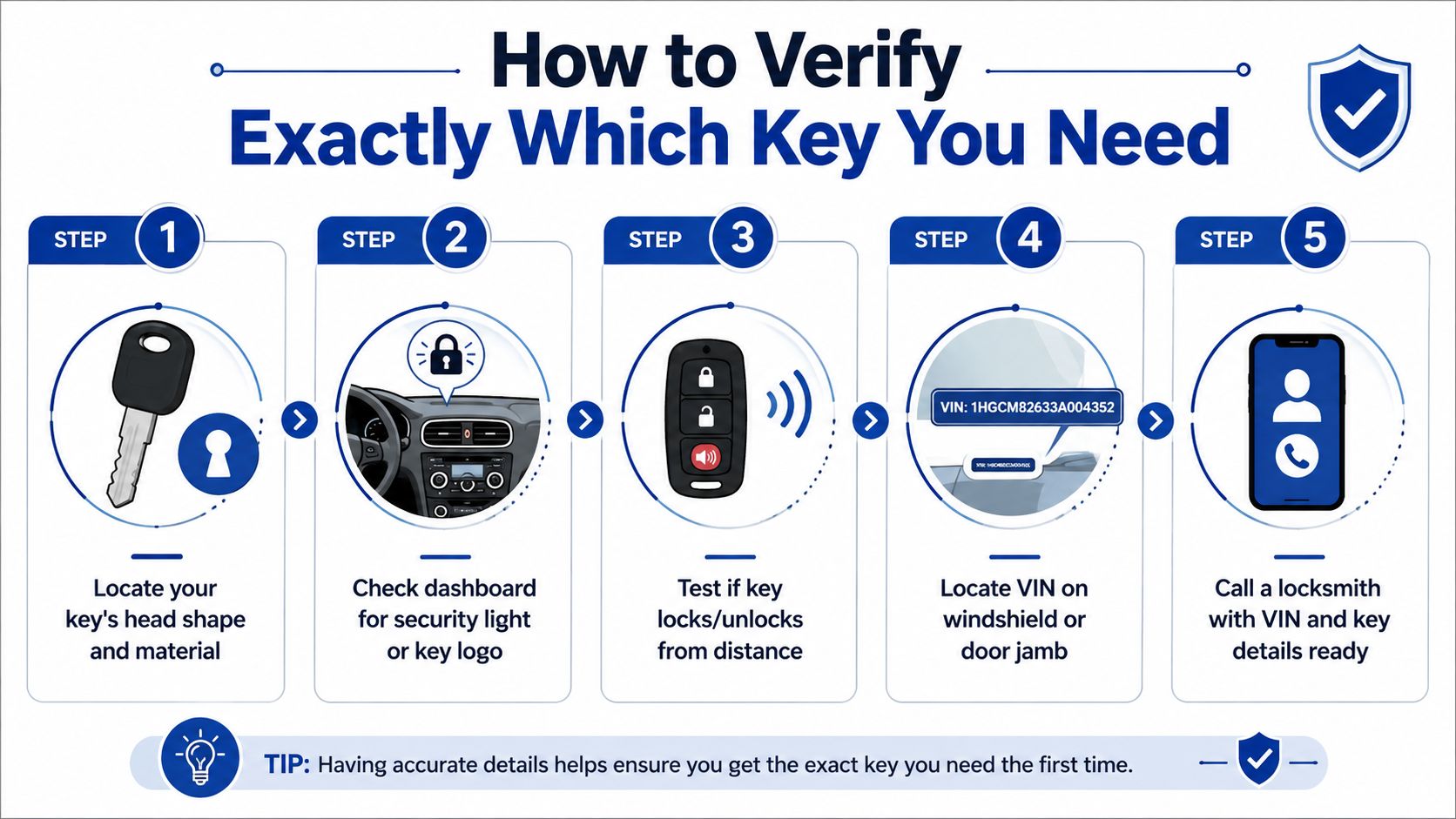
How to Verify Exactly Which Key You Need
The fastest way to save money is to stop guessing. Before you call anyone, spend five minutes checking the physical key, the ignition style, and the vehicle details, because the same model name can use different key systems depending on trim and year (Alibaba sourcing data).
Start with the key in your hand
If you still have a working key, look at the head. A plain metal head usually points to a mechanical key, while a thicker plastic head or fob housing usually points to electronics inside. If you see lock buttons, you're already out of the cheapest category.
If the car uses a push-button start, treat that as a warning sign that you're dealing with a smart key system. Those systems are rarely a simple cut-and-go replacement.
Shortcut: don't price the blank first. Verify the system first, then price the blank, programming, and service together.
Check the car itself
Look at the ignition and dashboard. A keyed cylinder usually means a mechanical or transponder setup, while a push-button dashboard points toward a proximity system. The owner's manual, VIN, and exact trim tell you whether the vehicle needs a chip or a plain blade.
If the original key is gone completely, the VIN and proof of ownership matter more than the old key shape. That's the point where a locksmith or dealer needs vehicle identity, not a guess based on the badge on the trunk.
Use a strict verification checklist
- Confirm the ignition style: keyed cylinder or push-button start.
- Inspect the key head: plain metal, chip housing, or full fob.
- Match year, make, model, and trim: don't assume every trim uses the same system.
- Check for programming needs: if the vehicle expects encrypted verification, a cut-only blank won't solve it.
- Prepare the VIN and ownership documents: especially if all keys are lost.
That checklist prevents the most common mistake, buying a cheap key that's physically correct but electronically useless. In Minnesota, that mistake usually costs more than the original quote you were trying to avoid.
Dealership vs Locksmith vs DIY in Minnesota
Once the key type is clear, the choice narrows fast. Dealerships bring OEM certainty, locksmiths bring mobility and flexibility, and DIY only makes sense on the simplest systems. That's the Minnesota decision tree, not whatever a generic national average says.
Minnesota car key replacement options compared
| Option | Typical cost range | Mobile / on-site | Best for |
|---|---|---|---|
| Dealership | Higher than local service in most cases | Usually no | Drivers who want OEM handling and can wait |
| Local locksmith | Often lower than dealership pricing | Yes | Most transponder, smart key, and lockout cases |
| DIY blank or shell | Lowest advertised price | No | Simple mechanical keys, if the vehicle truly supports it |
Dealerships
Dealers usually have the right OEM parts and the right software, but that convenience tends to come with the highest bill. They also often need the car brought to them, which means towing or arranging a ride, and that's before you deal with scheduling delays.
For a driver in Minneapolis or St. Paul, that can be the wrong trade-off when the car is stranded in a driveway or apartment lot. The certainty is real, but so is the cost.
Locksmiths
A mobile automotive locksmith can cut and program on-site, which is the practical advantage most Minnesota drivers need. That matters when the car won't move, the spare is gone, or the vehicle is parked somewhere inconvenient.
For local service, Mena's Key is one Minnesota option that handles automotive key work along with mobile response and quotes by phone. That kind of setup usually saves time because the work happens where the car already is.
DIY
DIY sounds cheapest because the blank looks inexpensive online. The problem is that a cheap shell or blank doesn't guarantee the chip, frequency, or programming match, and those are the parts that decide whether the car starts.
Use DIY only when the vehicle accepts a straightforward mechanical replacement. If the key has electronics, the low advertised price usually isn't the price.
Getting Accurate Quotes Without Getting Upsold
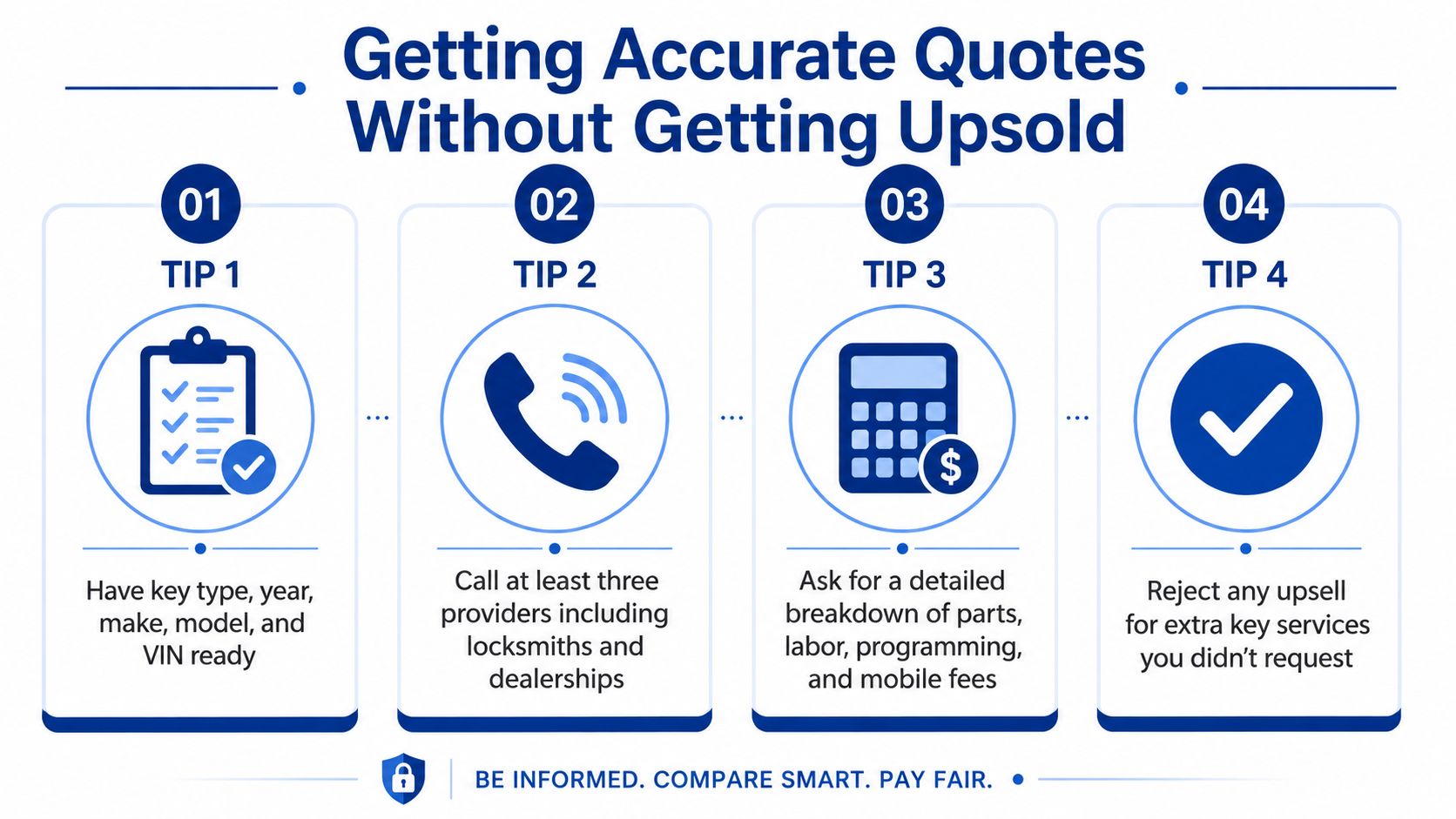
Most overpaying starts on the first phone call. The caller gives too little information, gets a vague number, and later discovers that cutting, programming, mobile service, or a required chip were priced separately. That's how a “cheap” quote gets inflated.
Give the provider the right details
Have the year, make, model, trim, VIN, and key type ready before you call. If you don't know the key type, say so plainly and ask the provider to identify it from the vehicle details.
That single step removes a lot of guesswork. It also makes it harder for a provider to quote a bare-minimum number that leaves out the work that matters.
Ask for the quote in pieces
Ask them to separate these items:
- Cutting cost: what they charge to cut the blade.
- Blank or fob cost: what the part itself costs.
- Programming cost: what it takes to pair the key.
- Mobile fee: what they charge to come to you.
- Warranty terms: what happens if the key fails.
A quote that combines everything into one vague total is harder to compare. A line-item quote shows whether the low number is real or just incomplete.
Good practice: compare at least three providers, including a locksmith and a dealership, before you commit. A low first quote isn't proof of a good deal.
Expect time-of-day pricing to change
Emergency work at odd hours costs more than daytime service, and that's normal. A late-night lockout in Edina is a different job than a weekday replacement in Brooklyn Center.
The fix is simple. If the car is still secure and you're not stranded, ask for a daytime appointment. If you need help immediately, pay for the emergency response with your eyes open, not after the invoice arrives.
Risks of Ultra-Cheap Online Keys
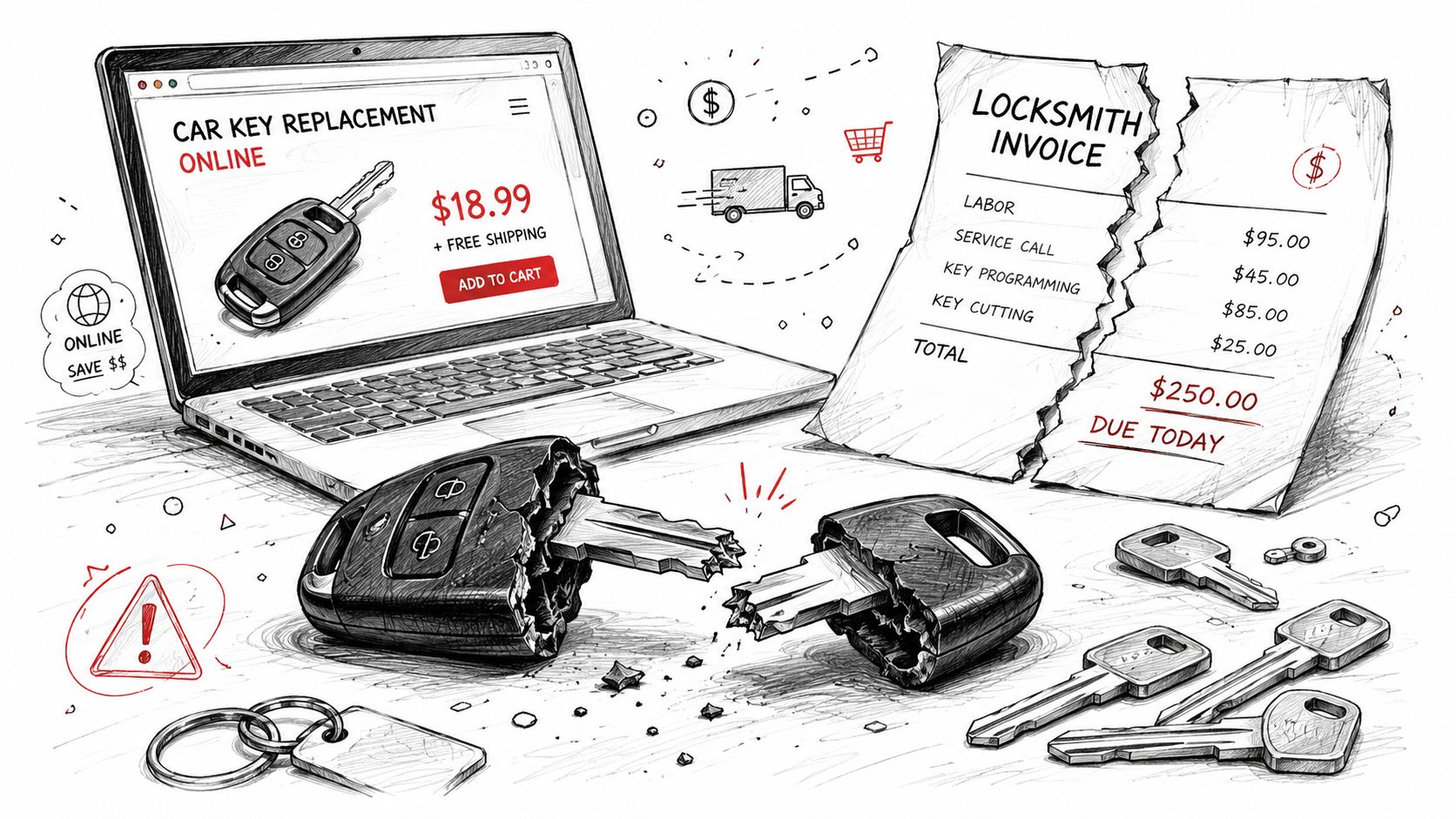
The cheapest online listing is often the most expensive mistake. A key can look right in photos, arrive quickly, and still fail in the one place that matters, at the vehicle. That failure usually comes from programming, a missing circuit board, or a mismatch in frequency and region.
Where cheap listings go wrong
One common failure is a blank that cuts perfectly but won't program because the chip isn't right for the vehicle. Another is a shell fob that looks complete but has no real internals. A third is a frequency mismatch, where the same nameplate uses different systems depending on model year or region.
Those mistakes are hard to spot in a product photo. They usually show up after the part arrives and the car still won't recognize it.
The warranty gap matters too
OEM and locksmith-supplied keys usually come with some kind of service backing. Marketplace blanks often don't. If the part fails or doesn't pair, the buyer eats the loss and starts over.
That's why the lowest listing isn't always the cheapest usable key. A cheap part that fails on the first attempt can cost more than a properly matched replacement from the start.
A short reality check
Savings come from one successful visit, not from chasing the lowest line on a shopping site. If you can't verify the chip, the frequency, and the programming requirement, you're gambling with the second trip.
Save Money and Get Back on the Road Today
The smart path is straightforward. Verify the key type, compare at least three quotes, make the provider itemize the work, and stay cautious with online blanks that haven't been confirmed for your exact vehicle. That's how you find the cheapest usable car key instead of the cheapest mistake.
For Minnesota drivers, advantage is local response. A mobile locksmith can usually come to the car, cut or program on-site, and spare you a tow or a wasted dealership trip.
If you're in the Twin Cities and need a clear estimate before you spend a dime, call for a quote from a Minnesota locksmith who handles automotive work on-site. The right number should make sense for your exact vehicle, not just your model name.
If you're stuck on a lost key, a bad fob, or a replacement that's getting overpriced, reach out to Mena's Key. They provide mobile automotive locksmith service across the Minneapolis, Saint Paul suburbs, with quotes by phone and on-site help that fits the key type your vehicle needs.