Facility Access Control for Minnesota Businesses
At 7:45 on a cold Minneapolis morning, a warehouse manager is standing at the front door with a delivery driver and a problem that looks small until it stops the day. A former contractor's badge still opens the side entrance, while a current employee has misplaced a mechanical key again. One person has access they no longer need. Another person who needs access can't get in.
That's facility access control in real life. It isn't just a lock, badge reader, or smartphone app. It's the operating system for deciding who enters, where they can go, when they can enter, and what happens when their relationship with the property changes.
The market reflects that shift. Global access control was estimated at USD 10.76 billion in 2024 and is projected to reach USD 17.30 billion by 2030, with an 8.4% CAGR from 2025 to 2030, according to ReportPrime's access control market data. For Minnesota owners, the practical question isn't whether access control is becoming more advanced. It's whether your building can support the system after installation day.
Table of Contents
- What Facility Access Control Actually Means for a Building
- The Core Components That Make a System Work
- Electronic, Mechanical, and Hybrid Deployment Options
- Benefits and ROI Minnesota Owners Can Actually Measure
- Best Practices, Maintenance, and Emergency Procedures
- Compliance, Local Minnesota Factors, and Cost Drivers
- A Vendor and Implementation Checklist for Minnesota Properties
- Putting It All Together and Next Steps
What Facility Access Control Actually Means for a Building
The warehouse manager's lost key and the contractor's active badge create the same underlying failure. Nobody has a reliable, current record of which people hold permission to use which doors. The physical entry points may work perfectly, but the property's access decisions are outdated.
Facility access control is the combined set of policies, credentials, readers, controllers, locking hardware, and management software that governs entry. It determines whether an employee can enter the warehouse before a shift, whether a cleaning contractor can use a rear door after hours, and whether a tenant can reach only the floors included in its lease.
A permission is not a key
A key is a physical object. A credential is a permission record. That distinction matters because permissions change more often than door hardware does.
An employee changes departments. A tenant gives up part of a suite. A contractor finishes a project. A visitor needs temporary access for a delivery. Each event should change the access record, not just prompt someone to collect a key when they remember.
The National Institute of Standards and Technology's definition of physical access control describes it as granting or denying specific requests to enter facilities. NIST also identifies authorization credentials, authorized-access list reviews, and removal of people whose access is no longer required. That makes access control a lifecycle governance task, not a one-time installation.
Treat access rights like a ledger
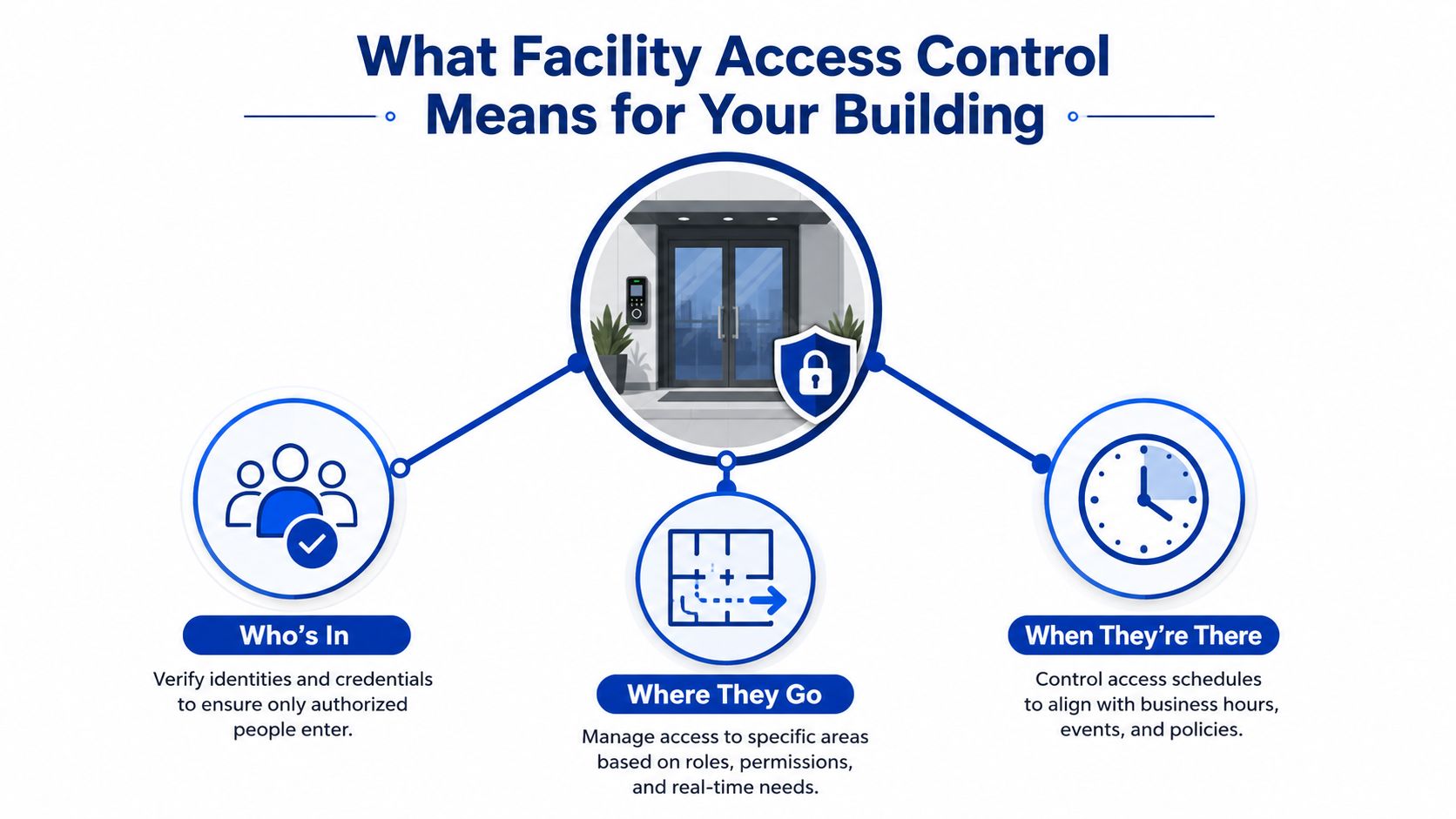
A good building operator should be able to answer basic questions without searching through old emails or asking several employees:
- Who has access: Employees, tenants, contractors, vendors, and visitors should have identifiable permissions.
- Where they can go: Exterior doors, offices, loading areas, server rooms, and mechanical spaces should have deliberate access groups.
- When access works: Schedules should reflect shifts, leases, service windows, and emergency requirements.
- When access ends: Offboarding, tenant changes, and contractor expiration should trigger prompt revocation.
If you manage a small St. Paul office, this may begin with a controlled key cabinet and a written authorization list. If you run a multi-tenant industrial building, it may require networked controllers, role-based permissions, visitor workflows, and event history. The scale changes, but the management principle stays the same.
The Core Components That Make a System Work
A facility access control system works like a security checkpoint. The credential is the ticket, the reader checks the ticket, the controller makes or relays the decision, the software manages the rules, and the lock creates the physical result.
Each piece matters. A strong credential paired with poor offboarding still leaves the building exposed. A well-managed platform connected to an unsuitable door can create safety, reliability, or maintenance problems.
Credentials identify the user
Credentials include cards, fobs, PINs, mobile credentials, and biometric factors. Choose based on the people using the building, the sensitivity of the area, and how quickly administrators need to issue or revoke access.
A Minneapolis office with frequent employee turnover may benefit from credentials that can be deactivated without rekeying every entrance. A warehouse with shared shift coverage may need clear rules against credential sharing and a practical process for replacing lost badges.
NIST's PIV-based facility access guidance treats the credential as a high-assurance authentication factor and evaluates PACS as an end-to-end system. That's the right mindset for commercial properties. An advanced reader can't compensate for weak authorization and revocation.
Readers capture the request
Readers sit at doors, gates, and other controlled points. Exterior readers need to tolerate Minnesota weather, snow, gloves, temperature swings, and repeated use. Interior readers may prioritize quiet operation, accessibility, and a clean experience for employees or tenants.
Controllers enforce the decision
The controller connects the reader's request to the access rules. It can manage one opening or support several doors, depending on the architecture. Ask what happens if the network connection drops, how decisions are stored, and how the system handles power interruptions.
Software governs the building
Management software is where administrators create users, assign permissions, review events, and remove access. The practical test is simple. Can the property manager make a routine change accurately without calling the installer for every adjustment?
Locks still carry the physical load
Electric strikes, electromagnetic locks, electrified panic hardware, and other locking options must match the door, frame, use pattern, and life-safety requirements. Before selecting a platform, inspect the opening. A door closer that doesn't latch reliably can undermine an otherwise well-designed system.
For existing buildings, start with a door and hardware survey. A commercial locksmith can help identify repair, rekeying, and electrification needs, while a PACS integrator can design the credential, controller, software, and network layers. Owners can compare commercial door hardware options before approving a larger system.
Electronic, Mechanical, and Hybrid Deployment Options
Minnesota businesses don't need to choose technology by trend. They need to choose based on turnover, accountability, expansion, and disruption.
| Deployment Type | Upfront Cost | Audit Trail | Scalability | Best Fit |
|---|---|---|---|---|
| Mechanical | Generally lower for simple openings | Limited | Limited | Very small sites with stable users |
| Electronic | Higher than keyed hardware | Available when properly configured | Good for controlled doors | Entrances or rooms needing traceability |
| Hybrid | Phased investment | Available on selected openings | Strong when planned well | Growing sites with mixed security needs |
Mechanical systems still have a place
A keyed system can remain reasonable for a small office with few users, low turnover, and limited restricted areas. It's familiar, serviceable, and independent of software and network infrastructure.
The weakness appears when keys circulate. A departing employee, former tenant, or outside service provider may retain a copy. Rekeying can restore control, but the owner needs a reliable trigger and inventory process.
Electronic systems add accountability
Electronic access makes sense where the owner needs to know more than whether a key exists. A front entrance, loading door, records room, or server room may benefit from credential-based access and event history.
Standalone electronic locks can work for one or two doors, but check battery management, local administration, emergency override, and future compatibility. A single smart lock that can't communicate with the rest of the building may solve one opening while creating another management task.
Biometrics may fit areas where credential sharing is unacceptable or where the organization needs a stronger identity check. Review privacy, enrollment, accessibility, and fallback procedures before selecting biometric access control for a Minnesota workplace.
Hybrid systems often make the most sense
A hybrid deployment can place electronic control on exterior doors and sensitive rooms while keeping mechanical cores on low-risk interior openings. For a light-industrial property in Brooklyn Park, that might mean electronic access at the employee entrance and loading area, with mechanical control for utility closets that only facilities staff use.
Practical rule: Don't electrify every door automatically. Electrify the openings where accountability or rapid permission changes justify the added complexity.
Benefits and ROI Minnesota Owners Can Actually Measure
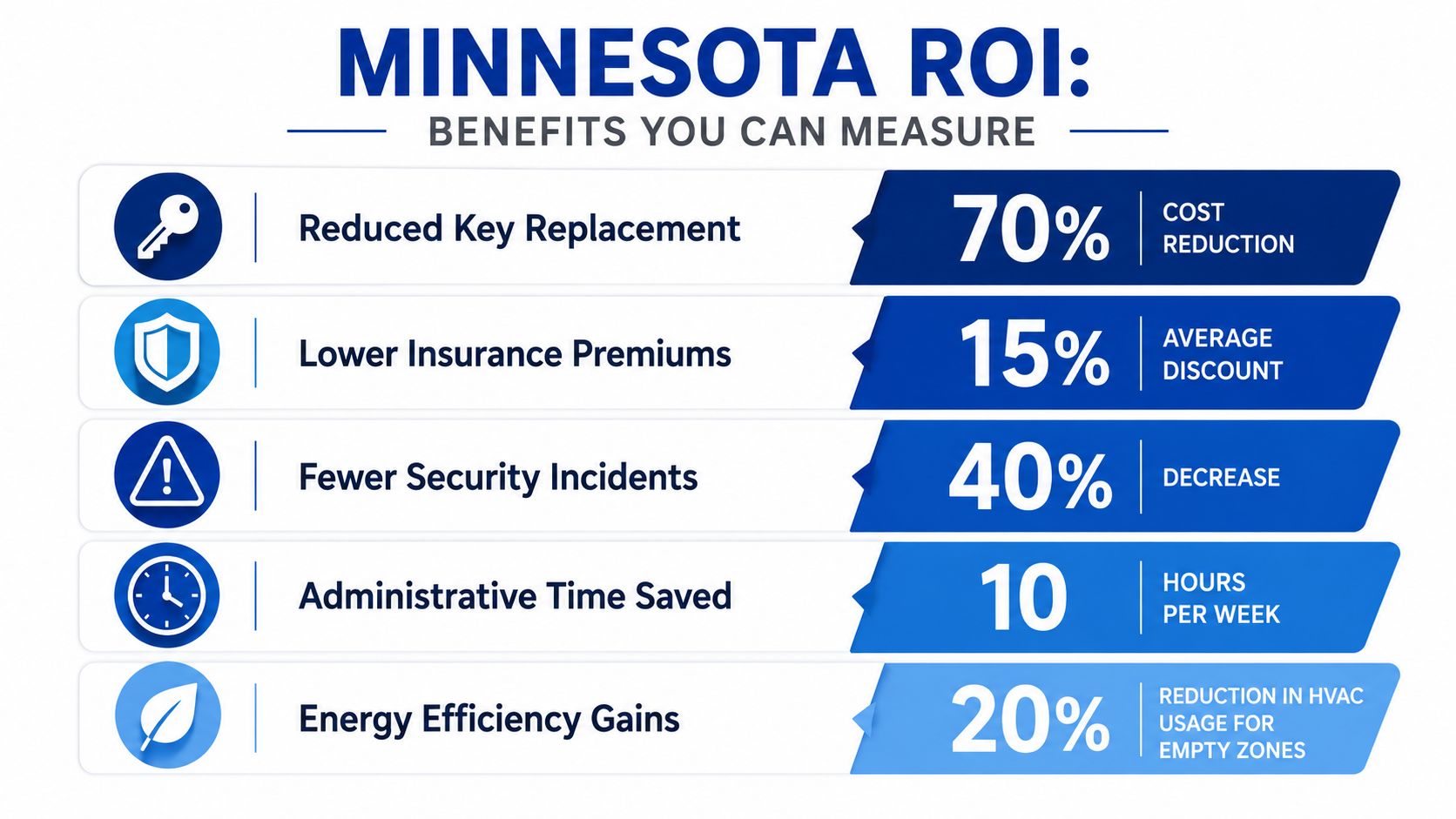
Owners should defend an access control project with operating evidence, not a list of device features. The right question is, what recurring problem will this system reduce, document, or resolve faster?
Start with the costs you already recognize
Track the current number of rekeying events, lost-key incidents, lockouts, emergency service calls, and hours spent maintaining access lists. Those figures create a baseline for comparing a new system against the building's existing burden.
A property manager with several tenants may also measure how long it takes to change access after a lease or personnel update. An office manager can record the time between an employee's departure and credential deactivation. These are practical indicators of administrative control.
Measure response and documentation
Event history can help staff investigate forced entry, tailgating, or access to restricted rooms. It can also support internal reviews by showing which credential used a door and when the event occurred, assuming the system is configured, maintained, and retained appropriately.
For regulated operations, keep a record of access-policy approvals, list reviews, visitor handling, and deprovisioning. Compliance isn't created by a badge reader. It depends on documented procedures and consistent execution.
Insurance conversations can also reveal useful benchmarks. Ask what physical-security questions appear during renewal and whether the carrier expects controlled entry, monitoring, records, or documented procedures. Don't assume a new system automatically changes premiums. Treat any insurance effect as something to verify with the carrier.
Account for confidence and continuity
Employees and tenants notice when doors work consistently, visitors are handled professionally, and access changes happen without disrupting normal work. That confidence has operational value, even if it's harder to place on a spreadsheet.
Mobile credentials and cloud platforms can simplify administration, but buyers should focus on reliability and compatibility. Coverage of the 2026 access control trends report cites 29% of organizations already using smartphone-based access and 27% planning adoption within 12 to 18 months. The same coverage says 63% of surveyed security professionals ranked uptime as the most important selection criterion, while 86% required backward and forward compatibility. Those figures support a clear recommendation: choose a migration path that keeps existing doors and credentials useful while new components come online.
Best Practices, Maintenance, and Emergency Procedures
A system becomes dependable through repetition. Assign responsibility for user changes, access reviews, testing, and emergency response before the first credential is issued.
Build the daily handoff
Write a one-page policy that answers five questions:
- Who approves access for employees, tenants, vendors, and contractors?
- Which doors does each role need?
- Who issues credentials?
- How does HR or property management notify the administrator of a departure?
- Who can authorize emergency access?
For a multi-tenant building in Bloomington, the lease administrator and facility manager should agree on the handoff. A tenant's move-out notice should not sit separately from the access process. The building needs a defined trigger for removing credentials, recovering badges, and changing mechanical keys when necessary.
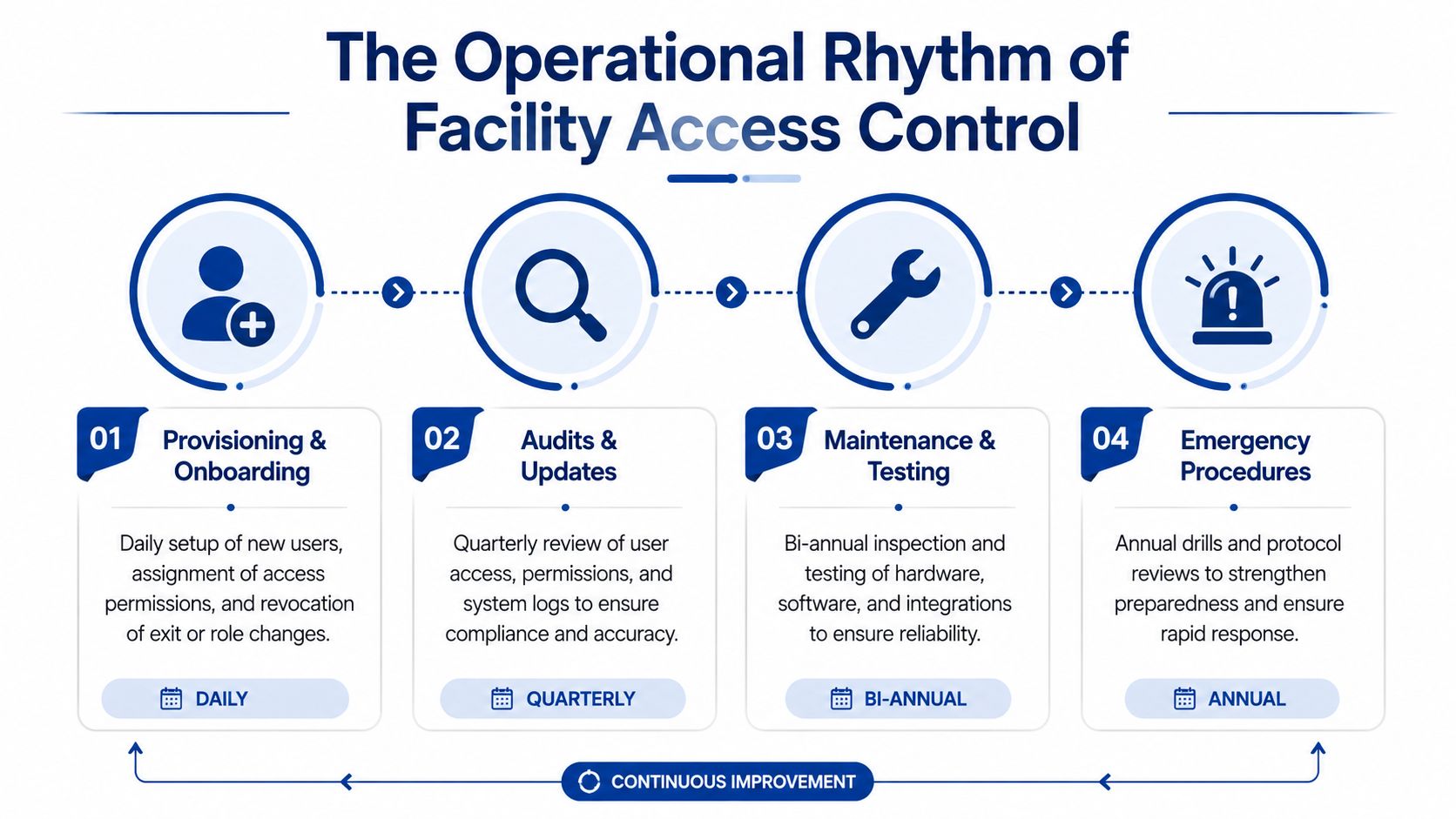
Review access on a regular schedule
During each review, compare the active user list with current employees, tenants, contractors, and approved service providers. Look for duplicate accounts, broad permissions, expired temporary access, shared credentials, and users who changed roles.
The reviewer should document who performed the review, what changed, and who approved the result. NIST's access-control guidance specifically emphasizes authorized-access list review and removal when access is no longer required. That administrative work is what keeps a credential program accurate over time.
Test the failure modes
Test doors, readers, request-to-exit devices, door contacts, batteries, backup power, network communication, and alarm integrations. Confirm that authorized users can enter during an expected outage and that unauthorized users can't bypass the opening.
Minnesota properties also need a winter plan. Exterior readers and electrified hardware should be checked for weather exposure, damaged seals, ice buildup, and door alignment. Keep mechanical override keys controlled, labeled, and available to authorized responders. Coordinate access behavior with fire and life-safety requirements, rather than improvising during an emergency.
For forced entry or tailgating, preserve event records, review available video, secure the affected opening, and document the response. A drill should test who makes the decision, who contacts occupants, and how staff restore normal operations.
Compliance, Local Minnesota Factors, and Cost Drivers
Compliance requirements should shape the access policy before they shape the equipment list. HIPAA-related healthcare operations may need controlled access and documented handling around sensitive areas. PCI DSS environments may need to restrict physical access around payment-related systems. SOC 2 audits may raise questions about facility controls, visitor handling, and access records.
The exact obligation depends on the organization, its contracts, and the systems inside the property. Ask the compliance owner what evidence auditors expect, how long records must be retained, and who can approve access. Don't buy a generic “compliance-ready” package without translating the requirement into doors, users, logs, and procedures.
Minnesota conditions affect hardware choices
Exterior openings in Minneapolis and St. Paul face cold, snow, salt, moisture, and repeated freeze-thaw stress. Door alignment can change. Closers can struggle. Readers and locks can fail operationally even when the software is healthy.
Have the installer inspect the complete opening, including the frame, hinges, closer, strike, panic hardware, weather protection, and drainage. A reader upgrade won't fix a warped door or a latch that doesn't engage.
Building and fire-code requirements also matter. Egress doors must operate safely during emergencies, and electrified hardware must be selected and configured with life safety in mind. Coordinate with the responsible code, fire, and building professionals rather than treating security as separate from egress.
Price the whole ownership cycle
Budget across four categories:
- Equipment: Readers, credentials, controllers, locks, power supplies, enclosures, sensors, and related hardware.
- Installation: Door preparation, wiring, network work, programming, testing, and repair of existing openings.
- Software: Licensing, cloud services, support plans, and integrations.
- Ongoing service: Credential administration, maintenance, replacements, troubleshooting, and emergency response.
Spend money on compatible hardware, proper door preparation, backup power, and training. Avoid paying for features nobody will administer. A system with advanced analytics and mobile credentials still fails if the property manager can't revoke a former contractor's access promptly.
North America is identified as the largest access control systems region in 2025, while Asia-Pacific is described as the fastest-growing region in The Business Research Company's market report. That global adoption doesn't determine the right system for a Minnesota property, but it does reinforce the importance of selecting an architecture with a credible support and migration path.
A Vendor and Implementation Checklist for Minnesota Properties
Start with the building, not the product catalog. Walk every exterior door, tenant entry, loading point, restricted room, emergency exit, and mechanical space. Record the current lock, door condition, users, operating hours, required audit trail, and emergency behavior.
Use this procurement sequence
- Map people and permissions: Separate employees, tenants, contractors, vendors, visitors, and emergency responders.
- Rank the doors: Identify which openings need traceability, time schedules, remote management, or stronger authentication.
- Choose a deployment path: Decide whether keyed, electronic, or hybrid control matches current needs and planned growth.
- Write the policy first: Define approvals, onboarding, offboarding, temporary access, lost credentials, and emergency overrides.
- Request comparable proposals: Ask qualified vendors to price the same door list, credential approach, integrations, training, warranty, and service terms.
- Pilot before expanding: Test a small group of representative doors, including an exterior entrance and a sensitive interior room.
- Verify support: Check licensing, insurance, references, response procedures, replacement availability, and who owns system administration.
A full PACS integrator is the right lead when the property needs multiple controllers, network design, video or alarm integration, tenant partitioning, or centralized management across sites. A local commercial locksmith is often the right first call when the immediate problem is a failed lock, a damaged door, a rekey after tenant turnover, a lockout, or an upgrade from mechanical hardware to electrified access.
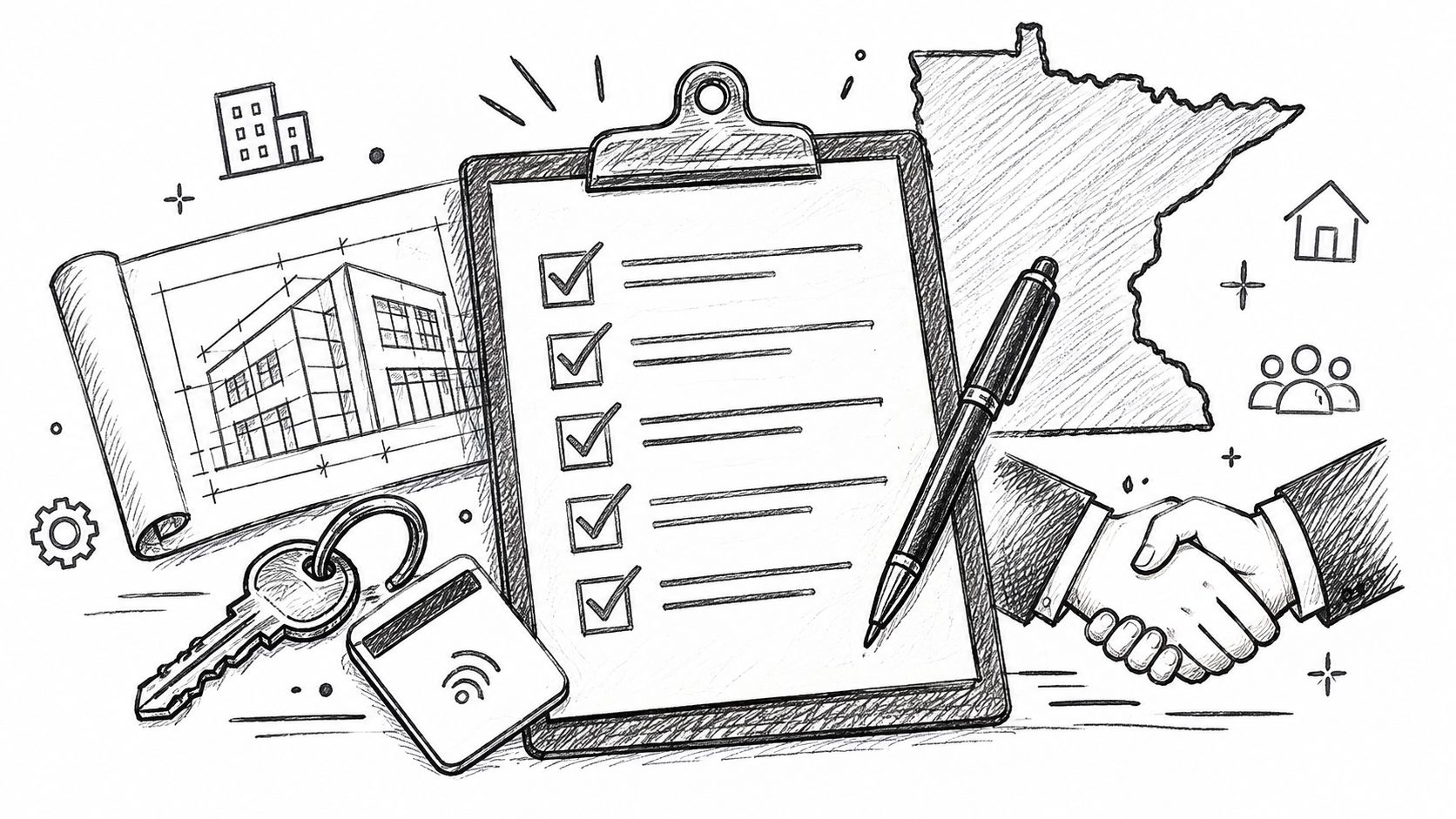
Mena's Key provides commercial lock and door hardware service, access upgrades, rekeying, and emergency assistance across Minneapolis, St. Paul, Brooklyn Center, Brooklyn Park, Blaine, Bloomington, and surrounding communities. Its access control integration services can fit into a broader project when the property needs local, on-site help alongside electronic system planning.
Putting It All Together and Next Steps
Facility access control comes down to three decisions. What needs protection? How will the property govern permissions? Who can install, maintain, and respond to the system locally?
The common Minnesota mistake is treating access control as a one-time lock purchase. Owners replace a cylinder or install a badge reader, then leave the user list, contractor access, emergency plan, and maintenance schedule undefined. The hardware remains in place while the permissions drift.
Start a 30-day improvement plan:
- Document every door, key, badge, PIN, mobile credential, and active user.
- Tighten the handoff between HR, tenants, property management, and whoever administers access.
- Remove credentials that no longer have a business reason to exist.
- Schedule a recurring access review and record the results.
- Test a representative door during a power or network interruption.
- Arrange a no-obligation walkthrough with a local provider before choosing a platform.
You don't need to modernize every opening at once. Protect the doors that matter most, establish the governance process, and phase technology around the building's actual condition and operating needs.
Mena's Key offers Minnesota businesses commercial lock and door hardware service, rekeying, access upgrades, lockout assistance, and 24/7 emergency response across the Minneapolis–Saint Paul area. Visit Mena's Key to request a no-obligation estimate or schedule an on-site conversation about your facility access control needs.