Rekeying Locks vs Replacing: Our 2026 Expert Guide
You closed on a house in Bloomington, picked up the garage remote, and got a small ring of keys at the closing table. Or your tenant just handed keys back in Brooklyn Park after a lease ended. In both situations, the same question matters more than most homeowners expect. Who else still has access?
That's where the decision around rekeying locks vs replacing stops being a technical detail and becomes a practical security choice. A lot of people assume the answer is always “replace everything.” Others assume rekeying is always enough. Neither is right every time.
The smart decision depends on what problem you're solving. If the issue is key control, rekeying is often the fastest, most cost-effective fix. If the issue is worn-out hardware, poor lock quality, visible damage, or a real security upgrade, replacement is the better move.
In the Twin Cities, homeowners often make this call during a move, after a breakup, after losing keys, or during a remodel. The good news is that the choice gets easier once you understand one overlooked point: changing who has a key is not the same thing as improving the lock itself.
Table of Contents
- Your Keys Your Control After a Move
- The Real Difference Between Rekeying and Replacing
- Comparing Key Factors Cost Time and Security
- Common Scenarios When to Rekey and When to Replace
- When Replacing Your Locks Is Non-Negotiable
- Your Local Minneapolis Saint Paul Locksmith Solution
Your Keys Your Control After a Move
A new homeowner usually notices the obvious things first. Paint color. Furnace age. Which light switch does nothing. The locks often get pushed down the list until the first night, when you realize the previous owner may have given spare keys to family, dog walkers, contractors, cleaners, or neighbors.
That uncertainty is the core issue. The lock might work perfectly well, but if you don't know where the old keys ended up, you don't truly control access to your own house.
For landlords, it's the same problem in a different form. A tenant moves out, returns one set, and says that's everything. Maybe it is. Maybe it isn't. If even one extra copy is still floating around, your property security depends on guesswork.
Practical rule: If possession changed, key control should change too.
That's why many homeowners start with rekeying. It solves the access problem without automatically turning a simple job into a hardware project. If the locks are in solid condition, changing the internal keying is often the most sensible first step. If the locks are already sticky, loose, rusted, or cheap builder-grade hardware, replacement may be the wiser move.
A lot of Twin Cities homeowners also want all exterior doors to work on fewer keys. That's another moment when rekeying can be useful. A locksmith can often configure compatible locks to work with a single fresh key, which makes daily life easier and reduces the clutter of multiple house keys.
If you're dealing with a move and want a local look at how this service works, Mena's Key rekeying services for Becker homes and businesses gives a good example of the kind of situations where rekeying restores control fast.
The Real Difference Between Rekeying and Replacing
Most confusion comes from one basic misunderstanding. People use the words as if they mean the same thing. They don't.
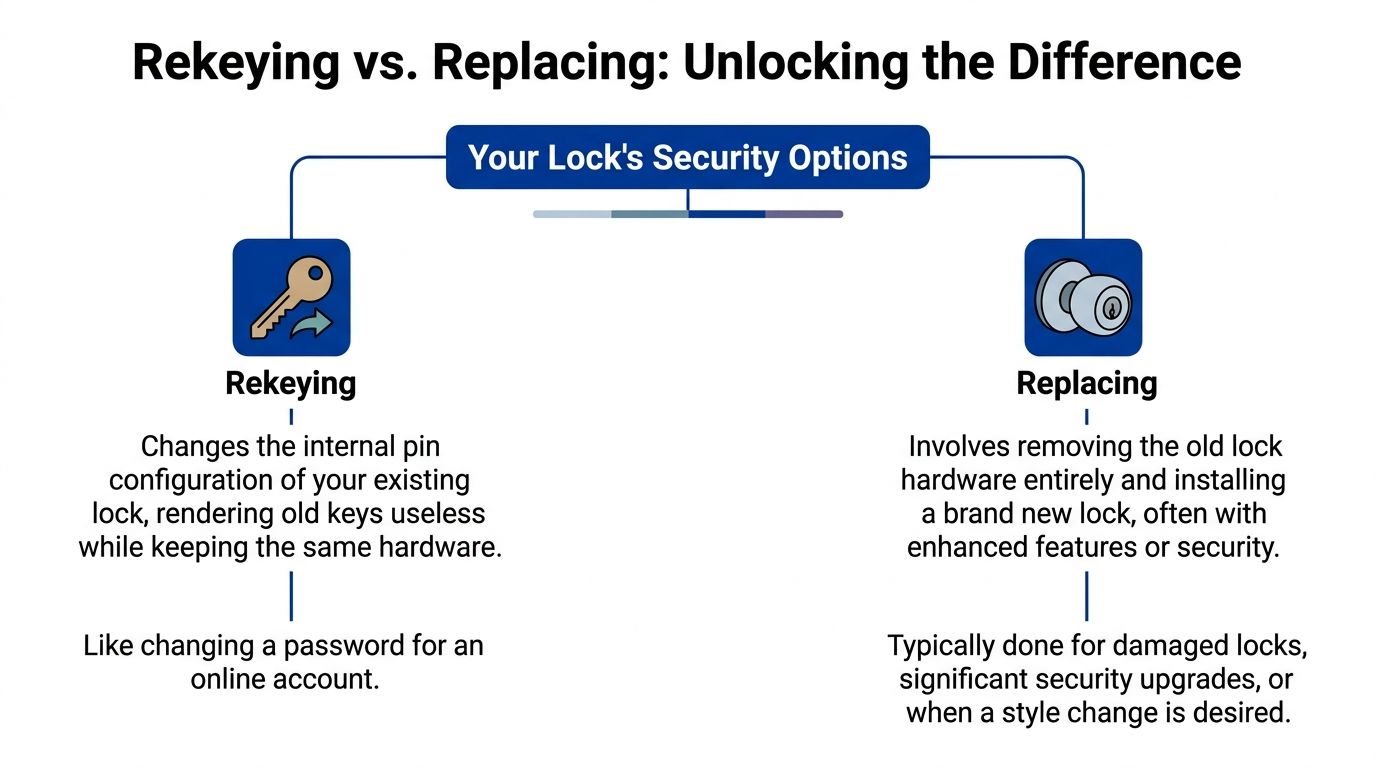
Rekeying keeps the existing lock hardware on the door and changes the internal pin setup so the old key stops working. Replacing removes the lock hardware and installs a different lock.
A simple way to think about it is this:
- Rekeying is like changing a password.
- Replacing is like getting a new device.
Here's a visual overview of that difference.
What happens during rekeying
A locksmith removes the cylinder, changes the internal pins to match a new key cut, tests operation, and puts the lock back into service. The outside trim, deadbolt body, lever, or knob usually stays in place.
That means rekeying is about access control, not a full mechanical reset. The lock looks the same from the outside, but the old keys no longer work.
This is usually the right move when the lock is functioning properly and the main concern is who can open it.
A short video can help make that mechanical difference easier to picture.
What happens during replacement
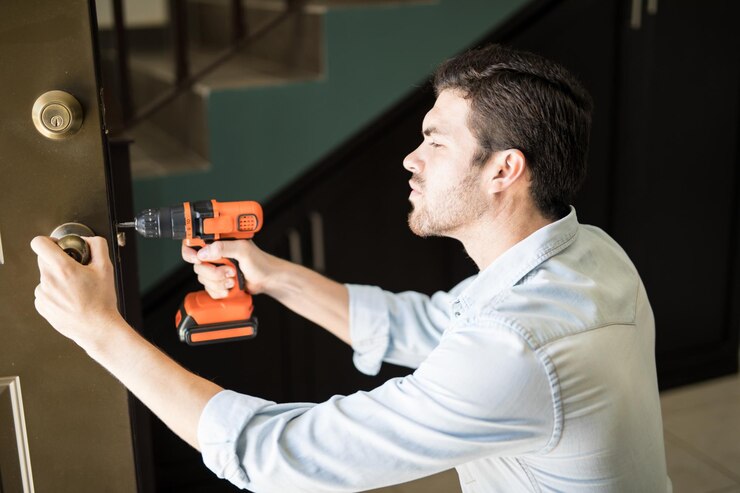
Replacement is more involved. The old knob, lever, deadbolt, latch, strike, or cylinder gets removed, and a new lock gets installed and aligned to the door.
That's why replacement is the right answer when the hardware itself is the problem. A homeowner might choose it because the lock is damaged, the finish is dated, the mechanism feels sloppy, or the door needs a more secure deadbolt than what's currently installed.
Rekeying changes permission. Replacement changes the hardware you're trusting.
That distinction matters because many homeowners think a fresh key automatically means a better lock. It doesn't. If the lock was mediocre before rekeying, it's still the same lock after rekeying. It just answers to a different key.
Comparing Key Factors Cost Time and Security
If you want the short version, the decision usually comes down to three things. Cost, time, and what kind of security problem you're fixing.
Rekeying vs Replacing At a Glance
| Factor | Rekeying Locks | Replacing Locks |
|---|---|---|
| Main purpose | Change key access | Change the entire lock hardware |
| Existing hardware | Stays on the door | Removed and replaced |
| Best fit | Move-ins, tenant turnover, lost keys, key consolidation | Worn locks, damaged locks, style updates, hardware upgrades |
| Labor time | Faster for most homes | Slower because installation and alignment take more work |
| Visual change | Usually none | New appearance and finish |
| Mechanical improvement | No, unless the lock is also repaired separately | Yes, because the hardware itself is changed |
| Smart lock path | Doesn't by itself create smart features | Can support a full smart hardware change |
Cost and labor realities
The biggest practical advantage of rekeying is efficiency. According to this lock rekey vs lock replacement guide, rekeying a standard residential lock takes about 5 to 10 minutes of labor per cylinder, while full replacement averages 30 to 60 minutes per lock because the work can involve door preparation, hardware alignment, and strike plate adjustments.
That labor difference becomes more obvious when you apply it to a full house. The same source notes that rekeying a 4 to 6 lock household typically takes 30 to 60 minutes total, while replacing that same number of locks usually takes 2 to 5 hours on site.
For a homeowner, that means less disruption, less labor time, and often a simpler appointment when rekeying is the right fit. It also explains why rekeying is commonly the first recommendation after a move. You're changing access without turning every door into an installation job.
Cost usually follows the same pattern. Reusing existing hardware is often the less expensive route because you're paying for pinning work, key cutting, and service labor instead of new locksets plus installation. If you want a broader view of why professional service matters during that decision, these benefits of using professional locksmith services line up with what homeowners run into in the field.
Security depends on the condition of the hardware
Many articles oversimplify the situation. They frame the choice as if both options “improve security” in the same way. They don't.
Rekeying restores key control. That matters a lot after a move, tenant turnover, or a lost key. But it doesn't replace worn internal parts, upgrade weak hardware, or fix a deadbolt that already feels rough and unreliable.
If the existing lock is smooth, properly aligned, and built decently, rekeying can be a very smart use of money. If the lock binds, wiggles, sticks in cold weather, or has visible wear, the security story changes. At that point, keeping the old chassis may save money today while preserving the same weak point on your door.
A homeowner should ask two separate questions:
- Do I need to stop old keys from working?
- Do I trust the lock itself?
If the answer to the first question is yes and the second is also yes, rekeying often wins.
If the answer to the first is yes but the second is no, replacement is usually the better investment.
A lock can have perfect key control and still be a poor lock.
That's the central truth behind rekeying locks vs replacing. One option controls access. The other can control access and change the quality of the hardware you depend on every day.
Common Scenarios When to Rekey and When to Replace
Real decisions rarely happen in theory. They happen when someone is carrying grocery bags to a new house, cleaning up after a tenant move-out, or staring at a deadbolt that only works if you jiggle the key just right.
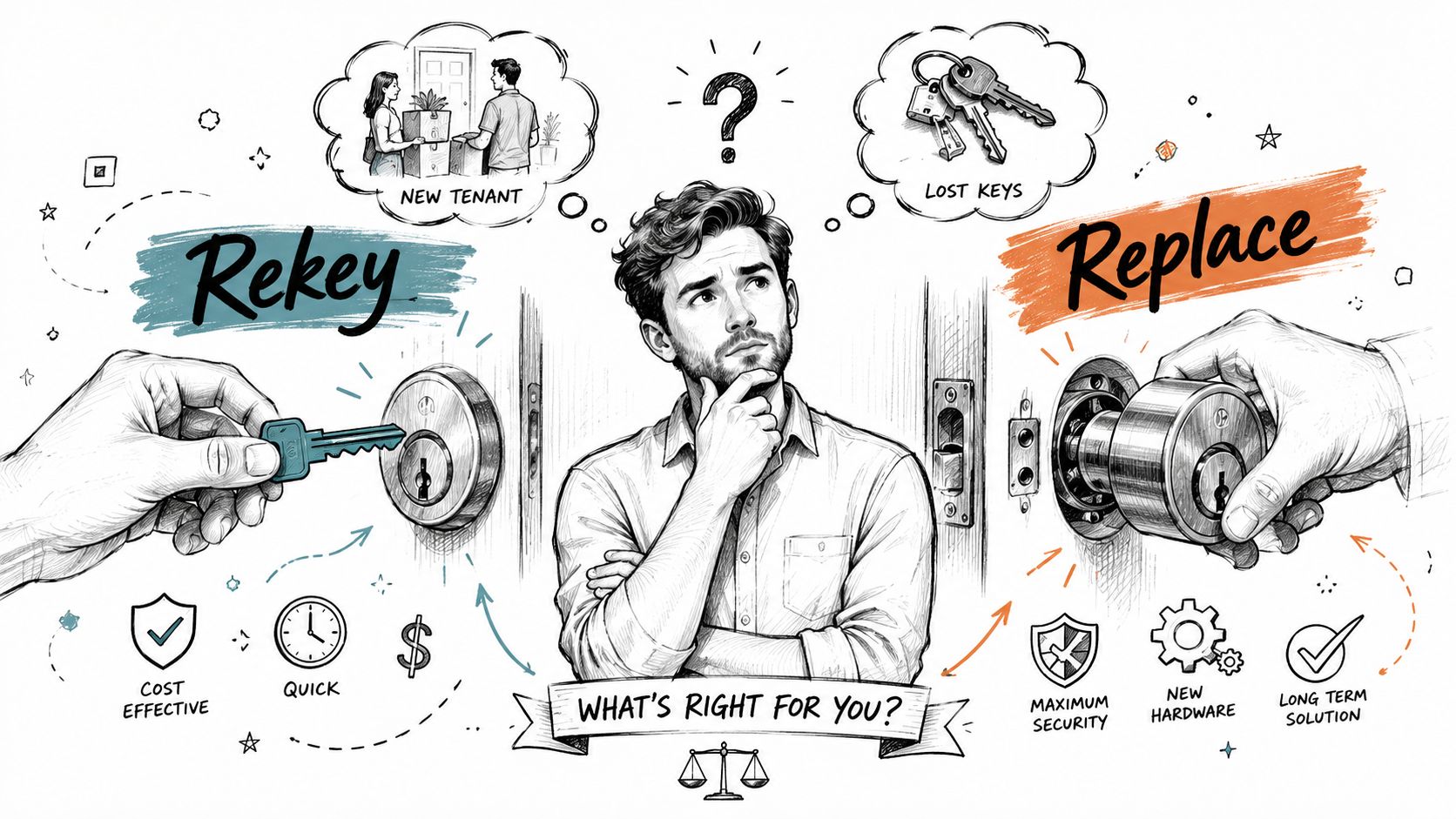
Situations where rekeying usually makes sense
A recent move is the classic example. You don't necessarily need new hardware on day one. You need certainty that old keys no longer work. If the lockset and deadbolt are functioning well, rekeying usually solves the immediate problem cleanly.
Tenant turnover is another straightforward case. Property owners need fresh access control between occupants, not cosmetic changes on every turn. Rekeying often handles that efficiently when the hardware is still serviceable.
Lost keys can go either way, but many times rekeying is enough. If the concern is that a missing key could still open the door, changing the internal keying closes that gap without swapping every lock on the property.
Some homeowners also choose rekeying when they want one key for multiple doors. If the locks are compatible, a locksmith can often match them to a single operating key. That's not flashy, but it's one of the most useful quality-of-life improvements you can make at home.
Situations where replacement is the better call
A remodel usually pushes people toward replacement. If you've updated your front entry, changed finish colors, or installed new hardware elsewhere, keeping an old brass deadbolt beside a new matte black handle set often doesn't make sense. Replacement lets the hardware match the house.
Break-in damage is another clear case. If a lock, latch, strike area, or cylinder was forced or compromised, changing the key alone isn't enough. The hardware needs to be inspected and often replaced.
Then there's the homeowner who wants an actual hardware upgrade. Maybe the current setup relies too much on a basic knob lock. Maybe the deadbolt is low quality. Maybe the entry door deserves something stronger and more reliable. That's not a rekeying job. That's a replacement decision.
A useful way to think about common situations:
- Moved in and locks work well: rekey first.
- Tenant changed and hardware is still solid: rekey.
- Key lost but lock is in good shape: often rekey.
- Lock is ugly, damaged, loose, or outdated: replace.
- You want a new finish or a stronger deadbolt: replace.
If your reason is “I don't know who has a key,” rekeying is usually the first thing to consider. If your reason is “I don't trust this lock,” replacement belongs at the top of the list.
When Replacing Your Locks Is Non-Negotiable
There are situations where rekeying is the wrong answer, even if it seems cheaper upfront.
The wear vs key problem
This is the part too many homeowners miss. Rekeying changes who can use the lock. It does not restore the lock's condition.
According to Liberty Home Guard's discussion of rekeying locks or changing locks, rekeying costs $50 to $100 per lock while full replacement averages $315, but the more important point is often overlooked: rekeying restores key control and does nothing for mechanical wear. The same source also points out that old or low-quality locks can remain vulnerable to forced entry or internal failure even after rekeying.
That's the heart of the wear-versus-key issue. If the lock is already junk, rekeying gives that junk a new key.
No source in the provided data quantifies exactly how much failure risk changes between rekeying worn hardware and replacing it, so the honest answer is qualitative. In the field, the concern is simple. A tired lock can still bind, fail internally, or give you unreliable operation after rekeying because the weak point was never the key in the first place.
Red flags you should not ignore
If you notice any of the signs below, replacement deserves serious consideration:
- The key sticks or drags: Friction inside the cylinder or poor alignment often points to wear, dirt, or failing parts.
- The deadbolt doesn't throw smoothly: If you have to push, pull, or lift the door to lock it, the whole setup needs more than a key change.
- The hardware feels loose: Wobbling trim, sloppy cylinders, and spinning collars are signs of a lock that's aging out.
- There's visible rust or damage: Corrosion and physical wear don't disappear because the pins were changed.
- You want a meaningful security upgrade: Moving from lightweight hardware to a stronger deadbolt requires replacement.
This is the mistake homeowners regret most often. They solve the key problem and assume they solved the lock problem too.
They didn't.
Your Local Minneapolis Saint Paul Locksmith Solution
Twin Cities homeowners don't need generic advice. They need someone who can look at the actual door, the actual deadbolt, and the actual condition of the hardware, then tell them plainly whether rekeying is enough or replacement is the smarter call.
That matters because homes across Minneapolis and Saint Paul vary a lot. Some have older locksets that still operate well. Others have builder-grade hardware that was never impressive to begin with. Some front doors are perfectly aligned. Others shift with weather and age, which changes how the lock performs.

The hybrid option more homeowners should consider
There's also a newer wrinkle in this discussion. Some homeowners want better key control now but aren't ready for a full hardware overhaul. Others want smart access without throwing out every existing lock.
According to this discussion of smart lock adoption and homeowner awareness, 68% of homeowners don't know that rekeying a traditional deadbolt doesn't integrate with smart ecosystems, and smart lock sales grew 22% in 2024. That matters because many people still think the choice is only rekey or fully replace.
It isn't always that simple.
In some cases, a hybrid path makes more sense. A homeowner may rekey an existing mechanical lock to regain control over physical keys, then add a compatible smart overlay or move selectively to a smart deadbolt at the most-used entry. That approach can balance budget, convenience, and security better than an all-or-nothing decision.
What a good locksmith should help you decide
A solid locksmith should inspect first and recommend second. The conversation should sound practical, not scripted.
You want someone who can answer questions like these:
- Is the current hardware worth keeping?
- Is the problem just key control, or is the lock worn out?
- Would rekeying all exterior locks onto one key make sense?
- Would a deadbolt upgrade solve a weak point at the main entry?
- If smart access is the goal, should you replace everything or phase it in?
For homeowners looking for local help with that kind of decision, Mena's Key locksmith service in Minneapolis is built around mobile, on-site support across the metro.
If you're in Minneapolis, Saint Paul, or a nearby suburb and need an honest recommendation on whether to rekey or replace, contact Mena's Key. They provide mobile locksmith service across the Twin Cities, clear estimates, and practical help for move-ins, tenant turnover, worn locks, lockouts, and security upgrades.